


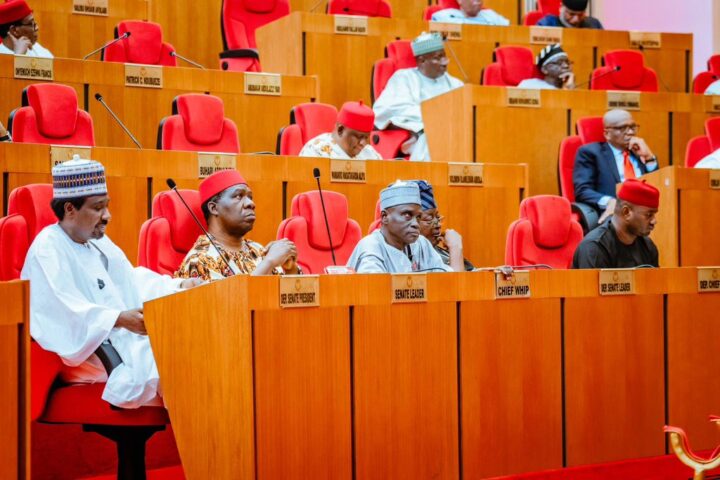
File photo: Senate chamber
BY NKIRU UZODI
In a country of over 200 million people, where women constitute nearly half the population, it is difficult to justify a national assembly in which fewer than 5% of seats are occupied by women. Many agree this imbalance is unacceptable, and while the need for reform is now widely acknowledged, debate persists over the most appropriate tool to correct it. One proposal now before the 10th national assembly – the constitution alteration bill for Special Seats for Women, scheduled for a vote in the coming days – has emerged as the most viable path forward. Critics dismiss it as tokenistic, discriminatory against men, or a dilution of merit. Such critiques risk overlooking a fundamental reality: without deliberate intervention, equitable representation in Nigeria’s legislatures will remain aspirational, not achievable.
The Special Seats Bill is a carefully considered, time-bound intervention. It proposes 37 women-only seats in the house of representatives – one for each state of the federation and the FCT. The same proposal is being made for the senate, even though the final number of seats is still being discussed/finalised. Three seats are proposed for each of the 36 state houses of assembly in accordance with the senatorial districts of the State.
This piece offers a clarifying perspective on why this bill, which is a form of seat reservation and a temporary special measure, is a pragmatic step toward improved representation. Rather than undermine merit or democratic principles, it recognises the entrenched barriers that have long prevented women from entering and staying in politics and seeks to address them.
Advertisement
The Special Seats Bill is a carefully designed, time-bound measure that seeks to structurally open the door for women’s entry into formal politics. It proposes 37 women-only seats in the house of representatives (one for each state and the FCT) and a corresponding arrangement for the senate, with details being finalised. At the state level, three special seats are proposed in each state house of assembly based on senatorial districts. These seats will be contested and are not permanent, as the bill includes a review clause.
Informed and Measured Constitutional Reform
Every country that has taken steps towards increasing women’s representation in parliament has done so in a way that reflects its unique political and constitutional context. This is the same with the Special Seats Bill, which is the product of years of research, advocacy, and lessons drawn from global, African and local Nigerian contexts. The Bill is tailored to Nigeria’s system, i.e., a federal legislature, first-past-the-post plurality voting, and single-member constituencies that provide little incentive for political parties to balance their ballot because there is just one seat per constituency, which raises the stakes in elections/is highly contested. It also responds to the failure or inability of political parties to implement party quotas and persistent resistance to proposals for seats to be reserved from existing legislative seats. The aim is to minimise disruption to existing electoral structures while ensuring inclusion. Moreover, it is not intended to be a permanent fixture in our politics as the bill contains a review clause.
Advertisement
Special Seats open the door; they do not lower the bar
Critics argue that reserved or special seats amount to tokenism. This critique assumes that any form of seat reservation automatically implies lesser value or symbolic placement. On the contrary, tokenism happens when presence lacks power. Because the seats are to be contested, this bill offers both. In a legislature, numbers matter; not just for passing bills, but for transforming public perception. More women in the national assembly would not only enable women to shape policy agendas; it would normalise women’s presence in public leadership.
Also, Nigerian women are not tokens; they are leaders, organisers, and political actors who have long operated on the margins of formal power. What the Special Seats Bill does is provide a structural gateway, not a lowered bar, for women’s political inclusion.
Arguments of Merit and Waiting for a Level Playing Field Means Accepting Delay
Advertisement
Some sceptics argue that election to political office should be based purely on merit and that the political playing field should be levelled instead of adopting the bill.
Unfortunately, such calls to “just” level the playing field often push reform to an indefinite future. Nigeria has had over two decades of democracy since 1999, with repeated promises by political parties to increase women’s participation. The result? A decline in the number of elected women. The 2023 general election saw the lowest number of women elected to the National Assembly since 1999, which is a stark indicator that the playing field is not just uneven; it’s getting worse.
Women in Nigeria’s political space face a range of disadvantages, from political gatekeeping to campaign financing gaps to electoral violence. The nature of political party primaries, often influenced by godfatherism and opaque decision-making, means that even where internal party reforms are encouraged, local political dynamics often override inclusion efforts. These deep-rooted problems take time to dismantle, and until these issues are structurally addressed, insisting on a ‘level playing field’ without intervention is, in effect, maintaining the status quo. The idea that we can maintain the status quo and expect different results is misguided.
Additionally, the appeal to “merit” embedded in the idea of a level playing field assumes that the current political process is merit-based. It is not. The most “qualified” or visionary candidates often don’t win elections. Instead, elections are influenced by several factors such as ethnic balancing, godfather endorsements, money politics, and even electoral manipulation. In such an environment, the idea that women should simply compete “like men” for limited seats ignores the fact that many men themselves benefit from privilege and informal party support. Moreover, levelling the playing field and adopting the Special Seats Bill are not mutually exclusive. These can be complementary approaches to solving a deep-rooted problem.
Advertisement
Women’s inclusion is not a passive outcome; it requires deliberate action
In many countries, reforms only began to produce measurable gains after special measures such as gender quotas were introduced. For instance, Senegal introduced a parity law in 2010, and within a year, women made up 44% of parliament. Kenya adopted a constitutional proposal on reserved legislative seats for women that guaranteed the election of 47 women in parliament.
Advertisement
The historical experience of the Nordic countries, i.e. Finland, Denmark, Norway etc., often praised today for their high levels of women’s inclusion, offers a sobering perspective. Despite granting women suffrage as early as the 1900s and the absence of legal discrimination, it took several decades for women to gain significant representation in parliament.
This shows how deeply rooted barriers operate even within formally equal systems. What made the difference? These countries introduced deliberate institutional reforms such as legislated quotas in addition to systemic efforts to reform political culture. These measures accelerated inclusion in ways that legal equality alone did not. Today, they boast some of the highest levels of women’s representation globally, but it was not a passive outcome. Their progress was neither automatic nor purely merit-based; it was the result of sustained advocacy and structured intervention.
Advertisement
Costs and Consequences
There are concerns about the cost of expanding the legislature, which are valid, but they must be weighed against the cost of women’s exclusion, which includes missed policy opportunities and untapped leadership potential of women. Furthermore, Policy and Legal Advocacy Centre, Abuja (PLAC) conducted a cost-benefit analysis on the bill and found that additional women members would amount to a less than 1% increase in the National budget and less than 5% increase in the national assembly budget.
Advertisement
Conclusion
The Special Seats Bill confronts a legacy of exclusion with bold but reasonable institutional reform. If countries that have long enjoyed high levels of education, democratic maturity, and political stability needed affirmative action to make real gains, it is neither realistic nor fair to expect Nigerian women to succeed without similar support.
It is noteworthy that since Nigeria began incremental amendments to its constitution in 2010, no women issue proposal has ever succeeded. The 10th National Assembly is therefore confronted with an opportunity to make history and leave a legacy with this bill.
It is time to move beyond rhetorical commitments to inclusion and take decisive action. The Bill offers a thoughtful, measured response to decades of advocacy, research, and lived experience. It deserves a chance to succeed.
The argument for the Special Seats Bill is not that they are the only solution, but that they are a necessary foundation upon which long-term reform can be built.
Democracy, to be credible, must be representative. If we wait for a perfect system before acting, we will never act. Inclusion cannot be postponed, and the time to act is now.
Views expressed by contributors are strictly personal and not of TheCable.