


BY ISAIAH KUMUYI
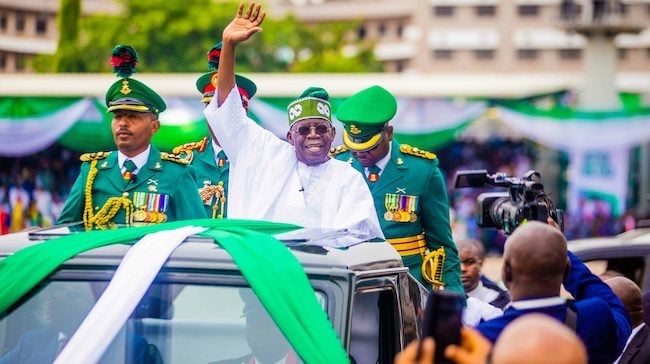
Last year, when President Bola Ahmed Tinubu slipped at Eagle Square while trying to board the parade vehicle during the Democracy Day ceremony on June 12, 2024, Nigerians responded with mixed emotions: from analysis to commentary, and from concern to plain humour. Yet beyond the fleeting reactions, that moment carried symbolic weight, the significance of which was not lost on me. One year later, with the heightened state of insecurity and governance pressure escalating, the meaning behind that slip has become clearer: Nigeria itself is off balance.
Nigeria is a federation in name, but a unitary country in practice. Too much authority rests in Abuja, while the states and local governments, the tiers that are closest to citizens, remain legally handicapped. The result is a governance structure that is cumbersome, reactive, and unable to respond effectively to local realities.
That imbalance now expresses itself in rising insecurity. Terror groups and bandit networks have taken advantage of ungoverned spaces. Communities are left vulnerable. State governments are reduced to spectators because they lack the constitutional power to act decisively. A nation cannot be secured from a single administrative point. No modern federal system, whether in the United States, Canada, India, or Australia, operates that way.
Advertisement
To his credit, President Tinubu has shown some willingness to address this structural weakness. His support for local government autonomy, the establishment of regional development commissions and, recently, his call on the National Assembly to provide the legal framework for states willing to establish state police are all significant signals. Unlike previous administrations that avoided the restructuring debate entirely, this President has at least acknowledged the structural problem. But acknowledgement is not good enough.
Nigeria requires more than incremental reform. The scale of the challenge we face right now demands constitutional re-engineering. This moment calls for statesmanship, not caution – and President Tinubu is uniquely positioned to lead this effort for two major reasons: he occupies the highest office in the land and because his own legacy is rooted in demonstrating what subnational autonomy can achieve.
Today, Lagos State stands as a living testimony of what is possible for component states in a Federation. Just as California drives America’s economy, Lagos drives Nigeria’s. Its transformation from a state dependent on federal allocation (FAAC) to a powerful economic hub happened because it seized the bull by the horn to take initiative, experiment, innovate, generate revenue, and defend constitutional rights to its advantage. Lagos proves that Nigeria is not lacking in capability; it is lacking in imagination and will to deploy that capability.
Advertisement
Imagine a Nigeria where every state can act like Lagos or like California: innovating, securing its territory, developing infrastructure, tailoring education, and attracting investment. A Nigeria where local governments govern, states solve their own problems, and the Federal Government focuses on defence, national cohesion, monetary stability, and international relations, and not on approving boreholes, roads, or primary school projects. That is what restructuring offers us: balance, clarity, efficiency, responsibility, and prosperity.
President Tinubu has already taken the first careful steps. The nation now waits to see whether he will walk fully into the moment history has placed before him. He can either be remembered as the President who touched restructuring or the one who completed it.
The slip we saw last year may have been accidental, but the message it symbolises is intentional. A nation out of balance must correct its footing before moving forward.
Nigeria stands at a decisive turning point, what the duo Acemoglu and Robinson call a “Critical Juncture” in their book, “Why Nations Fail: The Origins of Power, Prosperity and Poverty”. We either restructure and rise – or ignore the warning and continue to stumble toward a preventable collapse.
Advertisement
History is watching, and posterity will remember what choice was made.
Nigeria shall rise again.
Isaiah Kumuyi, a writer and communicator, writes from the University of Lagos.
Advertisement
Views expressed by contributors are strictly personal and not of TheCable.