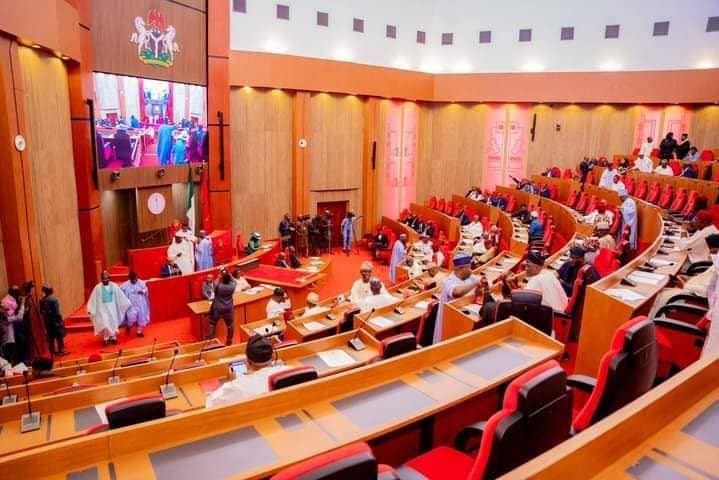
Lawmakers said the approved parameters were aimed at promoting macroeconomic stability, strengthening fiscal discipline and supporting the federal government’s economic reforms.
Advertisement
The senate approved a downward review of the crude oil benchmark price for 2026 to $60 per barrel, from $64.85.
However, lawmakers endorsed oil price benchmarks of $65 per barrel for 2027 and $70 per barrel for 2028.
The committee said the conservative adjustment for 2026 was due to heightened geopolitical tensions in Europe and the Middle East, as well as continued volatility in the global oil market.
Despite the cautious price outlook, the senate retained crude oil production projections of 1.84 million barrels per day for 2026, 1.88 million barrels per day for 2027 and 1.92 million barrels per day for 2028.
Advertisement
Lawmakers expressed optimism that improved security, industry reforms and increased investment would support higher output.
EXCHANGE RATE, INFLATION, GDP GROWTH
On exchange rate assumptions, the senate approved projections of N1,512 to the dollar for 2026, N1,432.15/$ for 2027 and N1,383.18/$ for 2028.
The upper chamber said the figures align with the Central Bank of Nigeria’s (CBN) policy direction and efforts to stabilise the naira through improved coordination of fiscal and monetary policies.
Advertisement
The senate also approved inflation projections of 16.5 percent for 2026, 13 percent for 2027 and 9 percent for 2028.
Lawmakers said the outlook reflects expected tightening measures by monetary authorities.
Advertisement
Real gross domestic product growth projections of 4.68 percent for 2026, 5.96 percent for 2027 and 7.9 percent for 2028 were also retained.
Senators expressed confidence that recent tax and structural reforms would begin to deliver measurable economic benefits from 2026.
Advertisement
REVENUE MEASURES AND TAX REFORMS
To boost revenues, the senate urged the strict implementation of newly enacted tax laws.
Advertisement
Lawmakers described the tax reforms as critical to economic growth and development.
The upper chamber also recommended the adoption of a national scanning policy under the national single window of the Nigeria Revenue Service to curb leakages, improve trade facilitation, boost transparency and enhance national security.
On fiscal aggregates, the senate approved a total federal budget size of N54.46 trillion for 2026.
The figure comprises retained revenue of N34.33 trillion and new borrowings of N17.88 trillion from domestic and external sources.
Debt service was pegged at N15.52 trillion.
Pensions, gratuities and retirees’ benefits were estimated at N1.37 trillion.
The framework also includes an overall fiscal deficit of N20.13 trillion.
Lawmakers endorsed capital expenditure of N20.13 trillion, statutory transfers of N3.15 trillion, a sinking fund of N388.54 billion and recurrent non-debt spending of N15.265 trillion.
The committee thanked the senate for its support and expressed optimism that the approved framework would support sustainable economic growth and long-term prosperity.