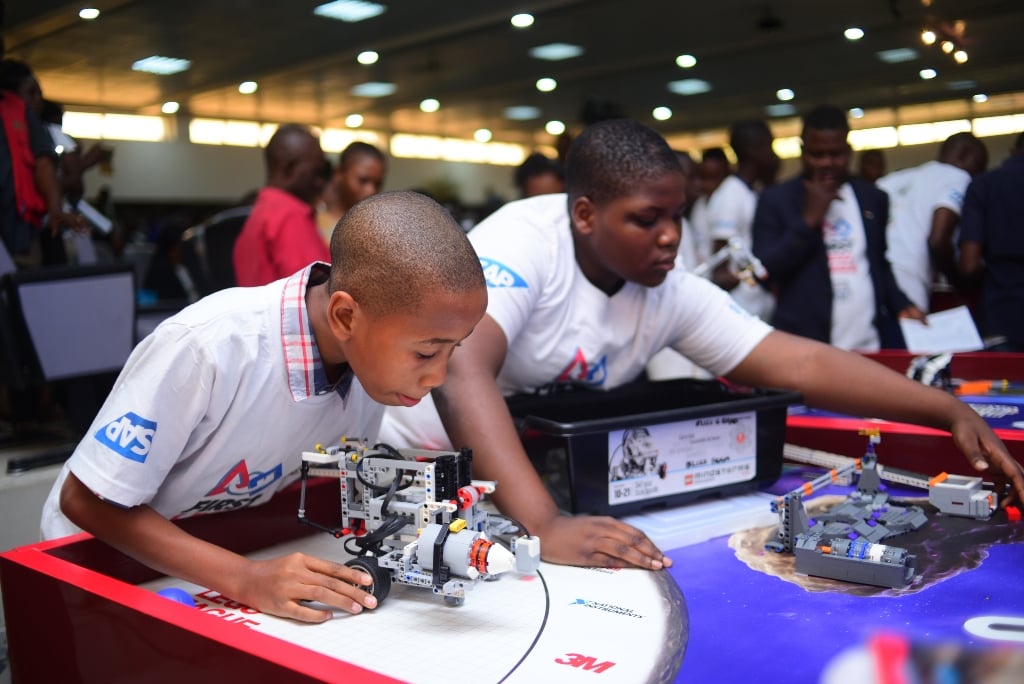
Robotics students | File photo
The federal ministry of education has addressed recent controversies trailing the newly revised curriculum for senior secondary schools.
It all began in November, after the management of a school in Lagos abruptly announced new subject offerings for the 2026 West African Senior Secondary Certificate Examination (WASSCE).
BACKGROUND
The decision was made after the West African Examination Council (WAEC) issued a communique on the new subject offerings for its 2026 SSCE.
The examination body stated that the revisions will apply to SS3 students who will write the WASSCE within the next six months.
Advertisement
The latest revision is to reduce subject overload and incorporate new skills, such as digital literacy and entrepreneurship.
The education ministry had stated that implementation would commence at the beginning of each three-year education cycle.
In the new structure, approved core subjects include English Language, General Mathematics, Citizenship and Heritage Studies, Digital Technologies (formerly Information and Communication Technology), and one trade subject.
Advertisement
The ministry said candidates will not be tested in Citizenship and Heritage Studies and Digital Technologies in 2026, stating that the subjects require new curricula and examination syllabuses.
The trade subjects have also been streamlined from 26 to six, while retaining the curriculum content.
CONTROVERSY
However, the decision stirred controversy over the requirements for subjects and the eligibility of students writing the next WASSCE.
There were concerns that students who currently do not offer the new six trade subjects will be forced to “select the subject they were never taught in SS 1 and SS 2”.
Advertisement
There are also objections that Marketing has become a compulsory subject for business students, even to schools who do not offer it.
Some commenters also argued that students who offer courses like Civic Education and Computer are being compelled to take new subjects to make up a minimum of required eight subjects to be registered for WASSCE.
NO COMPULSION
In a statement addressing the matter, Tunji Alausa, the minister of education, said there is no restriction or exclusion attached to the selection of any approved subject within the school curriculum.
The minister maintained that all subjects remain fully open for students to choose from.
Advertisement
He stated that management of schools must guide the students’ decisions.
“Science students may select subjects classified under the social sciences or arts, while students in the arts and social sciences may also choose subjects traditionally grouped under the sciences,” the statement reads.
Advertisement
The federal government added that the students who offer ICT are eligible to write the Digital Technology examination.
On the trade subjects, the minister explained that there is no obligation on students to write any of the six subjects if they have not been taught.
Advertisement