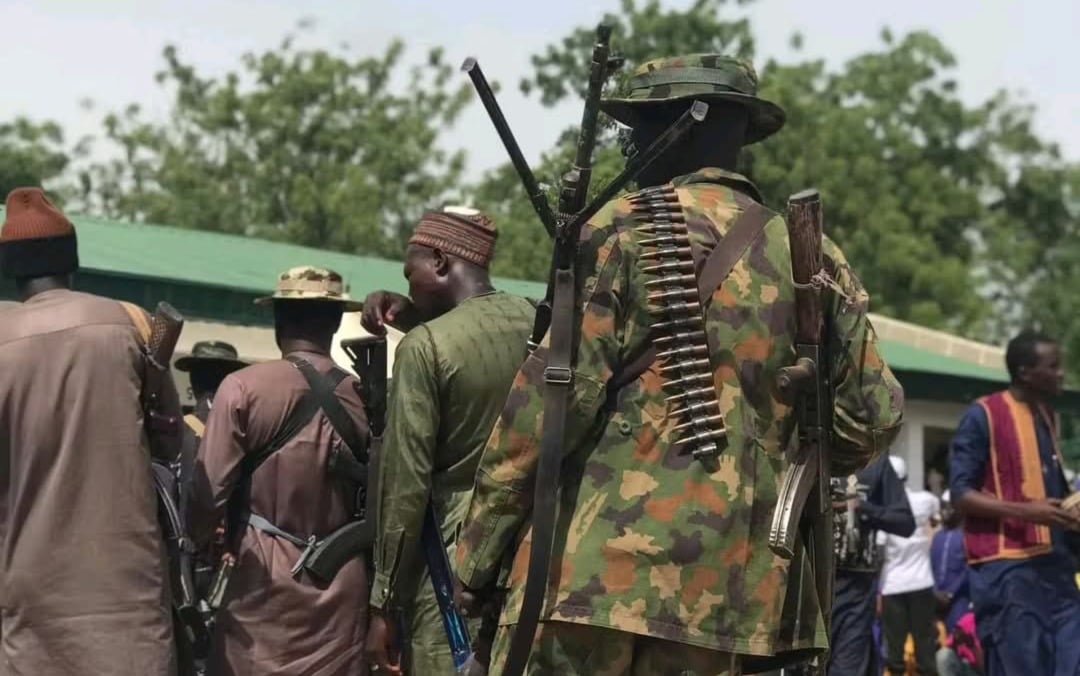
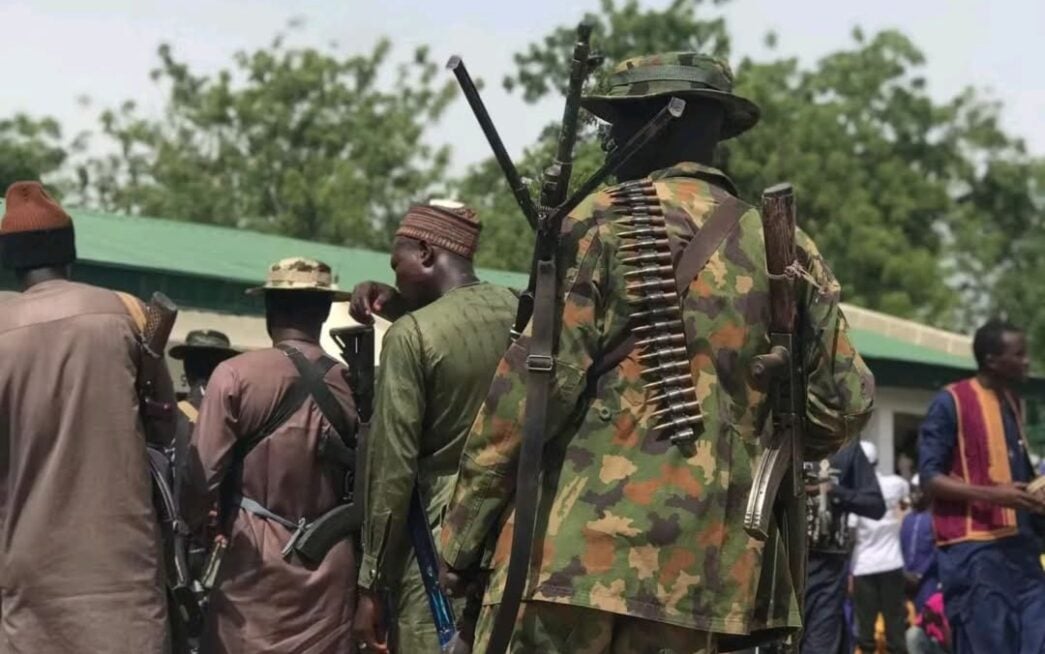
File photo: Bandit leaders at a peace meeting
BY LEKAN OLAYIWOLA
President Tinubu’s declaration of a nationwide security emergency is more than a tactical mobilisation; it is a rare moment of political clarity. By authorising mass recruitment, redeployment of VIP escorts, and forest guard deployments, the government has signalled seriousness and urgency. Citizens see this as reassurance that their trauma is being recognised.
The declaration also opens a window for deeper reform. Its centre of gravity is capacity and manoeuvre, but the opportunity lies in pairing that surge with measures that strengthen justice, disrupt harmful economic incentives, and rebuild civic trust. What makes this declaration significant is not only its scale but its symbolism.
For years, Nigerians have lived with the perception that government responses to insecurity were piecemeal, reactive, or confined to certain regions. By framing the emergency as nationwide, the administration has sought to reclaim narrative sovereignty, demonstrating that the state still has the capacity to act decisively and protect its citizens.
Advertisement
The Civic Roots of Insecurity
But symbolism alone cannot sustain trust. Unless the surge in manpower is matched by reforms in justice, resource governance, and civic engagement, the declaration risks becoming a temporary spectacle rather than a turning point.
Nigeria’s insecurity is not born in the forests alone. It is rooted in the collapse of the social contract. The NBS Labour Force Report (Q2 2025) indicates youth unemployment remains a pressing concern, while inflation exceeds 20% in several states, as noted in the April 2025 IMF’s Regional Economic Outlook for Sub-Saharan Africa. These conditions can contribute to desperation, recruitment pressures, and civic fatigue.
Advertisement
The judicial system compounds the challenge. Lengthy pre-trial detention, systemic inefficiencies, and slow case management mean that even when suspects are arrested, convictions can take months or years. Deploying tens of thousands of new officers into this context risks overwhelming the system, which could inadvertently erode trust unless reforms are implemented in tandem.
The Structural Economies of Insecurity
Banditry and kidnapping are not random violence; they reflect structured, localised economies. Research in Security Journal (2024) highlights how ransom cycles in northwest Nigeria generate sustained incentives, with communities often bearing the costs even after payments are made.
Nigeria’s artisanal and small-scale gold mining sector illustrates another layer of complexity: informal networks and unregulated practices can inadvertently create economic incentives that sustain insecurity. While these dynamics are not fully understood, engaging with them constructively is essential to long-term solutions.
Advertisement
The security emergency targets perpetrators in the field but also presents an opportunity to address the wider structural incentives that perpetuate violence. Policies that strengthen transparency, governance, and community oversight can make the response more sustainable.
Fragile and Fatigued Civic Actors
Citizens are traumatised and impatient. Years of kidnappings, bandit raids, and insurgent attacks have eroded trust. Police misconduct and corruption scandals deepen cynicism. The US State Department’s 2024 Human Rights Report highlighted arbitrary detentions and lengthy pretrial periods as major challenges. Communities feel unseen, unprotected, and unheard.
The emergency declaration is top-down. It treats communities as terrain to be secured, not partners in intelligence. Rapidly trained recruits deployed without civic engagement risk widening the trust deficit. Human rights abuses or indiscriminate raids will alienate populations further, cutting off the intelligence flows that are the true firewall against instability.
Advertisement
How Non-State Actors Recalibrate
The declaration’s signal is complex. Boko Haram and ISWAP, whose goals involve territorial control, may interpret the surge as a direct challenge, forcing them to retreat strategically and shifting attacks to less defended areas.
Advertisement
Bandit and kidnap networks, whose livelihoods depend on ransom and plunder, may adjust operations temporarily, using communities as protective buffers and seeking alternative avenues where enforcement is less visible. Herder–farmer groups interpreting ranching policies and disarmament calls may engage more with authorities to reduce conflict, but without credible land governance, tensions could persist.
Foreign actors involved in arms, minerals, and other illicit markets may wait to observe how enforcement measures are sustained. While immediate operations may slow some transfers, systemic incentives remain. Understanding these dynamics helps policymakers anticipate responses and calibrate interventions.
Advertisement
Policy Imperatives for Fixing Nigeria’s Security Blindspots
The declaration’s blind spots are threefold: (i) Justice: Without specialised courts and expedited prosecution, arrests risk overloading the system and impunity may continue; (ii) Economic incentives: Without transparent governance of resources and disruption of harmful networks, some incentives for violence remain; (iii) Community trust: Without integrated civil–military engagement, new recruits risk alienating citizens, which can undermine intelligence and cooperation.
Advertisement
Insecurity is civic before it is military. A security emergency is also a legitimacy emergency. Leveraging the surge for structural reform strengthens both protection and public confidence. Justice sector measures could include specialised courts, expedited case processing, and transparent sentencing. Responsibility lies with the Ministry of Justice and the National Judicial Council, supported by legislation where necessary.
Resource governance reforms could mandate tracking of minerals and other high-risk commodities, transparent licensing, and community benefit arrangements, coordinated across relevant agencies, including the ministry of mines, EFCC, and Financial Intelligence Unit. Civic engagement and civil–military integration should embed grievance redress, civilian-harm monitoring, and restitution mechanisms. Ministries and security services, with civil society participation, can ensure accountability.
Operationalising this approach includes community security councils integrated into local command structures, dignity-first training for new recruits, and grievance desks with defined timelines. Across fragile contexts, populations turned against governments when security measures neglected respect and inclusion. True security requires the presence of dignity, safety, and civic participation.
Real Justification for Extraordinary Measures
As Nigerians prepare to accept extraordinary measures, the nationwide security emergency should not be limited to recruitment and redeployment. It must also embed accountability, transparency, and civic trust. Accompanying the security surge with reforms will not only reassure citizens but also strengthen the legitimacy that underpins long-term peace and stability.
The emergency can thus be leveraged not merely for force projection, but for restoring civic confidence and strengthening institutions. The true emergency is not insurgency alone; it is the fragility of state legitimacy. Fixing Nigeria’s security blind spots requires attention to justice, economic governance, and trust-building. Only then can the declaration move Nigeria from emergency to resilience.
Lekan Olayiwola is a peace & conflict researcher/policy analyst. He can be reached at [email protected]
Views expressed by contributors are strictly personal and not of TheCable.