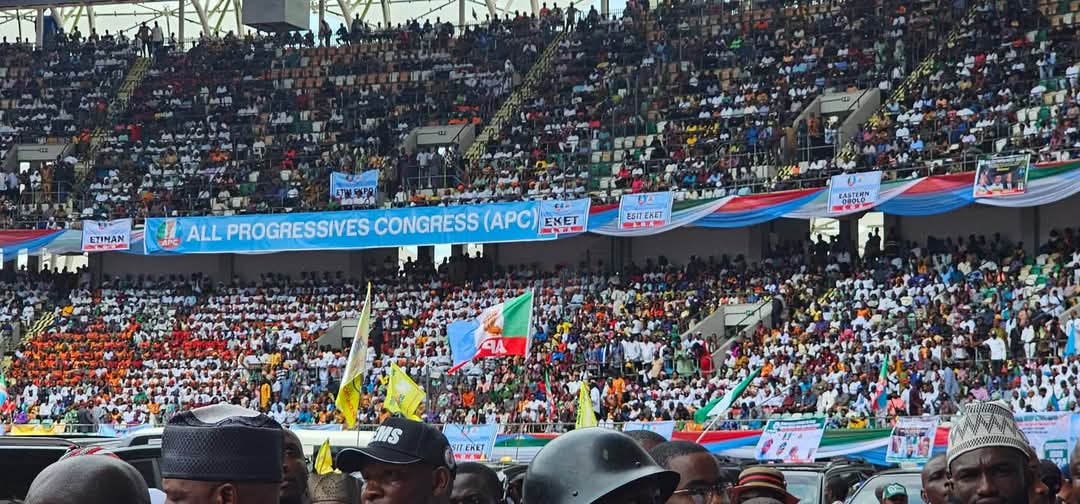
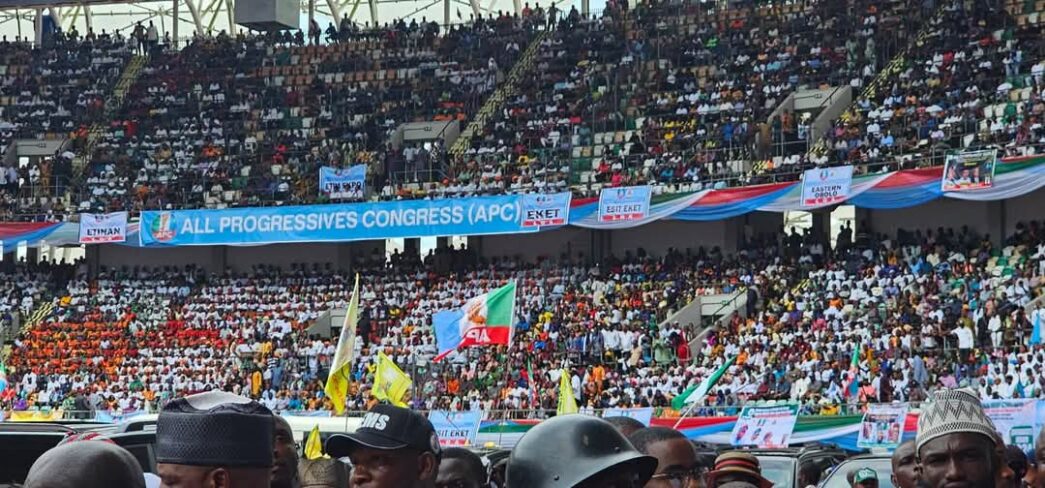
Akwa Ibom APC
BY NNAA KALU NTO
The recent gale of political defections sweeping across Nigeria has once again exposed the fragility of our democracy. From the chambers of the national assembly to state governors, state assemblies and local councils, politicians are trooping into the All Progressives Congress, APC, as if it were the last ark before a flood. Yet, the question begs asking, what are they running to, and from what?
As the Igbo say, onye buru chi ya ụzọ, ọ gbagbue onwe ya n’oso, he who runs ahead of his destiny will stumble. What we are witnessing is not ideology in motion but moral flatulence and survivalism at its crudest. Politicians, fearing political extinction, are seeking shelter under a party whose ten-year record should, by every moral standard, disqualify it as a refuge.
When Power Becomes the Only Ideology
Advertisement
In saner democracies, defections often signal deep disagreements about policy or principle. In Nigeria, they are merely an exchange of jerseys. Our politicians change parties as traders change market stalls, not to serve the people better but to remain close to the corridors of power.
This latest wave of defections into the APC defies both logic and conscience. After a decade of governance, the APC’s record reads like a tragic summary of promises betrayed. Inflation has eroded incomes, insecurity has multiplied across regions, and poverty has become a national identity.
According to World Bank statistics, over 75 percent of rural Nigerians now live below the poverty line. Between 2016 and 2023, more than ten million Nigerians slipped into extreme poverty. The cost of living has soared beyond imagination, while wages remain frozen in time. The economy might be growing on paper, but the people are shrinking in reality.
Advertisement
If performance were the measure of loyalty, the APC would be losing members in droves, not gaining them. What we see instead is a desperate rush to align with a government that has failed to inspire hope or deliver prosperity. It is like repainting a collapsing building and calling it new.
The Peril of a One-Party Democracy
A democracy without opposition is a body without a heartbeat. Yet Nigeria is fast drifting toward that dangerous cliff where one party becomes both referee and player, lawmaker and lawbreaker, judge and jury.
When opposition voices are silenced by inducement or intimidation, accountability dies quietly. A one-party state is not a strength; it is stagnation dressed as stability. The danger is not theoretical; history has shown that absolute power corrupts absolutely. Nigeria’s ruling elite should take heed that the death of opposition is the birth of tyranny.
Advertisement
A Study in Contrast
For a clearer picture of what good governance truly means, one needs only compare Enugu and Katsina states. Enugu state, a hitherto PDP-governed state, whose governor, Peter Mbah, recently defected to the APC, claims that his defection to the APC would make the “voices” of Enugu and the south-east finally heard in Abuja. This is both misleading and intellectually hollow. Representation in a democracy is not secured by political alignment but by effective governance and credible advocacy.
The south-east’s marginalisation is not a function of party membership but of systemic exclusion and leadership complacency. History shows that regions fully aligned with the ruling party, such as the North-West during various administrations, have still suffered from underdevelopment and insecurity. Thus, to suggest that political defection alone guarantees visibility or progress in Abuja ignores the complex realities of federal politics and reduces governance to mere partisan loyalty.
Enugu, hitherto governed outside the ruling party’s umbrella, has quietly risen among the top five states in internal revenue generation, recording ₦180.5 billion in 2024. The state enjoys relative peace, a stable economy, and ongoing infrastructural growth.
Advertisement
Katsina, by contrast, remains an APC stronghold and the home state of a former president from the APC. Yet, it continues to battle crippling insecurity, poverty, and economic stagnation. With an internally generated revenue of just ₦4.08 billion in the first quarter of 2024, the state is struggling to meet basic developmental needs. Banditry remains rife, and communities live under siege.
If political loyalty guaranteed progress, Katsina should be a model of transformation. Instead, it stands as a cautionary tale that governance, not party allegiance, determines success.
Advertisement
A Decade of Disappointment
After ten years in power, the APC’s scorecard is marked by more excuses than achievements. The World Bank reports that while GDP growth touched 3.4 percent in 2024, the highest in a decade, this figure is meaningless to the average Nigerian, whose income can no longer buy basic necessities.
Advertisement
Over seventy percent of household income now goes into food purchases. Millions of youths remain unemployed. The naira continues its downward slide; corruption remains endemic; and insecurity is an everyday reality. For a party that promised to make Nigeria work, it has instead made survival an Olympic event.
Electricity remains epileptic, schools crumble, and healthcare systems collapse under the weight of neglect. Hope has become a luxury only the rich can afford.
Advertisement
The Power of Choice
Nigeria is standing at a crossroads. The danger is not just in the defections but in the apathy of the people watching them unfold. If citizens surrender their will, the country will drift into a one-party state where elections become rituals without meaning.
Democracy survives only when voters act, when opposition breathes, and when leaders are reminded that power belongs to the people. Defections weaken democracy; silence kills it. The truth is that Nigerians have seen enough of empty promises and endless recycling of old faces. What the country needs now are leaders with clear vision, tested integrity, and a record of prudence. It is here that real opposition voices like Peter Obi stand out, not because of sentiment but because of evidence. His calm, disciplined approach to governance, his respect for public funds, and his insistence that leadership must serve rather than rule, make him a logical choice in a season of noise and confusion.
As our elders say, “the one who holds the rattle decides how it sounds.” In other words, for your voice to count in choosing a king, you must first be willing to take part. The next election must not be a contest of who can defect fastest or shout the loudest; it must be about who can serve best.
Nigeria doesn’t need more defectors. It needs more deciders; citizens with the courage to vote their conscience instead of their comfort. In the end, no messiah will come from the corridors of power to save this country. It is the people, standing firm in truth and demanding integrity over theatrics, who will reclaim Nigeria’s destiny by choosing leaders whose character, not their cunning, can rebuild the nation from the ground up.
Nnaa Kalu Nto ([email protected]) is the CEO of Analytix and a good governance advocate based in Abuja.
Views expressed by contributors are strictly personal and not of TheCable.