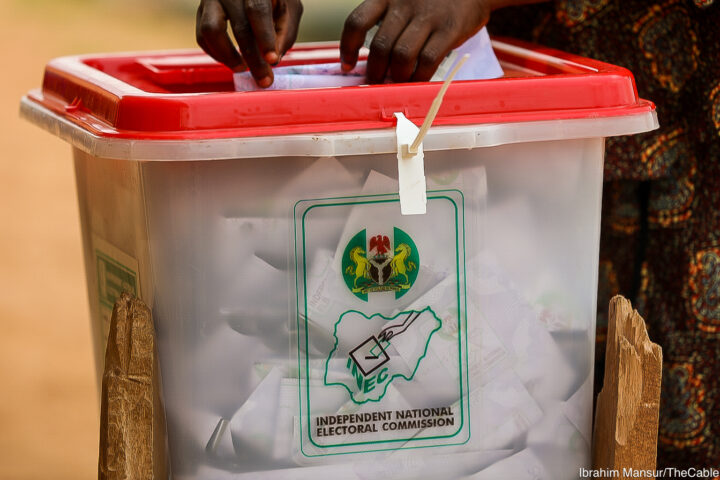
A statistical analysis of Nigeria’s 2023 elections says Labour Party (LP) strongholds recorded the highest concentration of irregularities in the polls.
President Bola Tinubu of the All Progressives Congress (APC) won the election with 8,794,726 votes.
Atiku Abubakar of the Peoples Democratic Party (PDP) had the second-highest vote total of 6,984,520, while Peter Obi of the LP came third with 6,101,533.
The study, conducted as part of a master’s thesis in Data Science at Pan-Atlantic University, examined 123,918 polling units across all 36 states and the federal capital territory (FCT).
Advertisement
The researcher employed several algorithms, including Random Forest classifiers, which flagged 4,351 polling units as anomalous (3.5% of all units analysed).
The analyst said while the percentage may appear small, such concentrations can be decisive in close elections, particularly when irregularities cluster in key regions.
‘SOUTH-EAST MOST AFFECTED’
Advertisement
The data suggests that electoral manipulation in 2023 was not uniformly applied but was concentrated in specific regions where opportunities allowed.
“Anambra State showed an anomaly rate of 24.9%. Nearly one in four polling units displayed multiple fraud indicators. Enugu came in at 16.7%. Imo at 10.9%. These aren’t rounding errors or statistical noise. These are neon signs visible from space,” the research said.
“For comparison, Lagos, despite being the political home of the winning candidate, showed an anomaly rate of just 2.3%. Oyo recorded 0.3%. The pattern contradicts the simple narrative that ‘the ruling party rigged it everywhere’.
“The data suggests something more complex and frankly more worrying: electoral manipulation is geographically concentrated, crosses party lines, and seems to follow opportunity rather than ideology.
Advertisement
“Another thing to note is that this only covers analysis for uploaded result sheets. The actual numbers announced by INEC, in some cases, are significantly different, indicating additional manipulation. The biggest example is Rivers State, which the Labour Party won, but was called for the APC in the final tally.”
‘LABOUR PARTY STRONGHOLDS HAD HIGHEST IRREGULARITIES’
According to the report, the LP—not the ruling APC—showed the highest concentration of irregularities in its strongholds.
“Here’s the twist that should make everyone uncomfortable: the Labour Party, not the ruling APC, showed the highest concentration of irregularities in its strongholds,” the study said.
Advertisement
“LP had 2,328 instances of what I call “perfect scores” (results clustering at suspiciously round percentages like 50.00% or 75.00%). Despite winning only 29.1% of votes nationally, LP accounted for more than its share of statistical red flags.
“This finding complicates the popular narrative. It suggests that electoral fraud in Nigeria 2023 wasn’t a one-sided affair orchestrated from Aso Rock. Multiple actors engaged in manipulation where they could.
Advertisement
“The southeastern concentration suggests that the very regions crying loudest about being cheated may themselves have been sites of significant irregularities.
“The above should not be confused with the fact that Peter Obi was not popular in the South-East. In fact, he was extremely popular. It is precisely that hegemonic popularity that provided cover for electoral manipulation. In a contested space, it is much more difficult.”
Advertisement
The research concluded that the 2023 elections in Nigeria were neither catastrophically fraudulent nor entirely free and fair.
“The 2023 data suggests that fraudsters have evolved. Crude ballot stuffing has declined, replaced by subtler manipulation of vote distributions. Instead of reporting 100% turnout with 95% for one candidate (which screams fraud), modern perpetrators report 65% turnout with 58% for their candidate. Plausible. Defensible. Still fraudulent,” the research said.
Advertisement
“The 2023 presidential election wasn’t catastrophically fraudulent, but neither was it credibly free and fair. It represents Nigeria’s ongoing struggle between aspiration and execution, between billion-naira technology and persistent dysfunction, between democratic promise and authoritarian habit.”
The researcher recommended independent audits of election data, mandatory real-time transmission of results, unbundling of INEC’s responsibilities, and development of in-house technical capacity, and the visible prosecution of offenders.