

President Bola Tinubu and Benin Republic's President Patrice Talon
On December 7, a group of military officers in the Republic of Benin, who called themselves the “Military Committee for Refoundation”, invaded the country’s national television and announced the dissolution of the government and the overthrow of Patrice Talon, the country’s president.
Hours later, the Benin Republic presidency said the coup had been quashed and that Talon was safe.
Subsequently, Nigerian jets were spotted in the Beninese airspace as part of the move to quell the coup.
Later on Sunday, the Nigerian presidency said the Republic of Benin made two separate requests for the intervention of the Nigerian Air Force (NAF) and ground troops in quashing the coup attempt in the neighbouring country.
Advertisement
Bayo Onanuga, presidential spokesperson, said President Bola Tinubu acted on the requests by ordering the air force to take control of the Benin Republic airspace.
All the requests were said to have been granted.
The development elicited varied reactions on whether Tinubu has the power to unilaterally send soldiers to the Benin Republic without the approval of the senate.
Advertisement
WHAT DOES THE LAW SAY?
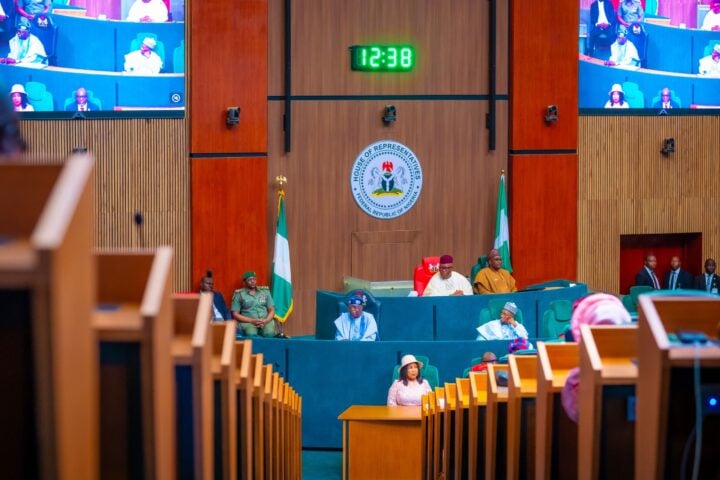
Section 5 of the 1999 constitution stipulates the powers of the president as it relates to the declaration of war and the deployment of the Nigerian military for combat duty outside the country.
Section 5 (4)(a) of the constitution states that the president cannot declare war between Nigeria and another country unless both houses of the national assembly approve such action.
Also, section 5 (4)(b) of the constitution states that no members of the Nigerian armed forces shall be deployed on combat duty outside Nigeria except as approved by the senate.
Advertisement
Section 5 of the 1999 constitution states:
“(4) Notwithstanding the foregoing provisions of this section — (a) the President shall not declare a state of war between the Federation and another country except with the sanction of a resolution of both Houses of the National Assembly sitting in a joint session; and
“(b) Except with the prior approval of the Senate, no member of the armed forces of the Federation shall be deployed on combat duty outside Nigeria.”
Meanwhile, section 5(5) of the 1999 constitution gives the president leeway to deploy members of the armed forces outside Nigeria “on a limited combat duty” before seeking the approval of the senate.
Advertisement
Section 5 of the 1999 constitution states:
“(5) Notwithstanding the provisions of subsection (4) of this section, the President, in consultation with the National Defence Council, may deploy members of the armed forces of the Federation on a limited combat duty outside Nigeria if he is satisfied that the national security is under imminent threat or danger:
Advertisement
“Provided that the President shall, within seven days of actual combat engagement, seek the consent of the Senate and the Senate shall thereafter give or refuse the said consent within fourteen days.”
On Tuesday, the senate approved Tinubu’s request to deploy Nigerian troops to the Republic of Benin as part of a regional peace-stabilisation mission aimed at protecting democratic institutions and preventing an “unconstitutional seizure” of power.
Advertisement
The approval was given 48 hours after the Nigerian military deployment to the neighbouring country.
LEGAL OPINION
Advertisement
Speaking with TheCable on the decision of the president, Akintayo Balogun, a lawyer, affirmed that Tinubu did not contravene the constitution since section 5 (5) of the 1999 constitution allows for deployment of military officers before senate approval.
Balogun said the situation warranted that the president act very fast to avert the military takeover of democratic structures in the Republic of Benin.
“Ordinarily, the president ought to act with the approval of the national assembly before taking up a crucial assignment of this nature outside the shores of Nigeria,” the lawyer said.
“The national assembly ought to receive a request from the president. The procedure in the national assembly requires calling a joint session of the upper and lower houses as provided for in the constitution, deliberation on the issues, and an approval or disapproval of the president’s request for military action outside the country.
“We must note that this is time-consuming, and the essence of the president’s action might be defeated.
“Now, for the president to get an approval from the joint session of the national assembly for a coup d’état that was already underway, the act would have been completed, and there would be almost nothing left for the government to save. This is why the action of the president was immediate and decisive.
“Now note that immediately after the military act was carried out by the president, the president, in compliance with sub 5 of the provision under reference, wrote to the national assembly, seeking their approval of the military action taken outside the shores of Nigeria.
“With this action, the president has fully complied with the provision of the constitution with respect to the military action taken in the Benin Republic and has not in any way run afoul of the provision of the constitution of Nigeria.”