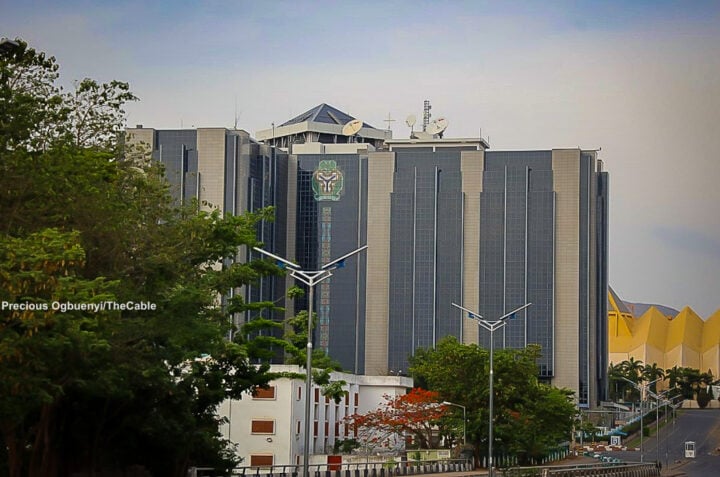
The senate is considering a bill seeking to amend the Banks and Other Financial Institutions Act (BOFIA) of 2020, to empower the Central Bank of Nigeria (CBN) to designate and supervise non-bank financial institutions.
The bill targets major fintech operators whose activities, lawmakers now say, constitute critical national infrastructure.
The bill is sponsored by Tokunbo Abiru, chairman of the senate committee on banking, insurance, and other financial institutions.
He said the amendment had become urgent due to the rapid evolution of Nigeria’s financial ecosystem.
Advertisement
Below are some of the highlights of the bill:
POWER OF THE BANK TO DESIGNATE SYSTEMICALLY IMPORTANT INSTITUTION
The proposed amendment bill seeks to empower the CBN to designate any licensed non-bank financial institution as a systemically important institution (SII) if its size, market share, number of users or value of transactions of the institution is of grave significance to the financial system.
Advertisement
The bill said firms may also fall under this category if they are deeply integrated with banks and payment infrastructure, or if their operational disruption could threaten financial stability.
The proposed law said the designation will be made by the CBN governor, noting that such firms may be subjected to stricter prudential and operational requirements, with the apex bank also empowered to suspend or revoke the status where necessary.
CRITERIA AND REGULATIONS FOR DESIGNATION
The bill provides that the CBN will set out formal criteria for determining systemic importance of such institutions, based on factors such as interconnectedness, technology reliance, substitutability, user concentration, and operational footprint.
Advertisement
OBLIGATIONS OF DESIGNATED SYSTEMICALLY IMPORTANT INSTITUTION
According to the bill, once designated, institutions must comply with the CBN directives, maintain governance and cybersecurity standards, provide requested documentation for supervision, and report any material changes in their operations.
ESTABLISHMENT OF THE SYSTEMICALLY IMPORTANT INSTITUTION REGISTRY
The bill said the apex bank will create and maintain a registry of all designated systemically important companies, which will be publicly updated at least once a year.
Advertisement
STRESS TESTING
The proposed legislation said the institution may also be required to undergo periodic stress tests covering liquidity, solvency, market risks, and must implement any corrective measures directed by the CBN.
Advertisement
“The bank may prescribe the methodology, scenarios, data requirements and frequency of such stress tests,” the document added.
ENFORCEMENT AND PENALTIES
Advertisement
The bill proposes that any SII that violates the regulations will be committing an offence and could face fines or operational suspension by the CBN, noting that each day the breach continues will count as a separate offence.
“A Systemically Important Institution aggrieved by any decision of the Bank under this Part may appeal to the Federal High Court within 30 days of such decision,” the bill said.
Advertisement
TRANSITIONAL DESIGNATION OF EXISTING INSTITUTIONS
The bill further stipulates that any institution already operating in Nigeria and considered systemically important by the CBN will receive a provisional designation for up to six months.
“The Bank shall, within 60 days of commencement, issue a Provisional List of Systemically Important Institution Candidates, identifying institutions required to undergo an assessment for final designation,” the bill said.
TRANSITIONAL REGULATIONS
According to the provisions of the bill, transitional regulations, including temporary risk thresholds and reporting formats, may be issued and will remain valid until full regulations take effect.
The bill said all transitional arrangements are expected to expire after 12 months, after which full compliance becomes mandatory.
DISCLOSURE OF ULTIMATE BENEFICIAL OWNERS
If the bill scales through, designated firms will be mandated to disclose their ultimate beneficial owners and notify the CBN of changes within seven days.
The proposed bill said the bank reserves the right to trace ownership or control structure — however complex — to identify the natural persons exercising actual or potential control.
REGULATION OF FOREIGN CONTROL
To sustain confidence and ensure a stable operating environment, the bill said the bank may review forms of foreign control strictly for the purposes of effective supervision, market integrity, consumer protection, and financial stability.
“Where, based on a risk-based assessment, the Bank identifies those certain forms of foreign control including those involving complex multi-layered ownership structures, offshore special-purpose entities, foreign state-aligned financing sources, or dependence on non transparent data, Artificial Intelligence, or compute infrastructure may materially impair effective supervision or pose systemic or national-interest risks, the Bank may require proportionate corrective measures,” the bill said.
According to the bill, corrective measures may include transparency requirements, local governance thresholds, data residency compliance or, in extreme cases, restructuring.
POWERS OF THE BANK OVER MARKET COMPETITION
The planned amendments also intend to grant the CBN the powers to address market dominance and anti-competitive practices among systemically important platforms.
The bill said the central bank may issue directives to enforce interoperability, curb predatory pricing or prevent data-driven exclusion of competitors.
Where necessary, according to the bill, the bank may also impose structural remedies such as divestiture or business separation to restore market fairness, protect consumers, or safeguard financial stability.