


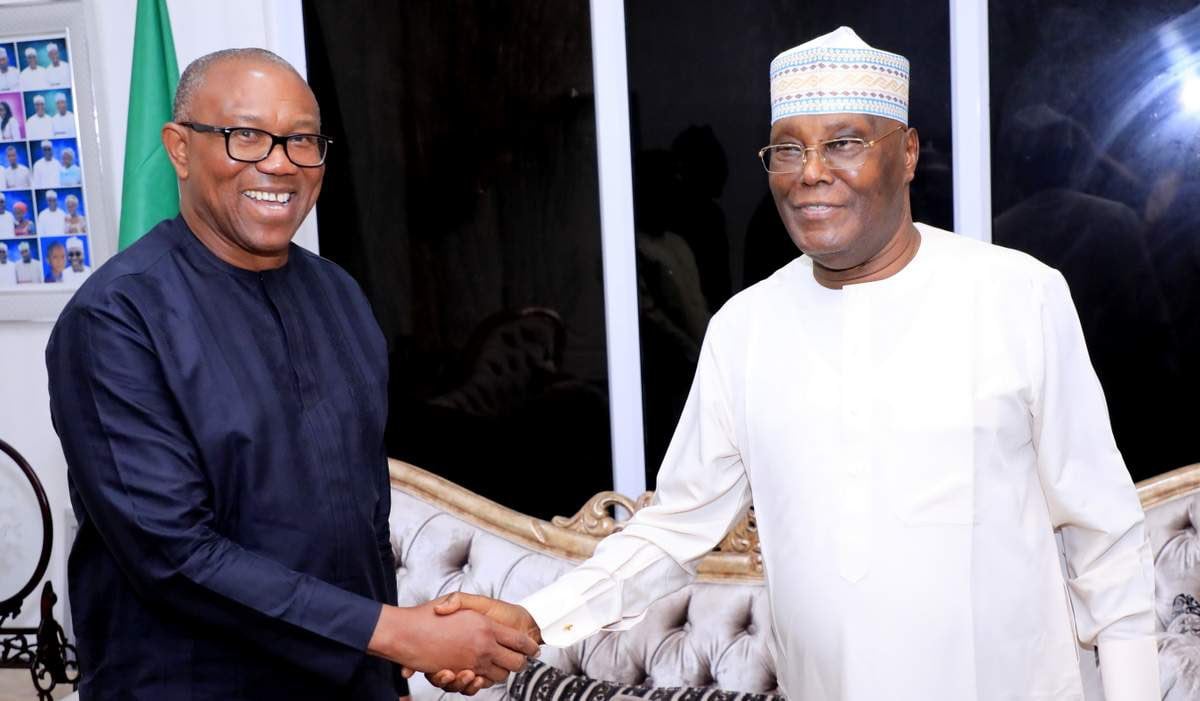
Peter Obi and Atiku Abubakar
BY AMERIJOYE DONALD BOWOFADE
Nigeria is not walking into 2027; Nigeria is staggering into it, wounded, hungry, humiliated, betrayed, exhausted, terrified, and furious. A nation that once held hope in trembling palms now clenches its fists in despair. Every street is a complaint. Every market is a lament. Every church is a prayer for deliverance. Every mosque is a cry for mercy. Every home is an interrogation of leadership failure.
The Nigeria of today is not merely disillusioned; it is bleeding, and like ancient Israel crying in bondage, the nation is groaning for a Moses who will part the sea of adversity. For as Scripture declares, “When the righteous rule, the people rejoice, but when the wicked rule, the people groan,” Proverbs 29:2, and today Nigeria groans louder than ever before.
According to the National Bureau of Statistics, more than 133 million Nigerians live in multidimensional poverty, inflation recently crossed above 30 percent, and food inflation rose beyond 40 percent before marginally easing, but the reality on the ground screams louder than statistics, because the pot on the fire tells no lies.
Advertisement
And as this wounded republic crawls toward another election, the political battlefield is not shaped by dreams or slogans but by raw power, ethnic mathematics, historical memory, demographic physics, and the existential hunger for a unifier who can carry the entire federation on his shoulders without breaking it. In this furnace of national anguish, one truth has become unavoidable: Atiku Abubakar is the only candidate whose acceptance spans all regions, all religions, and all identities, the only bridge between the fractured limbs of the Nigerian federation.
Atiku remains the only major opposition candidate who won substantial votes across all geopolitical zones in 2023, scoring 6,984,520 votes across 12 states spread across the federation, demonstrating a depth of cross-regional acceptance unmatched by any other aspirant. Even Lenin argued that in moments of historic rupture, societies choose leaders not by sentiment but by the dialectics of necessity. And in this moment of national crisis, Atiku is no longer a mere option but a necessity.
Yet this truth exists alongside another reality: Peter Obi remains the most emotionally beloved figure among urban youth and certain Christian blocs, while Tinubu, the incumbent, is collapsing under the weight of his own governance challenges, dragging APC into a political grave from which resurrection is a major issue.
Advertisement
Tinubu’s 8.79 million votes represent the lowest winning tally since 1999, and nationwide surveys across his first two years revealed approval ratings sinking into the abyss, and like the words of Nelson Mandela who said, “It is not the kings and generals who make history but the masses of the people,” the Nigerian masses have made their judgment: they have rejected hardship and are searching for salvation.
But the ultimate question is this: what configuration gives Nigeria its best chance of survival in 2027? What coalition can defeat APC? What alignment can silence hunger? What strategy can calm the Middle Belt, reassure the south, restore trust in the north, and inspire the youth? What choice can unite the nation’s fractured soul? The answer is not simple, but it is clear.
Atiku Abubakar stands today as the only Nigerian alive who can win if the opposition aligns. And the only one who can still win even if the opposition does not, provided he makes one monumental strategic decision, choosing a charismatic Southern Christian Vice Presidential candidate; capable of splitting the Christian vote, seducing Pentecostal networks, charming Catholic blocs, entering churches with thunderous reception and neutralising the emotional capital of the Labour Party movement, for like Gandhi said: “In the midst of darkness light persists.” And a Southern Christian VP becomes the candle that pierces the political dark.
Nigeria has an estimated Christian population of more than 100 million, with the South East voting almost monolithically for Obi in 2023, close to 90 percent, and the South South also leaning strongly toward him and other opposition candidates driven by Christian, ethnic and anti-APC sentiment. A Southern Christian VP remains a demographic masterstroke.
Advertisement
Because Nigeria votes along lines deeper than logic: religion, region, resentment, hunger, fear and hope. Any candidate who fails to understand this will be swallowed whole by the 2027 hurricane. As Frantz Fanon warned: “The oppressed will eventually verify the reality of their oppression,” and in Nigeria today, that verification has matured into political rebellion.
The Obi phenomenon cannot be dismissed. He carries the passion of the young, the moral anger of Christians and the intellectual frustration of the middle class. But passion is not structure, emotion is not demography, morality is not mathematics. Obi’s power is real, but it is geographically trapped, religiously concentrated and structurally limited.
In 2023, Obi won Plateau, Nasarawa, and the FCT, significant Christian-dominated Northern territories and performed strongly in Benue and other Middle Belt states, but he made no inroads into the Muslim Northern core, and his spread remained limited southward despite strong sentiment.
And crucially, while the Labour Party submitted large numbers of accredited agents on paper, Obi did not have physical polling unit presence in many rural polling units, especially across the North and deep rural belts nationwide. The difference between accreditation and actual presence was stark, and in thousands of polling units across rural Nigeria, Labour had no agents on the ground to defend votes.
Advertisement
Nigeria has 176,846 polling units, coverage requires machinery, ward captains, structures, money and years of preparation. In many rural units, especially in the North and riverine belts, Labour Party was simply absent.
The Labour Party cannot win a national presidential election alone, not now, not ever, not under Nigeria’s demographic arithmetic. The north will not yield to sentiment; the rural electorate does not vote for social media energy. Presidential victories are brewed in farms, mosques, markets, emirate councils, shrines of influence and ethnic coalitions, not in hashtags.
Advertisement
Peter Obi can be a kingmaker. Peter Obi can be a spoiler. But Peter Obi cannot be president alone.
This is why Atiku must keep the door open, not for weakness but for strategy. A north-south alliance anchored on Atiku Obi in any configuration would detonate APC beyond recovery, splitting Southern Christianity between emotional loyalty and national pragmatic hope, uniting Northern Muslims and Northern Christians under a candidate they trust. It would be the most formidable political architecture since 1999.
Advertisement
But if Obi decides to run alone, then he must be engaged respectfully, because his voters must not become enemies. They must become a second reservoir of votes waiting to be redirected by national logic.
Here lies the most devastating truth of 2023, they screamed with digital bravado: “We are everywhere.” They pounded their chests across social media highways, proclaiming themselves an unstoppable force. But when the real battle arrived, not online, not in echo chambers, but in the brutal arena of Nigeria’s 176,846 polling units, everywhere instantly dissolved into nowhere.
Advertisement
A movement claiming millions could not defend a single ward comprehensively, revealing structural emptiness behind digital noise.
If the movement had half the organisational power it claimed, it could have funded polling agents nationwide. At a modest rate of ₦10,000 per agent at least for their feedings and transportation, covering all 176,846 polling units would have cost ₦1,768,460,000.
Noise is not structure, hype is not machinery, and tweets are not ward captains.
And in litigation, even Obi’s camp relied on intelligence sourced outside their internal capacity, sourced from the Atiku Presidential Election Situation Room, a revelation of structural fragility.
The surprise Obi achieved in 2023 was a political lightning strike, brilliant, unexpected, but sadly unrepeatable. It succeeded because APC was distracted, PDP governors were divided, NNPP fractured the North West, and the political class underestimated Southern Christian anger. But as Scripture says: “The race is not to the swift nor the battle to the strong, but to those whom God shows mercy.” And mercy now leans toward national stability.
Those shouting that APC has more governors or APC has incumbency forget that in 2015, incumbency did not save Jonathan, and in 2023, it did not give Tinubu a clean sweep. APC lost multiple APC-governed states to opposition parties in the presidential election.
And beyond the states Obi won, APC also lost Lagos, Kano, Plateau, Nasarawa, Cross River, and Ebonyi.
Atiku won the following APC-governed States in 2023: Kaduna, APC governor, yet Atiku won. Gombe, the APC governor, yet Atiku won. Yobe, APC governor, yet Atiku won. Katsina, APC governor, Buhari’s home state, yet Atiku won.
In total, APC lost at least 10 APC-governed states in the 2023 presidential election, proving that governors do not carry voters in their pockets. Nigerians no longer obey incumbency and hunger has replaced structure as the true political force. In 2027, APC will lose 22 States controlled by APC governors.
Even in Benue, where PDP governor Ortom emotionally aligned with Obi’s base, Tinubu still narrowly won, proving governors cannot manufacture votes where people are suffering.
By 2027, the anger will be deeper. Over 133 million Nigerians are multi-dimensionally poor as inflation has crushed incomes, and subsidy removal and naira devaluation have ignited historic hardship. A hungry electorate does not vote for sirens; it votes for escape. And as Mandela said: “There is nothing more powerful than an idea whose time has come.” The idea now is liberation from hunger.
In 2027, the power of incumbency will be weaker than ever. No number of governors will save a party presiding over hunger, fear, insecurity and economic suffocation.
Atiku won Adamawa, Taraba, Bauchi, Gombe, Yobe and performed strongly even in Borno. The region delivered 1.74 million votes to Atiku.
Tinubu’s 2023 victory in the North-West came from Buhari’s CPC machinery. A massive portion of that structure is now aligning with Atiku through ADC. Tinubu cannot rebuild CPC in APC and he cannot win the North West without it.
In 2023, Obi dominated Christian-leaning bastions such as FCT, Plateau and Nasarawa and ran extremely strongly in Benue, while Atiku still retained long-standing networks among Northern Christian and Middle Belt leaders. With a Southern Christian VP, this becomes a decisive coalition.
A Southern Christian VP will break Obi’s emotional monopoly, penetrate Catholic and Pentecostal networks, neutralise anti-Northern fear, split the Labour Party’s bloc, win South West churches, soften the South-East, dominate the South South, and turn Atiku into a national inevitability.
Millions of Christian voters across these zones make the VP slot decisive.
Tinubu cannot lead Nigeria out of the crisis he created. Obi cannot overcome the North alone. The Labour Party cannot build a national structure in two years, and the opposition cannot afford division again.
Only Atiku stands at the crossroads where regions meet, where religions converge, where ethnic fears soften, where demographic mathematics aligns and where hope finds a home.
2027 is not politics; it is survival. It is destiny. It is the final battle for the soul of a nation. As the prophet Joel said: “Multitudes, multitudes in the valley of decision.” And today, Nigeria stands exactly there.
Millions of new voters will join the register by 2027; most voting from economic desperation, not sentiment.
Aare Amerijoye Donald Olalekan Temitope Bowofade is the director-general, The Narrative Force, wrote in from Lagos.
Views expressed by contributors are strictly personal and not of TheCable.