
A group of U.S. Soldiers keeps an eye on the demarcation line during a security patrol outside Manbij, Syria, June 24, 2018. These independent, coordinated patrols with Turkish military forces help ensure the stability, safety and the continued defeat of ISIS in the region. (U.S. Army photo by Staff Sgt. Timothy R. Koster)
Penultimate week, the American Congress by a bi-partisan vote of 285 in a joint session of the House and Senate approved a resolution granting President Donald Trump to initiate a range of actions from sanctions, visa denials against selected Nigerian officials and above all targeted military action against terrorist groups operating in Nigeria.
Titled ‘’Nigeria Religious Freedom Protection and Counter-Terrorism Act of 2025’’, this measure effectively puts Nigeria in the crosshairs of potential US military action in the not distant future.
US Intelligence and Military analysts believe that although President Trump now has the full authorization of the US Congress to intervene militarily in Nigeria as he had sought, it is not envisaged that a full-blown military campaign will follow. What Intelligence and Military analysts believe will happen are targeted drone strikes at Terrorists camps and their infrastructure. ‘’ The US is not at war with the Nigerian government and people’’ Steve McDale a Washington D.C based analyst told me. He further stated that ‘’the US government is going after the Terrorists who have for quite some time now wreaked havoc on innocent Nigerian people having watched with dismay the carnage and humanitarian crises the terrorists have inflicted on Nigeria resulting in hundreds of thousands of lives lost. The world cannot stand by and continue to watch on without doing something. Nigeria itself led a similar initiative to save Liberia and Sierra Leone when those countries faced existential challenges’’.
In anticipation of the Congressional approval, as is standard US military practice, advance teams of operatives may have been inserted into Nigeria to ‘’case the joint’’ in military parlance. The brief for these teams is to reconnoiter and gather enough intelligence on the targeted areas to enable precision drone strikes.
Advertisement
From what is known about American military operations of this nature, the targeted drone strikes on terrorist camps in Nigeria will likely be coordinated by satellite guidance as well ground technical intelligence from agents already infiltrated into the country. In addition to helping to guide home the strikes, they will also be expected to provide situational assessment on the impact of the strikes on both the terrorists and the people of the targeted areas. This will help determine what subsequent steps to be taken by the US government.
What the US government really intends to achieve with the Military Intervention
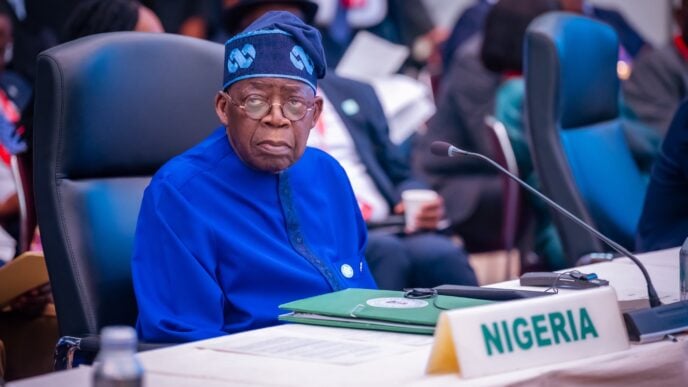
As the Act says, the US bombing strike being put together by American military planners is couched as a humanitarian action to allow for religious freedom now allegedly being denied adherents of the Christian faith by Islamist jihadists in Nigeria. But as has done in Ukraine and the Middle East we can expect a transactional president Trump to use the threat of American military intervention to extract from the Tinubu government some strategic and economic concessions. President Trump is likely to throw in the possibility of ‘’regime change’’ to force the Tinubu administration to the negotiating table wherein the Americans would up the ante and seek economic concessions on mineral extraction rights among others. The Americans would also likely seek to establish a military base in Nigeria in effect, to counter the growing presence of its strategic rival, China in the country. The Americans envisage that in the coming years, Africa is poised to be the new frontier of strategic competition with the Chinese, and being the most populous country and the largest economy on the continent, Nigeria will be a key factor in this geo-political game.
Advertisement
Can President Trump successfully carry out his military threat?
There is no question that the Americans have the capacity to carry out their military threats on Nigeria. But they would have to consider the daunting tactical challenges that will come with the intervention.
First of all, such an action will go against International Law. An approval in the American Congress does not amount to approval by the International community which must be secured through global consensus as a sine qua non for such an action contemplated by the Americans.
Secondly, President Trump has not shown proof to the American public that what is happening in Nigeria constitutes a direct threat to American interests or to any of its allies. Although the American Congress may have approved the intervention, that does not mean that the American people will agree with the course of action being contemplated on Nigeria. If President Trump goes ahead and initiate military action on Nigeria, before long there will likely be negative reactions in America.
Advertisement
Thirdly and very important too, as there is no evidence whatsoever that the American government had secured or will be acting with the willing collaboration of the Nigerian government on the intended military intervention, it will rightly be construed as an illegal and unjust declaration of war against a sovereign nation. We may have a government that has demonstrated unbelievable incompetence in living up to its constitutional responsibilities, but the if the Americans cannot show proof of exhaustively engaging the Nigerian government constructively in resolving this issue before embarking on what will for all practical purposes be a brazen unilateral action, then the matter will likely escalate across the globe.
Without squaring the circle on these factors, the Americans would be figuratively walking through a blind alley even with their massive military capabilities and advantages in Nigeria. This would negatively affect the tactical operations of the military intervention and the strategic calculations thereby limiting whatever successes they hope to achieve.
Questions like how would the drone strikes pin point and differentiate where the terrorists are camped and their supply chains as against dwellings of innocent folks? Can the American strikes avoid collateral damage on the Christian population which the action is supposed to protect? Can the Americans cope with the possible widespread panic and pandemonium that will follow the strikes? Have the Americans for that matter factored in that the strikes may likely trigger violence all over the country and even beyond in West Africa and Africa? Has President Trump and his Gung-Ho team of belligerents thought about the possibility of a massive pushback in America and the world which will consider his action as a dangerous violation of the International order? Suppose China considers this as cue to intervene militarily in Taiwan too as it has long threatened to do?
The Americans may dismiss these relevant questions, but let us not forget that both the first and second world wars occurred when Germany decided to tip the balance of European geo-politics by invading Belgium and Poland respectively. The Iraqi war too was triggered by the illegal invasion of Kuwait by Iraq which ironically was led by the Americans. Both the Germans and Iraqis at the time never thought such precipitate actions would eventually bring total ruin and disaster to their countries.
Advertisement
Before they reap the unintended consequences of their contemplated military interventions in Nigeria, President Trump would do well to change tactics. In this wise I recommend that they lean heavily on the Tinubu government and diplomatically compel them to agree to a collaborative effort in tackling the current existential security issues facing the country. If the price Nigerian people have to pay is some economic concessions to the Americans in the bargain, so be it. But the long suffering Nigerian people must be spared a tragedy of monumental proportions on top of the trauma of insecurity they are now facing, which is hardly of their own making but of the total abdication of responsibility by their leaders.
Gadu can be reached via [email protected] and 08035355706 (Texts only)
Advertisement
Corrigendum: In the first part of this article, I inadvertently mixed up the functions of B-52 and B-2 Bombers. The two platforms are different in many ways. The B-52 is a stratospheric bomber used for carpet bombing missions. It is manufactured by Boeing. The B-2 bomber however was built by Northrop-Grumman to replace the F-117 in the inventory and has additional cutting-edge stealth capabilities to make it undetectable by enemy radar and air defences. It was the B-2, I was referring to in the article not the B-52.
Advertisement
Views expressed by contributors are strictly personal and not of TheCable.