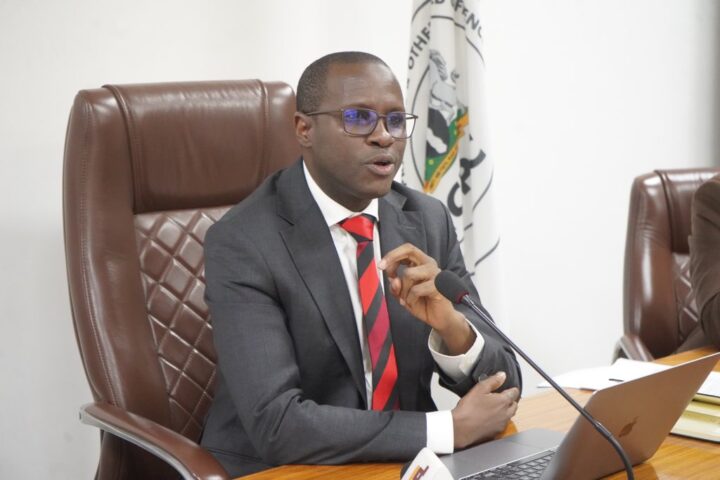
Musa Aliyu, ICPC chair
Musa Aliyu, chairman of the Independent Corrupt Practices and Other Related Offences Commission (ICPC), says stronger procurement oversight is needed to address abandoned and substandard projects across the country.
Aliyu spoke on Tuesday during a workshop organised for directors and heads of procurement of ministries, departments and agencies (MDAs), following a series of infractions identified during ICPC’s project-tracking exercises across government establishments.
Represented by Clifford Oparaodu, the commission’s secretary, Aliyu said the workshop, which coincided with the 2025 United Nations International Anti-Corruption Day, was timely, noting that public procurement remains the “single largest area of government expenditure” and the most vulnerable to corruption.
He said procurement accounts for 10 to 25 percent of Nigeria’s gross domestic product (GDP), making it a critical battleground in the fight against graft.
Advertisement
“Public procurement represents the critical juncture where policy meets practice and where budgets transform into tangible projects — or disappear into private pockets,” the ICPC chairman said.
Aliyu listed persistent corruption schemes uncovered by the commission, describing them as major drivers of abandoned projects nationwide.
He said the infractions include contract splitting, over-invoicing inflated by up to 300 percent, phantom contracts, substandard execution, collusion between contractors and aides of project sponsors, and round-tripping of projects funded multiple times under different names.
Advertisement
The ICPC chairman noted that poor supervision and manipulation of procurement processes often lead to incomplete or non-functional projects despite full budgetary allocation.
He said the commission created the constituency and executive projects tracking initiative (CEPTI) in 2019 to tackle widespread project abuse and abandonment.
He noted that the initiative revealed systemic failures affecting procurement across all levels of government.
“Beyond individual corruption cases, CEPTI revealed structural problems: projects sited on private properties of sponsors or cronies, violating the Public Procurement Act 2007; personal companies executing government projects; round-tripping of identical projects; project vehicles and equipment converted to personal use; lack of needs assessment resulting in white elephant projects; duplication between constituency projects and MDA mandate budgets; poor transition between legislative terms causing project abandonment; and collusion networks involving sponsors’ aides and contractors,” he said.
Advertisement
“Currently, the commission, in conjunction with the federal ministry of works, is tracking road projects across the 36 states of the federation, including the FCT, with a contract sum of N36 trillion.”
Aliyu said that while the Public Procurement Act 2007 provides Nigeria with a solid framework for fairness and competition, compliance remains poor, especially at sub-national levels.
He praised recent reforms introduced by the Bureau of Public Procurement (BPP) and reaffirmed ICPC’s readiness to support them.
Aliyu said implementing e-procurement could drastically curb fraud but warned that “technology alone is insufficient” without political will, proper funding, capacity building and effective change management.
Advertisement
The ICPC chairman urged lawmakers to strengthen oversight, review the procurement law, support the creation of a special crimes court, and ensure adequate funding for anti-corruption agencies.
“We cannot fight billion-naira corruption with million-naira budgets,” he said.
Advertisement
“Corruption thrives in darkness; let us flood the system with light,” he said, urging stakeholders to commit to reforms that will stop project abandonment and protect public resources.”
In his remarks, Adebowale Adedokun, director-general of the Bureau of Public Procurement (BPP), said strengthening procurement oversight remains central to Nigeria’s anti-corruption efforts.
Advertisement
“If we are truly going to prevent or fight corruption, strengthening procurement activities and working closely with anti-corruption agencies is the only way forward,” he said.
Adedokun explained that the federal government had recently approved a new procurement policy that provides a legal basis to prosecute contractors who execute substandard projects.
Advertisement
“This policy has placed Nigeria on the global stage. For the first time in our history, we can legally hold contractors accountable for shoddy work. That deserves applause,” he said.
The BPP DG said procurement audits must become routine if losses, wastages and abandoned projects are to be curbed.
“The delays, the insecurity, the collapsed infrastructure – all these things happen because Nigerians do not have equal opportunities to do business fairly,” he said.
“Corruption will fight back, but we can win the battle through systems, processes, and adherence to good governance, which will help us to do well.”
Samson Duna, director-general of the Nigerian Building and Road Research Institute (NBRRI), said ICPC’s involvement had reshaped how MDAs conduct procurement and project monitoring.