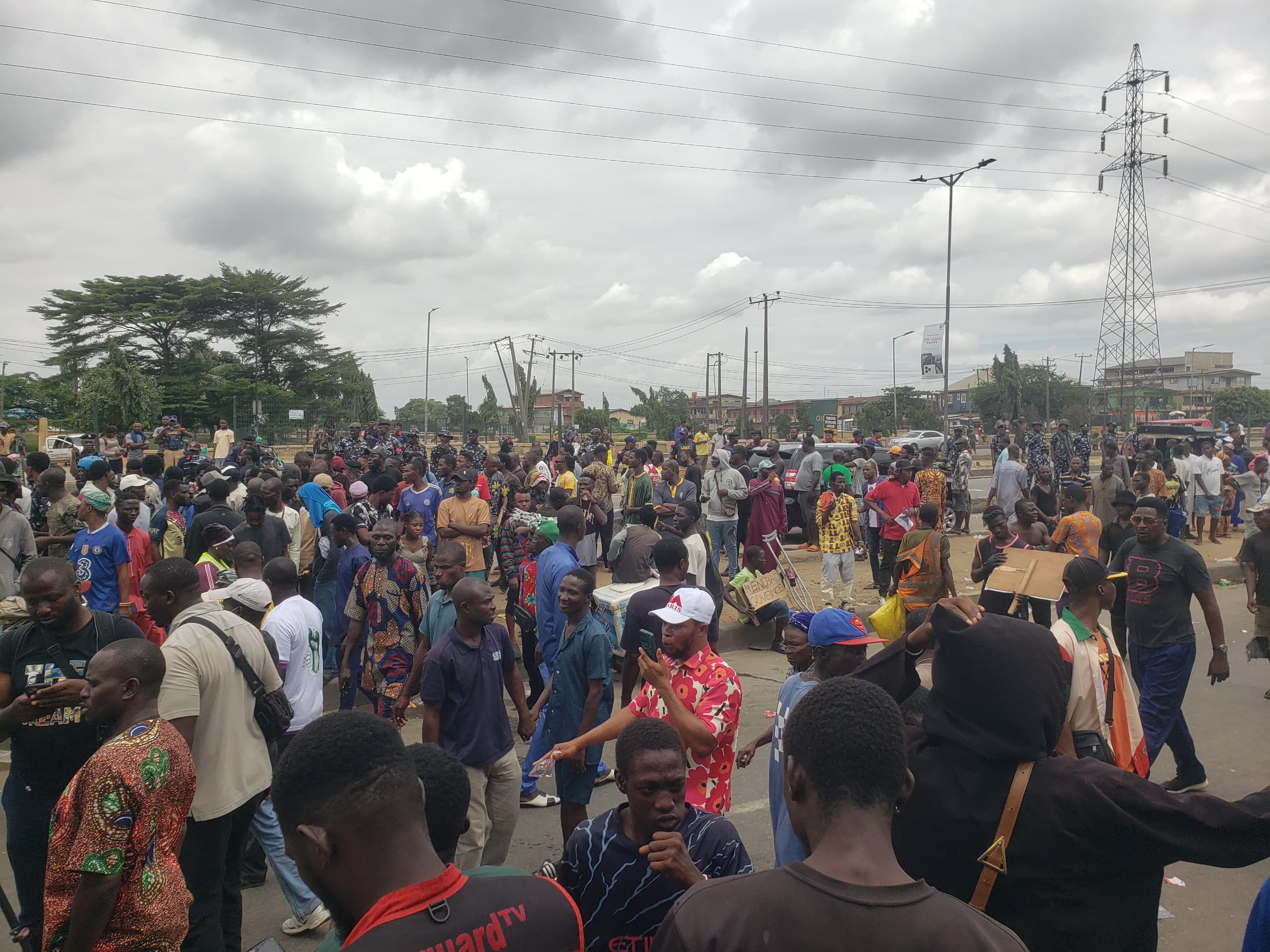
Protest against economic hardship in Ojota, Lagos
BY LEKAN OLAYIWOLA
Each time organised labour announces a nationwide protest, public attention narrows to the familiar questions: will the streets shut down, will the government respond, and will daily life be disrupted? These are understandable concerns, but they are also the least important ones. What matters far more is what these recurring moments reveal about how the Nigerian state hears, processes, and acts upon information about social distress.
In many governance systems, from public health surveillance to conflict prevention, early warning signals are treated as opportunities for pre-emptive correction rather than moments of confrontation. Labour protests in Nigeria, however, are still largely interpreted as bargaining episodes over wages or subsidies. Yet in practice, they function as one of the country’s most consistent early warning systems. The deeper problem is not that these warnings are sounded too often, but that they are rarely absorbed into durable policy learning.
Protest As Symptom, Not Storyline
Advertisement
In Nigeria, protests are often treated as discrete events: they begin, escalate, and then either fizzles out or is temporarily resolved. This event-centred framing makes protests appear episodic and disruptive, rather than diagnostic. Yet when the same social actors repeatedly mobilise around the same grievances across administrations, this persistence should invite a different interpretation.
Recurrence is not evidence of obstinacy; it is evidence of unresolved structural strain. In many social democracies, repeated labour mobilisation is understood as an indicator of dialogue breakdown rather than defiance. In this sense, organised labour in Nigeria operates less like a pressure group and more like a sensor registering changes in the lived conditions of workers, households, and communities long before such changes are fully captured in official data.
The Missing Language of Policy Absorption
Advertisement
Nigeria does not suffer from a deficit of civic mobilisation or information about hardship, insecurity, and declining purchasing power. Reports, statistics, union briefings, and media investigations are abundant. What is missing are reliable mechanisms for policy absorption—the institutional capacity to translate social pressure and lived knowledge into sustained reform pathways.
In international development practice, this absorption phase is central; in Nigeria, it is where reform routinely stalls. When labour mobilises, information enters the system: meetings occur, statements are issued, and committees are formed. Yet the machinery to carry these signals forward over time is weak or absent. The result is cyclical protest and institutional reset, as if each crisis were new.
Organised Labour beyond Interest Politics
Public discourse often frames organised labour merely as an interest group, negotiating bloc, or disruptive force. While unions pursue member interests, this view underestimates their broader civic function in fragile states. Where statistical capacity is uneven, administrative reach limited, and elections episodic, labour aggregates dispersed hardships into coherent public signals, translating diffuse grievances into legible claims and creating feedback loops where formal mechanisms falter.
Advertisement
Similar roles are seen in Latin America and Southern Europe during economic adjustments. This does not make labour infallible, but recognises that unions often detect societal pain earlier than official data and at a scale individual voices cannot achieve. Ignoring this function delays rather than silences the signal.
Why Protests Do Not Accumulate
A striking feature of labour mobilisation in Nigeria is its lack of lasting institutional memory. Each protest seems to start from scratch, negotiating similar commitments under new labels. This is not because agreements fail, but because they are rarely embedded in enduring structures. Key reasons include the absence of protest memory; agreements are often personalised, undocumented, or disconnected from formal policy cycles, leaving both the public and institutions unable to track progress.
Weak binding timelines further hinder continuity, as commitments lack sequencing, budgetary anchoring, or deadlines, making delay appear as denial. Executive personalisation compounds the problem, tying negotiations to individuals rather than offices, making agreements vulnerable to personnel changes. In contrast, many countries embed labour agreements within standing social dialogue frameworks to preserve continuity. These patterns reflect broader governance habits; labour protests simply expose them, showing that continuity depends on institutional design, not goodwill, for reform and accountability.
Advertisement
From Demands to Design
A policy-serious response to organised labour focuses not on whether demands are reasonable, but on how protest-generated knowledge moves through the state. Nationwide labour actions should trigger structured policy review, not as concessions, but as formal diagnostic assessments. In several advanced economies, major disputes automatically initiate tripartite reviews with government, unions, and employers, producing published findings linked to existing policies and defined timelines. Equally crucial is agreement architecture: commitments lacking institutional ownership, budgetary reference, or monitoring rarely endure.
Advertisement
Embedding these elements protects the government from repeated crises rather than constraining it. Independent compliance assessment is essential; post-agreement monitoring, common in fiscal or peace reforms, shifts accountability from whether the government is listening to whether agreed actions are implemented. This approach transforms episodic protests into sustained institutional learning, strengthens trust among stakeholders, and ensures labour mobilisation becomes a structured input into durable governance rather than a recurring crisis.
Rethinking Success and Failure of Labour Protests
Advertisement
Labour protests are often judged by visible disruption or immediate concessions. This is a narrow metric. A protest that shuts down cities but leaves institutions unchanged may be symbolically powerful yet structurally inconsequential. Conversely, a protest that triggers durable policy learning may appear modest in the moment but prove transformative over time. Failure, in this deeper sense, occurs not when protests end quietly, but when the state remains unable to learn from them. Learning is the true test of institutional maturity.
A state that hears workers only when roads are blocked is responding to interruption, not engaging in dialogue. Early warning systems exist to prevent crises; when ignored, disruption becomes the only language. Recognising organised labour as an early warning system is governance, not deference.
Advertisement
It affirms that social signals matter beyond the moment they are expressed and that institutional dignity lies in the capacity to listen, learn, and act before pressure hardens into rupture. The key question is not whether labour will protest, but whether Nigeria will treat these moments as interruptions or finally as valuable information for structured, preventive policy responses.
Lekan Olayiwola is a peace & conflict researcher and policy analyst. He can be reached at [email protected]
Views expressed by contributors are strictly personal and not of TheCable.