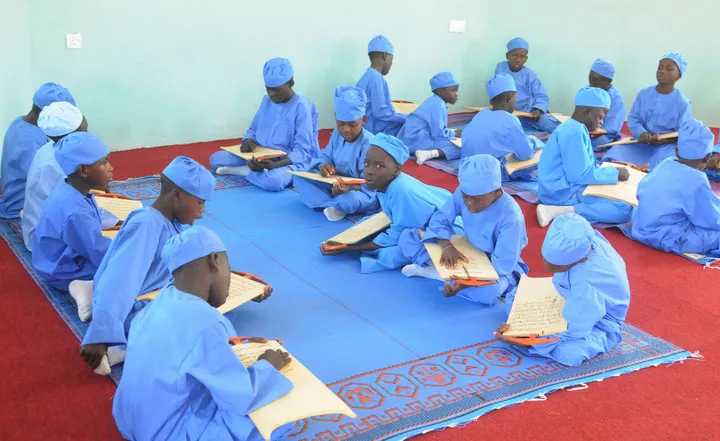
Almajiri students | File photo
The Jigawa government says it has earmarked N3.5 billion for the development of Tsangaya education in the state.
Tsangaya education in Nigeria is a Islamic learning system focused on memorising the Qur’an and learning Islamic principles.
Although the system was self-sufficient through community support and chores in pre-colonial Nigeria, it has faced modern challenges with resources and integration.
In 2024, the federal government commenced processes to integrate Almajiri schools into Nigeria’s formal basic education system while incorporating foundational literacy and numeracy lessons into their curriculum.
Advertisement
States also constituted implementation committees to revitalise Islamic education and reabsorb out-of-school Almajiri children.
Abubakar Maje, the executive secretary at the Jigawa State Tsangaya Education Board, defended its budget for the 2026 fiscal year before the state house of assembly committee on basic education.
Maje said the amount covered both capital and recurrent expenditures of the board in 2026.
Advertisement
He said that part of the money would be used for the completion of three mega tsangaya schools in Kafin Hausa, Ringim, and Dutse local government areas of the state.
The executive secretary said that skill acquisition centres, teacher accommodations mosques, water and electricity, would be provided in each of the three mega schools.
Part of the money, he said, will be used for work continuation at seven tsangaya schools inherited from the federal government.
“One of the major works we have in this budget is the construction of new reading sheds, and classes at 60 tsangaya schools established across the 30 constituencies in the state,” Maje said.
Advertisement
“Also, we will build toilets in all the schools since almajiri have been identified as one of the major contributors to open defecation. So, we planned to provide adequate toilets in our 30 major tsangaya schools across the state.
“This initiative is aimed at providing access to education to over 6,000 children across the state.”
Maje said the N3.5 billion would also covers the financing of the National Board for Arabic and Islamic Education (NBAIS) programme and the Accelerated Basic Education Program (ABEP) introduced by the federal government.
“It will also be used to procure more instructional materials, beds and mattresses aside others,” he said.
Advertisement