BY AYO ALADE
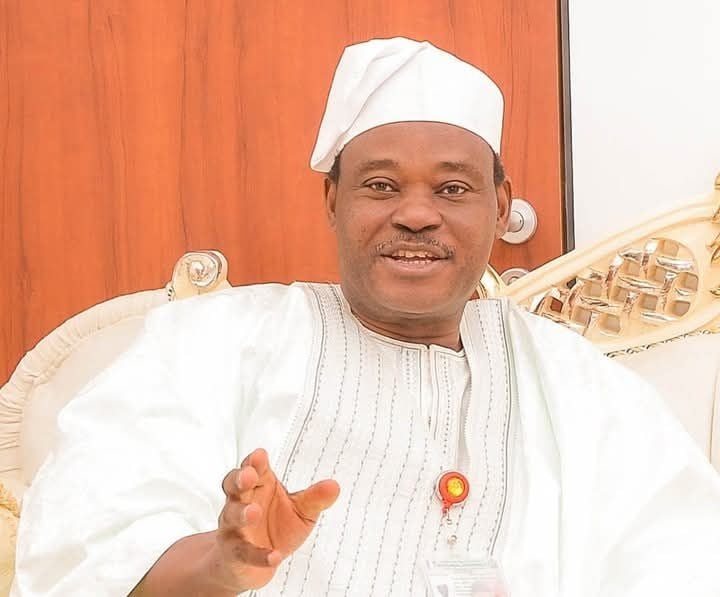
In a country crippled by moral fatigue and a crisis of public trust, nothing wounds the national conscience more deeply than the elevation of individuals whose records should be under investigation, not celebration. The reported nomination of Senator Jimoh Ibrahim — businessman, politician, and the protagonist of some of Nigeria’s most contentious privatization sagas — as an ambassador, is one of those national injuries that cannot be ignored.
Nigeria stands today at a crossroads:
Will it be a country that rewards accountability, or one that canonizes impunity?
Will it be a nation that learns from its past, or one that insists on repeating its own tragedies?
The choice of Jimoh Ibrahim tells us that those entrusted with shaping the image of Nigeria are leaning dangerously toward the latter.
Jimoh Ibrahim is a catalogue of controversies disguised as credentials.
His business odyssey is long, loud and littered with ruins. The man has left behind him, not a trail of corporate excellence, but a graveyard of once-thriving institutions:
NICON Insurance — collapsed.
Advertisement
Nigeria-Re — collapsed.
NICON Luxury Hotel — collapsed.
Air Nigeria/NICON Airways — collapsed.
Advertisement
Global Fleet Group — collapsed. So also are National Mirror and Daily Newswatch, created out of the once respected and influential Newswatch magazine, to mention a few. These are not abstract failures. Most of them were institutions created with public resources, entrusted with national assets, and expected to serve public interest across generations. Under Ibrahim’s stewardship, they suffered spectacular decline, asset stripping, mass layoffs, pension crises, and legal battles that continue to this day.
The NICON tragedy for instance is a loss too loud to ignore.
No acquisition in Nigeria’s privatization history is as tainted or as controversial as that of NICON Insurance.
NICON was not a struggling company. It was a national institution with properties in every state of the federation, and offshore accounts that reportedly held tens of millions of dollars.
Advertisement
Retired insiders maintain that NICON’s London account alone held more money than the total sum Ibrahim paid for its acquisition — an astonishing indictment of a process shrouded in opacity and still begging for investigation.
Yet rather than probing this blatant economic anomaly, the Nigerian state seems poised to reward its beneficiary with diplomatic immunity and prestige.
What do we say of the human toll and the broken lives behind the shuttered doors?
Behind every corporate collapse orchestrated under Ibrahim’s tenure are the wrecked lives of real Nigerians.
More than 300 former employees of NICON Airways are still owed over ₦850 million in entitlements since the airline was shut down nearly two decades ago. Some have died. Others have aged into poverty.
Advertisement
One survivor, now driving a taxi in Abuja, said bitterly: “We lost everything. Even our dignity. To now see that the man responsible is being proposed as ambassador — it is as if Nigeria hates its own people.”
A former NICON Insurance regional manager also expressed anguish: “We were proud professionals once. Today, our buildings are dead, our careers are dead, and our pensions are forgotten. How can this same man speak for Nigeria?”
Advertisement
These voices are not isolated. They are part of a nationwide lament — a chorus of Nigerians who feel betrayed by a nation that repeatedly lifts up the very hands that brought it low.
Except perhaps President Bola Tinubu, every Nigerian is aware that Jimoh Ibrahim’s reputation is built on high-handedness, not excellence.
Advertisement
His public persona is one defined not by innovation or sustained corporate success, but by:
- Alleged asset plundering
- High-handed rule marked by intimidation
- Illicit accumulation of wealth under questionable transactions
- Hostile treatment of employees and executives
- Corporate mismanagement on a monumental scale
- Repeated boasts of political protection.
Within business circles, it is no secret that Ibrahim often bragged about his political leverage — most recently about his closeness to President Tinubu and his alleged contributions to the 2023 campaign.
Advertisement
If political repayment is now the guiding principle for ambassadorial nominations, then Nigeria’s foreign policy has been cheapened into a market square, where national honour is traded for campaign IOUs!
The question is, what manner of image will Jimoh Ibrahim carry abroad?
An ambassador is not just an appointee. He is the face, the voice, the handshake, the moral silhouette of a nation.
What message would Nigeria be sending to the world by presenting Jimoh Ibrahim as its representative?
That Nigeria does not value integrity in its senior envoys?
That corruption is negotiable, if not outrightly rewarded?
That public assets can be cannibalized without consequence?
That political loyalty outweighs public accountability?
That Nigeria no longer knows — or cares — what dignity means?
If a man whose business legacy is littered with crises becomes the face of Africa’s largest democracy overseas, what credibility do we have left to speak of reform, transparency, or renewal?
This nomination, if confirmed, would be one of the most flagrant moral misjudgment of this administration.
President Tinubu owes Nigerians more than political transactions. He owes the nation a sense of direction — not a slide into the old swamp where failure is rewarded, controversy is ignored, and the nation’s international image is thrown to the wolves.
The President must rethink this.
The Senate must resist this.
And Nigerians must refuse to be numbed into silence!
At this juncture, Nigeria must choose who It wants to be.
There are moments in a nation’s history when silence becomes betrayal.
This is one of those moments.
Nigeria cannot afford to export shame in the uniform of diplomacy.
It cannot continue to canonize the architects of public ruin.
It cannot keep insulting its own people with appointments that mock justice and reward wrongdoing.
If this nomination goes through, it will stand as one of the clearest confirmations that in today’s Nigeria:
Integrity is optional
Failure is a credential
Disaster is a pathway to promotion
But Nigeria is better than this.
Nigerians deserve better than this.
And the world deserves a more honourable representation of us.
President Tinubu must withdraw this nomination — not out of political fear, but out of national respect.
Nigeria is watching.
History is watching.
And the world is watching.
Alade, an international relations expert, writes from London.
Views expressed by contributors are strictly personal and not of TheCable.