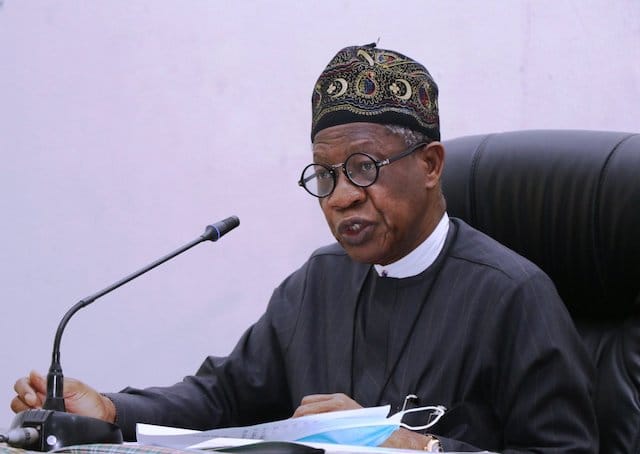
Lai Mohammed
Lai Mohammed, former minister of information and culture, says the suspension of microblogging and social networking platform Twitter, now known as X, was one of the toughest decisions he took while in office.
In June 2021, the federal government announced the “indefinite” suspension of Twitter operations in Nigeria, citing the persistent use of the platform for activities that are capable of undermining Nigeria’s corporate existence”.
However, in his new book “Headlines & Soundbites: Media Moments That Defined An Administration”, launched in Abuja on Wednesday, the former minister offered insights into how the decision to suspend the platform was taken.
In chapter 14 of the 601-page book, Mohammed cited two reasons why shutting down Twitter at the time was a tough decision for him.
Advertisement
The chapter, “Silencing the bird: The story of Nigeria’s Twitter suspension”, gives a detailed account of how the government reached an agreement with the owners of the social networking platform to resume operations after the blackout.
“The decision to suspend Twitter (now X) was one of the toughest decisions I made as a minister, for two reasons,” he wrote.
“First, the impact it would have on Nigerians who used the platform to advertise their goods and services or as influencers.
Advertisement
“Second, the optics it would project regarding government’s commitment to freedom of expression and the opening up of the democratic space.
He, however, argued that “none of the reasons outweighed the threat to national security posed by a freewheeling and irresponsible use of social media platforms, especially Twitter”.
He noted that “in governance, public interest must always take precedence over individual interest”.
Speaking on the reactions of Nigerians to the decision, Mohammed said “the condemnations were fast and furious.”
Advertisement
“I was under no illusion that the decision would be popular. In fact, the condemnations were fast and furious. Many Twitter users besieged the official twitter handle of the Federal Ministry of Information and Culture (@FMINONigeria) to vent their displeasure, expressing their anger in every possible way,” he said.
‘TWITTER NOT SUSPENDED BECAUSE BUHARI’S HANDLE WAS DELETED’
Debunking the claim that the federal government suspended Twitter operations after deleting the late President Buhari’s handle two days earlier, Mohammed said, “The coincidence of timing created the optics problem that shaped both domestic and international reactions.”
The former minister said he had “publicly criticised Twitter’s deletion of the President’s tweet”, arguing it amounted to double standards.
Advertisement
“While Twitter claimed it removed the President’s tweet under its ‘abusive behaviour’ policy, the platform had consistently left up far worse posts, despite formal protestations,” he added.
He cited a tweet by Nnamdi Kanu, leader of the proscribed Indigenous People of Biafra (IPOB), that was left undeleted by Twitter as “particularly inciting and violent”.
Advertisement
“The same Twitter that said this tweet by Nnamdi Kanu did not violate its rules was quick to delete the President’s Contrary to popular belief, Twitter’s suspension did not come out of the blue,” he added.
“The government had consistently warned social media companies operating in Nigeria not to lend their platforms to be used by purveyors of fake news, disinformation and hate speech.
Advertisement
“Our concerns deepened during the #EndSARS protest of October 2020, when Twitter became the platform of choice for those spreading fake news and disinformation.
“Unverified images and videos were amplified, inflaming passions and transforming a peaceful protest into widespread violence.
Advertisement
“For the record, when I approached President Buhari to inform him of my intention to suspend Twitter, he asked me two direct questions:
“Are you suspending Twitter because it deleted my past? I answered in the negative.
“Do you have the capacity to block the platform? 1 answered in the affirmative.”
“The President then gave me his approval.”
On January 12, 2022, the federal government lifted the 222-day suspension on Twitter, with access restored the next day.