


BY SULEIMAN A SULEIMAN
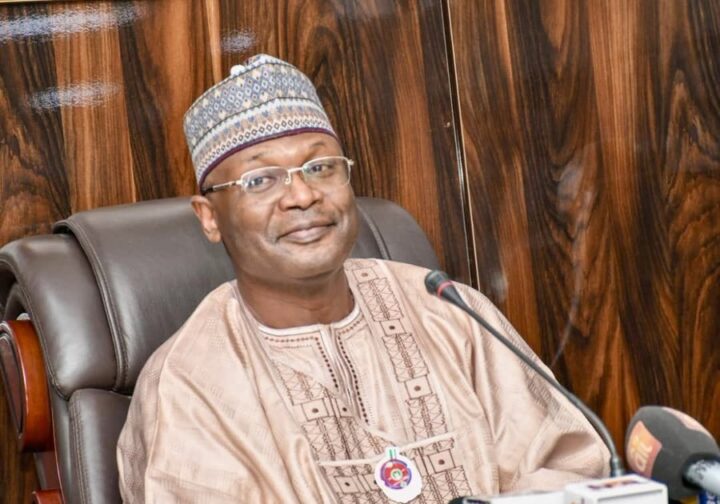
Of the 35 or so Nigerians nominated by President Bola Ahmed Tinubu over the past week to represent Nigeria at various foreign missions and embassies across the world, none stands out as much as Professor Mahmood Yakubu, the immediate past Chairman of the Independent National Electoral Commission, INEC. Yakubu stands out not just because he is the most distinguished public servant in the list, having served under four Nigerian presidents in a row, but also precisely because he left his INEC position only last month.
These two facts—that he was Chairman of INEC, and that he left that post only in early October—have become the basis of a mild uproar by some politicians and pundits. Overall, criticisms of his nomination have centred on two main arguments. First, critics argue that as the immediate past head of INEC, Yakubu’s nomination for an ambassadorial post has come too soon and too close to the end of his term at INEC, and therefore violates an unnamed ethical guideline that critics believe would compromise the independence or impartiality of INEC, Nigeria’s foremost electoral management body. Secondly, Yakubu’s nomination has been presented as a form of “reward” for conducting the 2023 presidential election, which Tinubu won. This, critics say, will incentivise subsequent INEC chairs in future elections.
As a journalist and political scientist, I will not read any malicious motivations into these arguments. Rather, I accept them as well-intentioned issues by concerned citizens and legitimate political actors who only want to help deepen our democracy. In the same sense, however, I argue that these concerns are misplaced, even misguided, because they stem from a narrow and superficial understanding of what both true democracy and public service entail.
Advertisement
First of all, let’s clarify the position of the law. One of the points raised by some observers on this issue is that an INEC Chairman or National Commissioner—Mahmood Yakubu or whoever—should spend a “cooling off” period of at least five years before they should hold any elective office. This idea is, in fact, the subject of a long-running debate and legal changes. Section 7 of the Independent National Electoral Commission (INEC Establishment) Act 2004), the law that established INEC in 1998, states among other things that “a person who holds or has held office as a member of the Commission under this Act shall not, until after a period of five years immediately thereafter, be qualified for any elective office”.
During the electoral overhaul of 2010, however, that section was strenuously debated in both chambers of the National Assembly, who, in their own wisdom, repealed it in the Electoral Act 2010. The main argument in favour of repeal was that such a provision goes against the Constitution, which guarantees the rights of all Nigerians to stand for any elected office they are qualified for. Equally important to note, the provision was specific to “elected office”, not all public offices like ambassadorships or other appointive positions. Therefore, that provision is no longer a part of Nigerian laws and is certainly not in the extant Electoral Act 2022.
In other words, this whole argument has already been raised, debated and settled by the representatives of all Nigerians since 2010, a time when no one—least of all Yakubu himself—would ever have known that he would one day serve as the chair of INEC. Moreover, the argument that a cooling-off period of five years or five days post-INEC service violates the fundamental rights of a citizen was valid fifteen years ago in 2010, and remains valid today.
Advertisement
Secondly, we must raise the question: is an ambassadorship even a reward in the Nigerian context? Hardly. In Nigerian political culture, ambassadorships are among the most lowly ranked public offices. For career diplomats, an ambassadorship is the pinnacle of their profession, the zenith which every official who enlists into the foreign service aspires to reach someday. For non-career appointees, however, an ambassadorship is a form of banishment, if not exile, from mainstream politics. Even among the Nigerian public, ambassadorial roles are generally viewed as a consolation prize, a containment, or the first step to quiet retirement or obscurity.
For Mahmood Yakubu, who served two full terms as INEC chairman, his nomination to this role would, in effect, be deemed as a step-down rather than a promotion or reward. This is why we must detach politics from his nomination and view it in one sense and one sense only: as a renewed call to public service. After all, genuine public service to the nation is simply public service to the nation, regardless of post. I am aware that the idea of “public service” is not yet ingrained in the Nigerian political psyche, but for reasons I shall outline presently, it must be.
Third, the idea that the independence and impartiality of INEC will be compromised by Yakubu’s nomination or appointment, or indeed for any future chairs, is not only misplaced and misguided, it is also reckless. The independence and impartiality of INEC does not and should not depend on the post-service career any of its previous chairs or commissioners. INEC’s independence is codified in law. INEC is also easily the most scrutinised public institution in Nigeria, which is rightly so. Therefore, INEC’s impartiality does not depend on the saintliness—or lack of it—of any one man. Rather, it depends on the structural safeguards around its operations: the enabling laws and the active monitoring and scrutiny of all actors.
Moreover, since the electoral reform of 2010, INEC has had a robust system in place that is only growing stronger, as far as the facts on the ground are concerned. It is up to all actors, particularly the political parties, civil society, media and Nigerians to uphold and strengthen that system further, not the post-service career of one man. Democracy, after all, is a system of checks and balances whereby all competing actors monitor one another constantly at every step. Democracy is a system of strong institutions, not strong men.
Advertisement
Most importantly, what the critics are saying about Professor Yakubu’s nomination reflects a deep misunderstanding of democracy as it is and of public service as it should be. We Nigerians tend to have puritanical and unrealistic assumptions about democracy, and consequently, we impose high-handed expectations on individuals and institutions that even the most advanced democracies in the world do not have. In most developed and developing democracies, Yakubu’s nomination would be entirely normal practice.
In Europe and the United States, it is common practice for officials to move from leadership or membership of central or local election management commissions to other elective or appointive roles in government, with or without much time-lag in between. In France since the 1990s, almost all heads of the Constitutional Council, which overseas French presidential and parliamentary elections, were, and still are, card-carrying members of one or other political parties in the country. In the UK, each political party with a certain threshold of Members of Parliament nominate one person to the UK Electoral Commission
In the US, particularly, the “Secretary of State” (not the foreign minister) is the official in charge of all state-wide elections in 47 states, including elections for president, governor, congress and senate. All of them are card-carrying members of either the Democratic or Republican party. The Republican Brian Kemp of Georgia, and the Democrat Katie Hobbs of Arizona, for example, both ran for and won the governorships of their states while still in office as Secretary of State, meaning, directly in charge of their own elections. As a Nigerian equivalent, that is like the Chairman of a State Independent Electoral Commission (SEIC) standing for the chairmanship of a local government at the same time.
In India, the country with the largest and most complex electoral system in the world, T. N. Seshan retired as Chief Election Commissioner—their INEC Chairman—in December 1996. By July 1997, he contested for president himself. The example of the Eastern European country of Georgia is even more dramatic. Zurab Kharatishvili was appointed Chief Electoral Commissioner in 2010 for a five-year term. Midway in 2013, he resigned, created a new political party and contested the presidential election himself directly. He lost.
Advertisement
There are even closer examples nearer home. Dr Christiana Thorpe, who ended her two terms as Sierra Leone’s chief electoral commissioner in 2015, was appointed Deputy Minister of Education, Science and Technology just about a year later in 2016. And in Guinea-Bissau, José Pedro Sambú became head of that country’s National Electoral Commission in 2016, and immediately after his one term of five years, became president of the supreme court in 2021, that is, much like Nigeria’s Chief Justice of the Federation.
These examples illustrate a few things. First, they reinforce my earlier point that elections are institutional practices and their impartiality do not depend on the career choices of one electoral officer. Rather than impose impossible expectations that infringe on the fundamental rights of Nigerians to serve their country, we should be working towards how our elections can work, regardless of any individual. Second, they show that our unrealistic expectations are merely a consequence of our status as a new democracy. Because we have only had about 25 years of uninterrupted democratic development, many practices that are otherwise normal democratic practices appear unusual, strange or even unacceptable to us. But we cannot allow present fears to stand in the way of current and future possibilities.
Advertisement
Finally, and most importantly, the issues some have raised about this nomination merely reflect our rather shallow understanding of public service. Professor Mahmood Yakubu has had a sterling career as a public servant, working under four Nigerian presidents with very different personal attributes—Yar’adua, Jonathan, Buhari, and Tinubu—and belonging to different political parties. That means each of these presidents saw something in his abilities which he has deployed in the service of this country, without any reservations. As head of the Tertiary Education Fund (TETFUND) from 2007 to 2012, he worked with both Presidents Yar’adua and Jonathan to reposition Nigeria’s tertiary education system by putting in place structures and services that remain the backbone of that sector to date. As Chairman of INEC for an unprecedented two terms, he oversaw innovations that in the 2023 general elections helped opposition parties win their highest tally of elective offices in Nigerian electoral history.
His time at INEC has now closed, and a new chapter in his public service career for God and country has opened. Let it be.
Advertisement
Views expressed by contributors are strictly personal and not of TheCable.