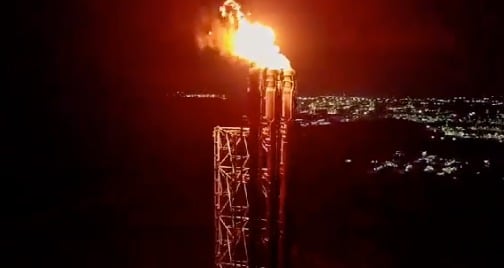
The Nigerian Upstream Petroleum Regulatory Commission (NUPRC) has rolled out the permit to access flare gas (PAFG) under the 2022 Nigerian gas flare commercialisation programme (NGFCP).
In his remarks on Friday at the launch ceremony, Gbenga Komolafe, NUPRC’s chief executive officer (CEO), said the issuance marks a critical milestone for Nigeria’s upstream petroleum sector.
“The issuance of the Permit to Access Flare Gas (PAFG) under the 2022 NGFCP is not simply a ceremonial exercise; it is a strategic inflection point,” he said.
“It signifies the transition from legacy challenges to market-driven solutions that unlock economic opportunities, strengthen energy security, reduce emissions, and improve operational efficiency across the industry.”
Advertisement
Komolafe said the milestone not only signals an ever-maturing energy sector but also a promise kept, “from when we relaunched the Nigerian Gas Flare Commercialisation Programme in 2022”.
The CEO said when the NGFCP was relaunched in September 2022, the goal was to turn flare gas from an environmental problem into an economic opportunity.
By giving flare sites to capable developers, he said the NUPRC created a unique, commercially viable model that converts waste into value, transforming challenges into investment prospects.
Advertisement
“This programme is fully aligned with Nigeria’s Energy Transition Plan (ETP), which outlines our national pathway towards a cleaner, more resilient energy system,” Komolafe said.
“The NGFCP is therefore not merely a policy initiative; it is a pillar in our quest to eliminate routine flaring, reduce emissions, and enhance Nigeria’s global credibility in energy transition commitments.”
Speaking on achievements of the NGFCP programme, the CEO said “from 300 initial expressions of interest, 139 applicants qualified for the RFP stage”.
“Following a competitive and transparent evaluation process, 42 successful bidders were awarded 49 flare sites, an achievement widely recognised for its integrity and rigour,” he said.
Advertisement
“Today, we are pleased to announce that 28 awardees have fully executed the required suite of commercial agreements, which include the Connection Agreements, Milestone Development Agreements, and Gas Sales Agreements; and now qualify to receive the Permit to Access Flare Gas.”
Komolafe said the entities represent a strong blend of operational capability, financial readiness, and technological competence.
‘ISSUANCE OF PERMIT SIGNALS START OF IMPLEMENTATION PHASE’
Komolafe said while the issuance of the permit is significant, it only signals the commencement of the implementation phase.
Advertisement
“The competitive bid process may now be complete, but the real work just started. Engineering, construction, financing, commissioning, must begin in earnest,” he said.
Highlighting the key achievements and projected impacts of the programme, he said “a total of 49 flare sites have been auctioned,” with 42 bidders awarded sites.
Advertisement
“Between 250 and 300mmscfd of currently flared gas will be captured and commercialised, eliminating approximately six (6) million tonnes of carbon dioxide (CO2) annually,” Komolafe said.
“The programme is expected to attract up to US$2 billion in investment. More than 100,000 direct and indirect jobs will be created.
Advertisement
“About one hundred and seventy thousand (170,000) metric tons of LPG will be produced annually, enabling clean energy access for approximately 1.4 million households.”
He added that nearly 3 gigawatts (GW) of power generation potential will be unlocked.
Advertisement
“An NGFCP Forum and College of Awardees has been established to support project implementation and knowledge exchange,” Komolafe said.
“We have also deepened engagement with international financiers and technology partners.”
Komolafe added that Nigeria’s leadership in practical upstream decarbonisation is increasingly being recognised worldwide.