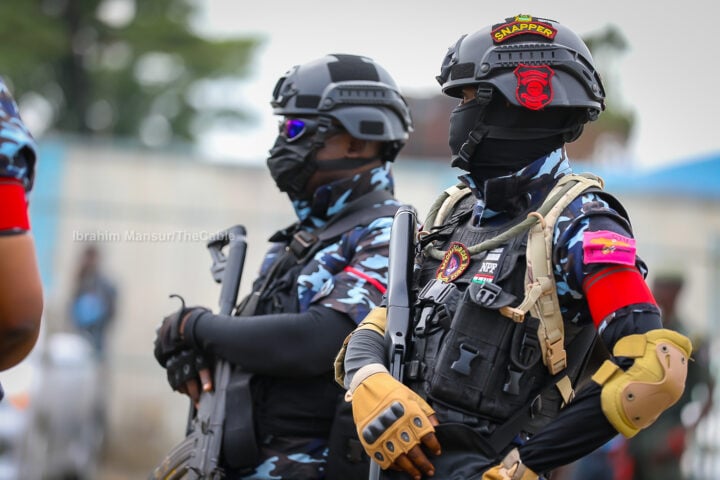
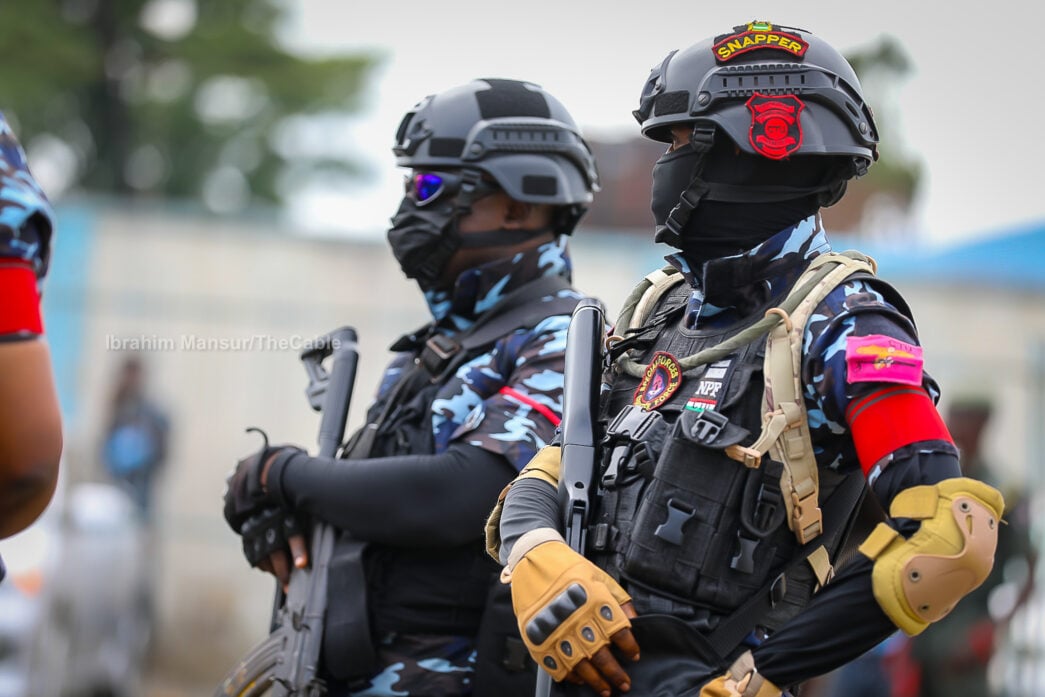
Police officers | File photo
BY OGECHI OKORO
The outrage over the security detail surrounding Seyi Tinubu, son of President Bola Ahmed Tinubu, is worth examining, not with hysteria, but with honesty. At issue is a simple yet important question: how much security is appropriate for members of a president’s family in a constitutional democracy?
Across much of Africa and even in the United States, some level of protection for presidential relatives is not unusual. Political power attracts both privilege and danger, and no reasonable citizen wishes harm upon the family of a sitting president. Yet context and culture matter. Having lived overseas for decades, particularly in the United Kingdom and New Zealand, I can say without hesitation that no such extended family presidential protocol exists in these countries. There, the image of a leader’s son moving with soldiers, sirens, and heavy security would not be defended as normal; it would be regarded as excessive, even embarrassing.
Nigeria did not always conduct itself this way. Past presidents governed without turning their families into public fixtures. During the tenure of the late President Muhammadu Buhari, his children were largely absent from public life. They neither courted attention nor appeared to benefit from the instruments of state power. That restraint mattered. It helped preserve the idea, however imperfectly, that political office is temporary stewardship, not hereditary elevation.
Advertisement
Today, of course, the environment has changed. Social media amplifies visibility, security threats are more complex, and public figures are under constant scrutiny. Tinubu is Tinubu, and Seyi is Seyi. Yet even in acknowledging these realities, restraint remains a virtue. Security should be proportionate, discreet, and clearly tied to demonstrable risk. As Nobel laureate Wole Soyinka has cautioned, we must be careful not to overdo it, lest protection slide into provocation.
The United States, often cited as the big brother of Nigeria’s presidential system, offers a useful comparison. There, Secret Service protection for presidential children becomes discretionary after the age of sixteen, although a president may extend it when circumstances warrant. The guiding principle is balance: protection without ostentation, safety without spectacle. Nigerians are not asking for recklessness; they are asking for modesty. It is difficult to justify a situation in which a president’s son moves with a longer convoy than elected officials who carry constitutional responsibilities and answer directly to the people.
Convoys, in truth, have long been status symbols for the rich and powerful. In Nigeria, they serve not merely as security arrangements but as public announcements of importance. Many politicians fear anonymity and therefore surround themselves with fleets of vehicles, blaring sirens, and armed escorts to remind citizens who is in charge. Stories abound of this privilege extending beyond officeholders to friends, associates, and romantic partners. Such excesses deepen public resentment and widen the psychological distance between leaders and the led.
Advertisement
This is why the current debate resonates so strongly. It is not really about one individual or one family; it is about a political culture that too often equates power with display. When the symbols of authority become louder than the substance of governance, trust erodes. Citizens begin to feel that the state exists to protect a few rather than serve the many.
President Tinubu occasionally signals a willingness to listen and adjust course. The proposed withdrawal of police officers from the high and mighty could be a step in the right direction if it is genuinely and consistently implemented. Scepticism persists because Nigerians have heard similar promises from previous administrations, only to watch them fade under elite pressure. The wealthy and powerful often win these battles because they are bound together by shared interests and mutual protection.
Real reform cannot rest on announcements alone. It requires strong institutions, clear rules, and impartial enforcement. No society is free of crime, but some have succeeded in reducing insecurity to the barest minimum by strengthening institutions rather than expanding privileges. When laws apply equally, whether to the president’s son or the ordinary citizen, public confidence grows, and the burden on security agencies is reduced.
This is where leadership is tested. Mr President, you must walk the talk. Doing things right is not the same as doing the right things. Your political ruggedness and mastery of power brought you to office. Statesmanship now demands something more difficult: restraint, example, and moral clarity. The tone set at the top shapes behaviour across society.
Advertisement
This moment offers a choice. Nigeria can continue down the familiar path of excess, symbolism, and elite insulation, or it can begin deliberately and modestly to normalise power. Choosing modesty over spectacle, institutions over privilege, and leadership over display would send a powerful signal that the presidency is a public trust, not a royal court.
That is the reassurance Nigerians seek, not perfection, but proportion; not vulnerability, but humility. And it is still within reach.
Happy Christmas, my people.
Dr Ogechi Okoro writes from Hamilton, New Zealand. He can be contacted via [email protected]
Advertisement
Views expressed by contributors are strictly personal and not of TheCable.