Screenshot
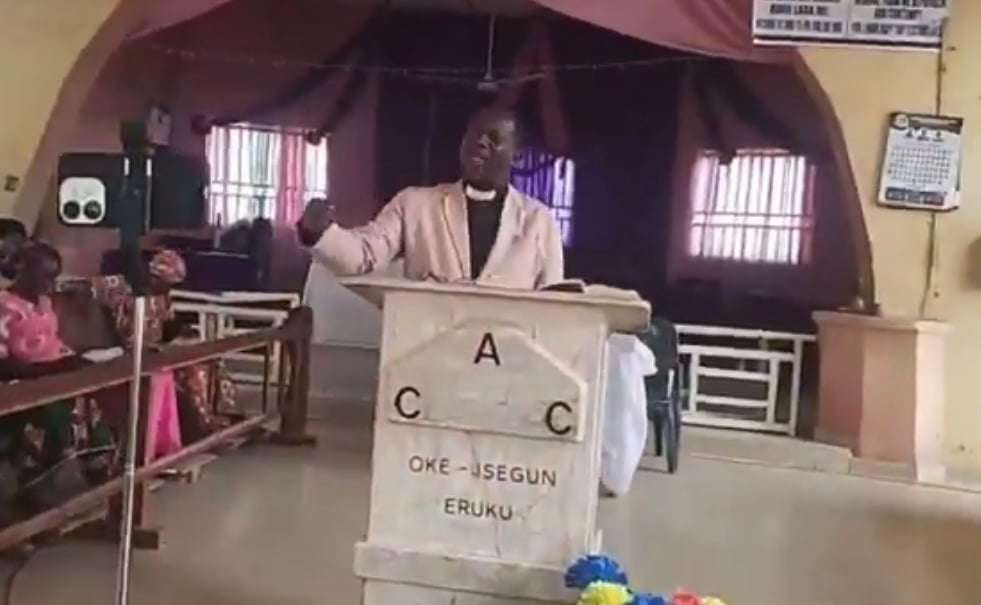
I lived in Kwara State for a little over a year and attended Christ Apostolic Church (CAC), Oke Isegun, Taiwo Road, Ilorin. So you can imagine my feelings when I heard that CAC Oke Isegun was attacked by terrorists, who were brave enough to post a live video while at it. It was not close to home, it was home.
I dissociated myself from the news and avoided all the videos at all costs, but you know how it works with journalists, the news finds you. The CAC Oke Isegun attacked was not the exact one I attended, but as we say in CAC, “one fold, one shepherd”. We are of the same family, and the church is a family of the one I attended.
If you asked any Christian of who has lost members of their family to any bandit or Boko Haram attack, whether a Christian genocide was ongoing in Nigeria, their answer will most likely be a resounding yes. Ask anyone who was abducted during a church service in their place of worship, they definitely will say yes.
But is there really a Christian genocide in Nigeria?
Advertisement
I know my entry into the conversation is largely belated, but it proves my point: As with many cases of national importance, after a few days, rarely weeks, the matter is overtaken by another interesting news cycle. However, with clear eyes and sound minds, let’s review the problems with this genocide tag and response.
Is there a Christian genocide in Nigeria?
When Yusuf Tuggar, the minister of foreign affairs, was asked by British broadcaster Piers Morgan, whether there was a Christian genocide going on in Nigeria, the minister said no. His argument was that when Nigerians are killed by terrorist groups, nobody picks up the body and checks if the victim is Christian or Muslim, which is largely correct.
Piers then pressed harder, citing American writer and comedian Bill Maher, who claimed that 100,000 Christians have been killed in Nigeria since 2009, and that 18,000 churches have been destroyed in the same period.
Advertisement
The minister rejected the claims and was asked how many churches had been attacked and how many worshippers had been killed. He did not have immediate answers, but after getting some help, he said there have been 102 attacks in the last five years.
Tuggar also added that 177 Christians have been killed in the country in the last five years. In other words, the minister did not know how many Christians had been killed or churches destroyed since 2009, when Boko Haram actively began its onslaught in Nigeria.
That is the problem with the Christian genocide in Nigeria.
When the US President said there was a genocide in Nigeria and cited civil society groups, claiming numbers as high as 100,000 deaths since 2009, one would think the first thing the Nigerian government would do is to actually get some data to rebut claims by America. More than a week later, the minister went on air, and did not have a clear data-backed counter-narrative, further enforcing the less-than-ideal beliefs about our country.
Advertisement
Can NBS provide the data for counter narrative?
Much of the data on security in Nigeria is housed by civil society organisations and private entities operating within and outside the country. The National Bureau of Statistics, which should naturally have this sort of data for reasons such as this, does not have this data, or does not have the candour and courage needed to share it.
Remember just last year, the NBS released the Crime Experience and Security Perception Report, which detailed kidnapping and ransom payments in Nigeria. Less than 24 hours after the release, the NBS website was hacked and was offline for about four weeks. When the website came back up in January 2025 that report was gone and as consequential as that report was, it has not been re-uploaded to date.
So, I ask again, will NBS be able to provide any form of data on churches destroyed in Nigeria over the past 15 years or speak to the number of Nigerians and Nigerian Christians killed within the same period?
Here’s a glimpse into how many churches have been attacked
In May 2011, the Council on Foreign Relations (CFR) set up a tool called the Nigerian Security Tracker to monitor state and non-state violence in Nigeria. The tracker relied on news sources to track violence in Nigeria, and acknowledged its methodological limitations, but provided significant information on the state of violence in Nigeria. Due to its transparent data handling, Nigerians could verify every number published there.
Advertisement
I took some time to analyse the data to see attacks on churches from 2011 to 2023, and found that there were about 268 attacks on churches with approximately 2,347 deaths in total. While this is indicative, it is far from what the Nigerian government can report, and also considerably distant from what the US claims. Over the same period, 143 Mosques were attacked and 2,332 people killed, according to the data.
Sadly, in 2023, the NST project came to a close, and the updates stopped, so the last two years are not included in the data above.
Advertisement
Final Take
When I think about CAC Oke Isegun, I no longer think of a genocide or otherwise, I think of a nation that cannot fully account for its blood-stained cassock, shattered pews, and silenced congregations. I think of a country that does not just struggle with insecurity, but also now struggles with memory.
So, if we are to insist that there is no genocide in Nigeria, then we must prove it with evidence and action. Not rhetoric, not nationalism, and definitely not vague assurances. Nigeria cannot continue to outsource its own truth to chance.
Advertisement
Until we can clearly account for who is dying, where they are dying, why they are dying, and who is killing them, we will remain a country constantly defending itself with empty hands.
Advertisement