


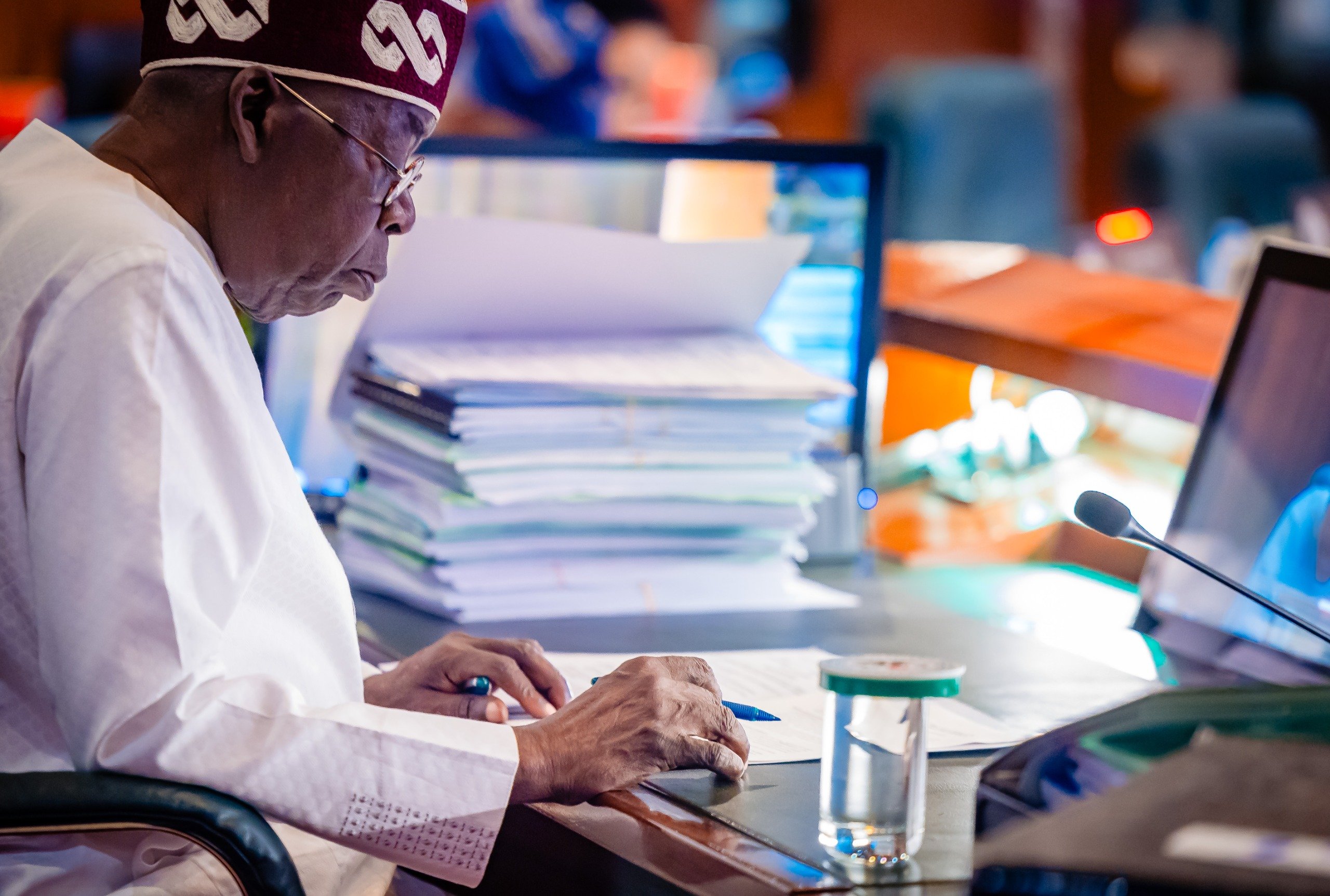
President Bola Tinubu
BY ARIWOOLA SAMUEL AKINWALE
We continue to hover between best practices and shoddy attitudes. Two recent decisions by the Nigerian government demonstrate this. For us, we sacrifice everything and anything for politics.
The recent ambassadorial nominees and the change of heads in the defence unit are quite revealing: we are either not yet ready to address our problems, or we are satisfied with their current status. Better still, we suffer from both.
This week, the presidency published its list of ambassadorial nominees to foreign missions. Expectedly, there have been concerns about the composition of the list.
Advertisement
A look at that list reveals the salient nature of our political economy. Some of these features are worth examining to understand how our national decisions are shaped and the broader implications.
In their award-winning book titled “Why Nations Fail: The Origins of Power, Prosperity, and Poverty,” Daron Acemoglu and James A. Robinson explained that in extractive economies like Nigeria, the ruling class lives off the collective patrimony or national wealth.
Frankly, the presidency should be commended for enabling a wider spread of nominees across the federation.
Advertisement
His appointments of board chiefs some months ago also mirror this effort. I suspect political correctness here, an attempt to address his current reputation for nepotism. Another noticeable feature of the ambassadorial list is an attempt to balance the composition of career (commissioned) and non-career (non-commissioned) ambassadors among the nominees.
But there are deep reservations about the list, particularly concerning the background and characters of the candidates.
For instance, there are those who felt the inclusion of Mahmood Yakubu, former INEC chairman, suggests a compromise of his former role—signalling a compensation for the alleged abuse of office during his stewardship.
The ADC described the list as compensation for IOUs. A political error that borders on both omission and commission—forsaking moral ethics for political gains.
Advertisement
The list showed that clearly—names of career politicians who are incentivised with ambassadorial positions, often to countries where Nigeria needs no more than High Commissioners.
There’s a precedent to this. In 2021, former president Muhammadu Buhari appointed four service chiefs to ambassadorial roles after much persistent clamour for their removal due to what many considered ineffectiveness.
Lt. Gen. Tukur Buratai (retd) was named Ambassador to the Benin Republic. Defence Chief Abayomi Olonisakan was named as head of mission to Cameroon. Others were Ibok-Ette Ibas, Sadique Abubakar, and Mohammed Usman.
Our presidents often reward public servants with ambassadorial positions for loyalty. Under Jonathan, 93 appointed ambassadors in 2012 were former Ministers and PDP stalwarts.
Advertisement
This pattern is also obtainable locally, where the government appoints board chiefs for moribund agencies and public enterprises, the cost implications for governance and the national budget notwithstanding.
This dilly-dallying in our foreign relations even impacts the government’s recent decisions on security. The president has relieved the Service Chiefs and the Defence Minister following the recent nudge from the White House and the spate of killings that trailed the kidnappings in Kebbi, Kwara, and Niger states.
Advertisement
The drama that took place at the senate screening exercise of the new defence head speaks to such a level of descent that the chamber now wallows. The nominee was literally asked to take a “bow and leave” since the president nominated him. Sadly, Senator Akpabio needed to remind members to quiz their guest on the issues of insecurity.
Clearly, we are not anywhere near putting an end to this mess; nothing suggests that. So far, our capacity is nowhere close to victory—that capacity is not in place. Aside from Buhari, who promised to end Boko Haram during his pre-2015 campaigns and failed, none of our leaders could muster such confidence. Nothing suggests such an admission.
Advertisement
Similarly, there is either cluelessness or avoidance of responsibility in addressing these multiple wars (I suspect the latter). For instance, why are we yet to know the General who ordered the withdrawal of troops at the crime site in Kebbi?
On one hand, the government is increasing the number of soldiers and withdrawing security details from VIPs—a misnomer for elite robbery of available resources. On the other hand, it is aiding and abetting insecurity by its decisions for political reasons.
Advertisement
How else can one explain the use of “non-kinetic,” according to Bayo Onanuga, in getting the kidnapped victims released? No doubt ransom was paid. More cash is made available in “funding” terrorism by the government, indirectly. It’s a case of funding security and insecurity simultaneously.
Ironically, we are funding both the defence and the terrorists together—a house divided against itself. We are jokers!
If we had thought we were winning the war, as many of the president’s image-makers often insinuated, the more recent events proved otherwise.
Like others, I have experienced a déjà vu with these recent pronouncements by the government: we’ve been here before. Previous initiatives suffered from political execution and were, in any case, merely cosmetic. The causes of our problems are evident, and we simply shy away from them for political expediency—an error of omission of truth in good governance.
Yet, in all of this, our omissions are here: the population crisis in the North, the current literacy level, the number of out-of-school children, joblessness, climate change, and desertification.
Without addressing this, everything else is only shadowing. Tomorrow’s terrorists and bandits are in incubators already. I suspect a gestation of thirteen years in recycling our terrorists; this is the period taken for a generation of terrorist armies to ‘mature’ for the field. For this reason, the war has remained protracted. Can we now address the supply side?
Of course, appointments to critical offices cannot continue to be a settlement of political indebtedness; security decisions can’t be performative action and theatrics. The world is not waiting for us. Nigeria, the clock is ticking!
Ariwoola Samuel Akinwale wrote this piece from Lagos. He can be contacted via [email protected]
Views expressed by contributors are strictly personal and not of TheCable.