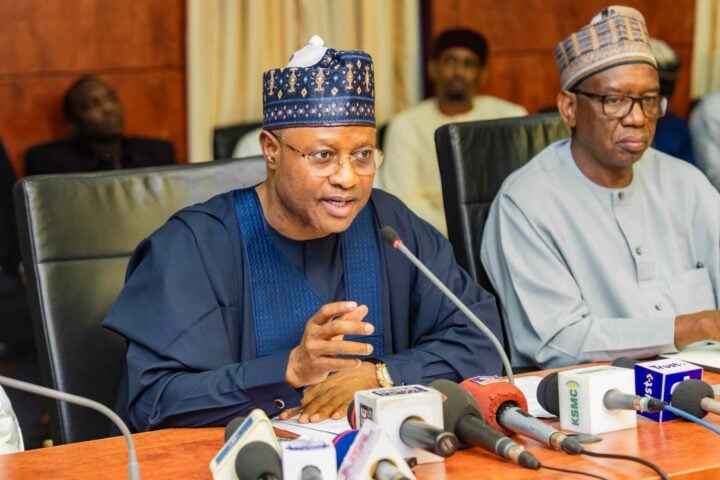
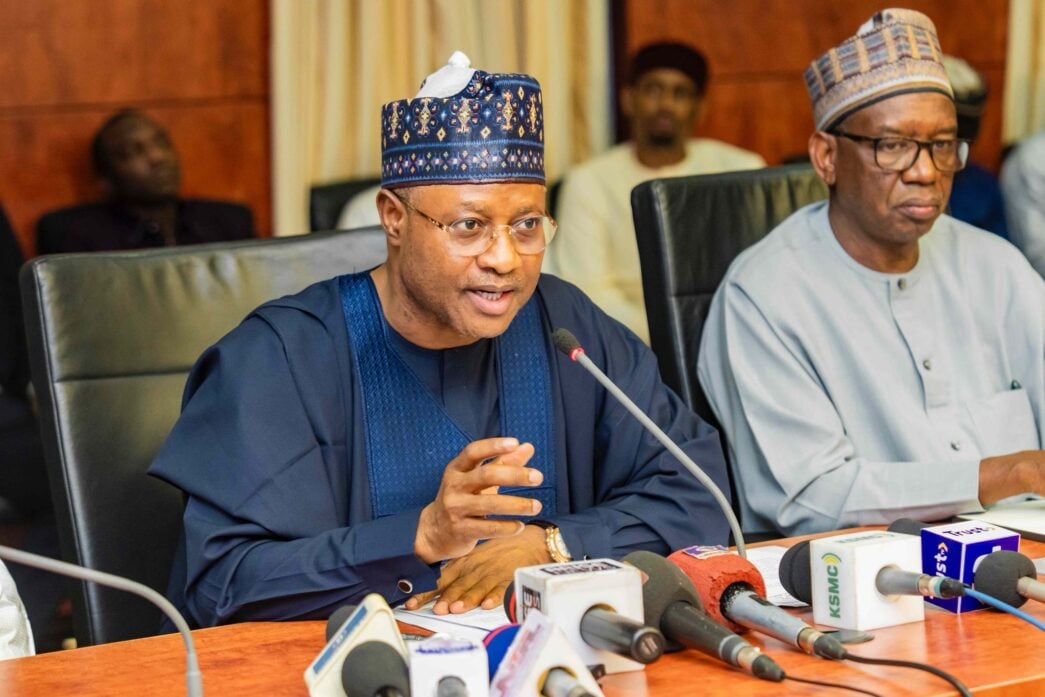
Uba Sani (in navy blue attire)
Uba Sani, the governor of Kaduna state, says poverty, exclusion, misinformation, and weak social cohesion are major drivers of insecurity in Nigeria’s north-west.
Speaking at the north-west zonal peace and security summit in Kaduna on Wednesday, the governor called for integrated security operations and governance reforms to address the challenge.
Themed ‘Towards Enduring Peace and Harmony in the North-West Zone’, the event was organised by the Cheren Peace Foundation in collaboration with the North-West Governors Forum.
Represented by Sule Shaibu, a senior advocate of Nigeria (SAN) who is the state’s commissioner for internal security and home affairs, Sani said no single state, institution or security agency would tackle insecurity in isolation, harping on the need for inter-state collaboration, intelligence sharing and joint responses.
Advertisement
He advocated for the empowerment of local communities to serve as partners in peace, noting that the region’s security challenges transcend state borders and are sustained by socio-economic vulnerabilities.
The governor noted the “success” of the ‘Kaduna Peace Model’, a people-centred, intelligence-led and non-kinetic security approach.
According to him, the model combines logistical support for security agencies with dialogue, reconciliation, social cohesion and justice.
Advertisement
Sani said Kaduna’s early-warning mechanisms and local peace structures are founded on the belief that communities are not merely victims of insecurity but critical actors in its prevention and resolution.
He added that the state is pursuing inclusive development by expanding access to education, skills acquisition and social protection for youths and women.
These, he said, are part of efforts to reduce criminality and extremism.
The governor also cautioned against hate speech, misinformation and inflammatory rhetoric, urging political leaders, media practitioners, civil society organisations and citizens to promote unity, tolerance and peaceful co-existence.
Advertisement
In his remarks, Muhammad Sa’ad Abubakar III, the Sultan of Sokoto and chairman of the Supreme Council for Islamic Affairs in Nigeria, called for collaboration to tackle insecurity, noting that development cannot thrive in an unsafe environment.
Represented by Muhammadu Isa Muhammadu II, the Emir of Jama’a, the Sultan urged religious leaders to champion peace by promoting interfaith dialogue and preaching compassion, forgiveness and co-existence based on shared values.
Similarly, Christopher Musa, the minister of defence, who was represented by Hussain Kasim, his special adviser, said security challenges cannot be resolved through kinetic measures alone.
He reaffirmed the federal government’s commitment to inter-agency collaboration and community-focused security strategies.
Advertisement
Musa advised young people to reject social vices and embrace education, skills development, entrepreneurship, and community service, urging them to become agents of peace rather than instruments of criminality.
The convener of the summit, Bishop Timothy Cheren, said the event was organised in response to the breakdown of peace across the country, marked by rising banditry and terrorism.
Advertisement
He noted that the Cheren Peace Foundation, which has a 25-year history of peace-building initiatives, previously hosted a north-central peace summit in Nasarawa in October.
Advertisement