


BY JIDE OJO
“As persons with disabilities and organisations supporting the ecosystem of disability inclusion in Nigeria, we need to continue the advocacy. There should be zero tolerance for discrimination, oppression, and marginalisation of anyone because of impairments.” – Abdullahi Usman Aliyu, the national president of JONAPWD. (P. 93)
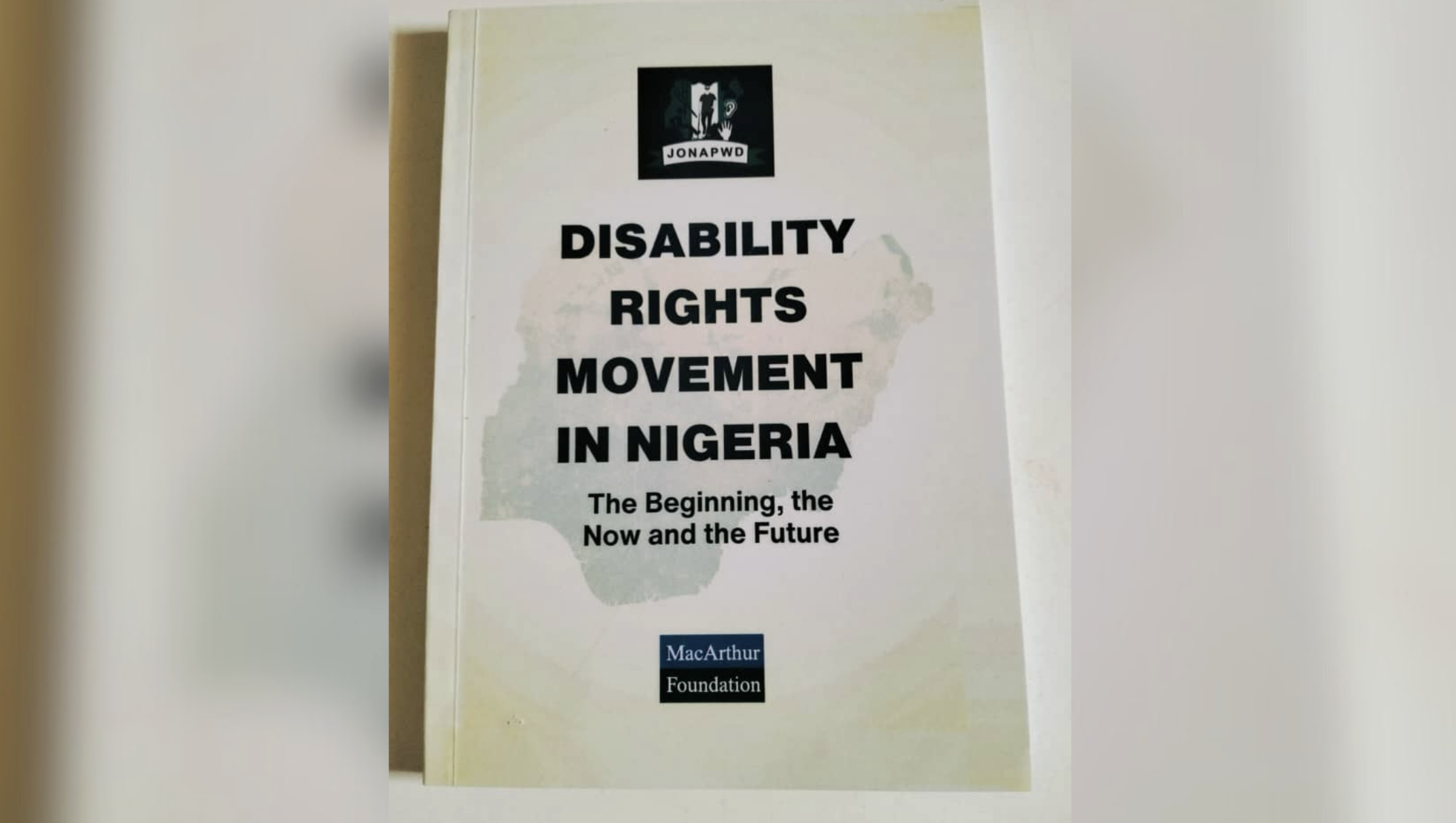
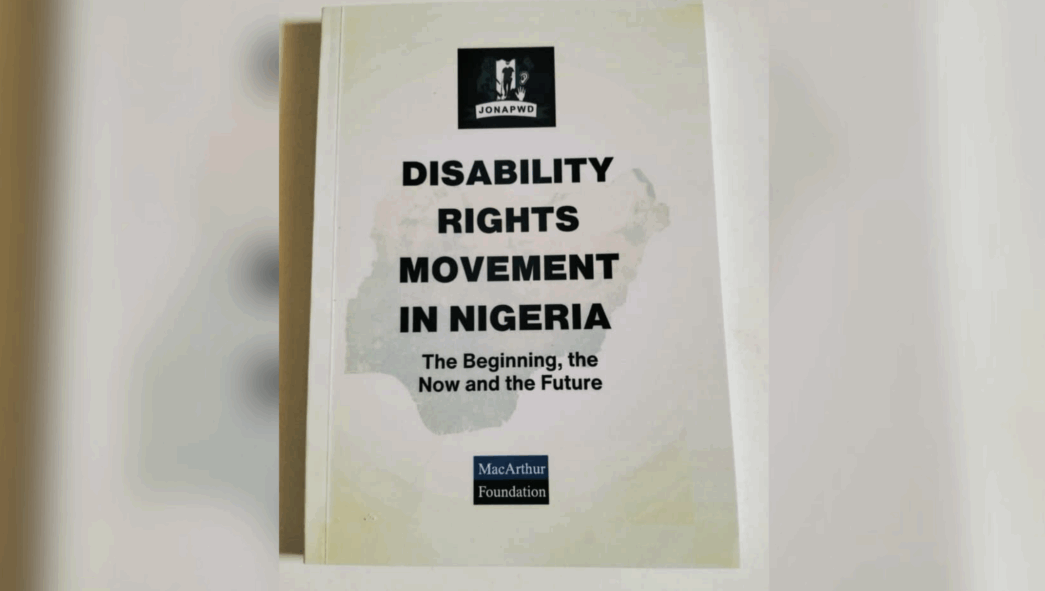
The book ‘Disability Rights Movement in Nigeria: The Beginning, The Now; The Future” was co-authored by Abdullahi Usman Aliyu, the current national president of Joint National Association of Persons with Disabilities (JONAPWD), Ekaete Judith Umoh, the immediate past president, and Olumide Olaniyan, a governance and disability inclusion expert of over two decades. While there are books on disability issues out there, there is hardly any book about JONAPWD, nor is there any about disability movements in Nigeria.
In a powerful Foreword, Dr. Amina Salihu who is the Deputy Director of MacArthur Foundation, Africa Division said inter alia, “This book is not just a documentation of our past; it is a living testimony to how far we have come—from the days when disability was viewed through the lens of charity and pity to this era of rights, inclusion, and active citizenship. Each chapter carefully unfolds a layer of our collective experience as persons with disabilities, as advocates, as dreamers, and as nation-builders.” She went further, “This book is more than a chronicle; it is a mirror and a map. It mirrors our struggles and triumphs, and it maps the road ahead for those who will continue this work when we are gone. For policymakers, it offers insight. For allies, it offers understanding. For young persons with disabilities, it offers hope, proof that their dreams are valid and their voices powerful…. This book is a celebration of resilience, of identity, and of the unstoppable spirit of persons with disabilities in Nigeria.”
In the Preface we are further informed that “This book documents the evolution of the disability rights movement in Nigeria. It highlights the movement’s origins, growth, and significant milestones that culminated in the enactment of the Discrimination Against Persons with Disabilities (Prohibition) Act. It also includes stories about how our community mobilised to ensure the effective implementation of the Act. The work captures real stories from individuals involved in the disability rights movement in Nigeria, though largely at the national level, and to some extent at the sub-national level.”
Advertisement
“The book offers a detailed account of JONAPWD’s struggles and achievements. It also captures key lessons and aspirations for the future. Using historical narrative methods, the book tracks the origins and development of disability rights movements in Nigeria. It highlights key accomplishments of JONAPWD, as the umbrella body and national organisation of persons with disabilities in Nigeria. It focuses on its core actions, events, and roles in the significant events for the passage of the Discrimination Against Persons with Disabilities (Prohibition) Act at the national level. This came after several failed attempts since Nigeria’s return to democracy in 1999.”
The methodology used in writing the book include Desk Research and oral interview. The book has 13 chapters and a Supplement.
Chapter 1: Evolution of Disability Discourse in Nigeria. Here, the scale of exclusion was highlighted with data. According to report, “The current population of Nigeria is approximately 238 million people (2025 estimate), according to Worldometer. This translates to approximately 36 million people in Nigeria being persons with disabilities as at 2025. This population of persons with disabilities in Nigeria exceeds that of at least forty (40) other African countries, including Côte d’Ivoire, Republic of the Niger, Tunisia, Mali, Cameroon, Zambia, Malawi, Chad, Zimbabwe, Sierra Leone, and Guinea.”
Advertisement
Chapter 2: The Disability Experience: Stories from JONAPWD’s Current and Immediate Past National Presidents; Chapter 3: Unpacking Disability: Beyond Myths and Realities; Chapter 4: Who Counts? Defining Persons with Disabilities in Our Stories; Chapter 5: What Disability is Not: Moving beyond the Label; Chapter 6: Disability is Not the Opposite of Ability; Chapter 7: Diverse Experiences: Exploring Types of Disabilities Through Stories In this chapter, the authors highlighted that as an umbrella association, JONAPWD has expanded from the initial six clusters to 10. They are:
Initial Six Clusters are: National Association of the Blind (NAB); Nigerian National Association of the Deaf (NNAD); Spinal Cord Injuries Association of Nigeria (SCIAN); Integration, Dignity and Economic Advancement (IDEA) – Survivors of leprosy; National Association of Persons with Physical Disabilities. (Broad cluster for polio survivors, amputees, and other physical disabilities) and Intellectual and Development Disabilities (IDD), Four Additional Clusters Registered in the Last Two Years: People of Short Stature; Persons with Albinism; Persons with Multiple Disabilities (such as DeafBlind Cluster) and; Persons with Mental and Psychosocial disabilities.
Chapter 8: The Journey on an Uncharted Route; Chapter 9: Advancing Inclusion: Gender Equity and Cluster Representation; Chapter 10: From Signature to Action: Nigeria and the UNCRPD; Chapter 11: Everyday Barriers and Bold Responses: JONAPWD’s Current Challenges; Chapter 12: Inclusion of Persons with Disabilities in Nigeria: Achievements, Future Directions, and Partnerships.; Chapter 13: Visions of Tomorrow: Hopes and Expectations for Disability Rights
Supplement: Building Your Own Path: An Outline for Disability Organisations is a guideline that provides emerging leaders with a roadmap to establish legally compliant, democratic and sustainable organization of persons with disabilities (OPDs) that can continue advancing rights and claiming space in Nigeria’s development agenda.
Advertisement
The book will benefit disability rights activists, disability inclusion researchers and students, OPDs, Organisations for Persons with Disabilities (OfPDs), donors, national and international civil society organisations, academic community, policymakers, legislature, ministries, departments and agencies (MDAs), disability community members, and the media. It will guide these stakeholders in their work with persons with disabilities and the rest of the population. Moreover, individuals within the rest of the population could read the book to improve their knowledge of disability rights issues in Nigeria and beyond.
Among the commitments and call to action made by JONAPWD in the book are: There is a commitment that JONAPWD will, in the not-too-distant future, work towards reproducing the book as a short audiovisual documentary in Pidgin English and a few other Nigerian languages to be systematically selected. JONAPWD intends to establish comprehensive demographics of persons with disabilities in Nigeria. The organisation is working to ensure that all the thirty-six state chapters also have local government chapters.
JONAPWD demanded that all leaders and decision-makers should be taught Disability Awareness 101, not just those in the mother ministry; Every development partner-funded project in this country should have clear-cut disability-related costing. In fact, the National Planning Commission (NPC) should not sign or approve any development partner coming in without that. For those that are already in, when they come to renew their licences, the Commission must demand that none of their projects should leave their coffers without disability-related costing. JONAPWD enjoined everyone to use the right language at all times. It is both structural and psychological violence to use demeaning words and phrases to describe persons with disabilities
The book is a very important sourcebook for researchers on disability movement in Nigeria. It was written in a storytelling format and is reader friendly and educative. The book which was presented to the public at Sheu Musa Yar’Adua Centre in Abuja on Thursday, November 27, 2025 remains a vital advocacy material that is recommended to all.
Advertisement
Ojo can be contacted via @jideojong
Advertisement
Views expressed by contributors are strictly personal and not of TheCable.