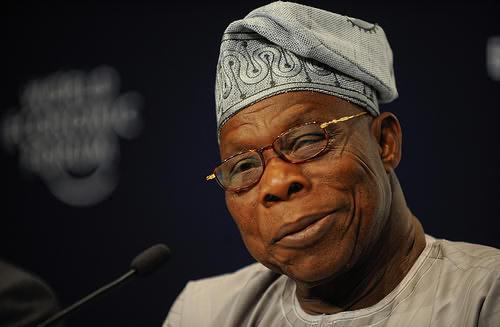
In April 2004, Nigeria foiled a coup attempt to topple then-President Olusegun Obasanjo’s administration.
The incident tested the country’s nascent democracy, just five years after its return to civilian rule. Nearly 30 mid-ranking officers were implicated.
Remi Oyo, presidential spokesperson at the time, said “serious breaches of security” prompted an investigation which led to arrests.
“Let me say that President Olusegun Obasanjo trusts the security agencies and officials of government,” Oyo said in a statement.
Advertisement
“He believes in the Nigerian people. He knows that the Nigerian people believe in democracy and will continue to work for and with democracy and what the intelligence community is doing is not anything extraordinary, it’s all in its job.”
In October of the same year, four military officers and a civilian were charged with plotting to kill Obasanjo by shooting down his helicopter with a missile.
The military officers included, Hamza Al-Mustapha, a major and the former head of personal security of Sani Abacha, late head of state; Mohammed Umar Adeka, a lieutenant colonel; Yakubu Kudambo, a navy commander; and Tijani Abdallah, a lieutenant. The civilian was Onwuchekwa Okorie.
Advertisement
The men faced two count charges each of treason. Al-Mustapha, Adeka, and Okorie pleaded not guilty at a federal high court in Lagos. Kudambo and Abdallah were charged in absentia.
According to the charges, Al-Mustapha gave various sums of money through Okorie to Abdallah between November 2002 and March 2004 “for the purpose of purchasing a Stinger surface-to-air missile to be used in shooting down the President’s helicopter with the President on board”.
Abdallah subsequently made several trips to Togo and Cote d’Ivoire in an effort to acquire the US-made shoulder-fired missile, the charge sheet said.
Meanwhile, Kudambo prepared the draft of a coup speech outlining a new regime to replace Obasanjo’s elected government, it added.
Advertisement
That was the government’s first admission of the reported coup.
Daniel Abutu, the presiding judge, ordered the accused plotters to be remanded in military custody pending the outcome of investigations.
Days later, Ganiyu Adewale, spokesperson to Alexander Ogomudia, then chief of defence staff, announced that a “Special Investigation Panel” composed entirely of military officers had been constituted to determine whether the suspects would face a court-martial.
Under Nigerian law, treason — which includes attempted coups — carries the death penalty.
Advertisement
There are, however, limited public reports on the final outcome of the coup investigation or prosecution.
Al-Mustapha later faced other high-profile charges, including the murder and attempted murder of Kudirat Abiola, wife of MKO Abiola, winner of the annulled 1993 presidential election; and Alex Ibru, publisher of The Guardian newspaper. He was acquitted and discharged in 2013.
Advertisement
A former military insider turned political aspirant, Al-Mustapha has since announced his intention to contest the 2027 presidential election under the Social Democratic Party (SDP).
Obasanjo, himself a former military ruler who voluntarily handed over power to an elected civilian government in 1979, had been imprisoned under Abacha’s regime in 1995 over an alleged coup plot.
Advertisement
Last month, the federal government cancelled a parade scheduled to celebrate the country’s 65th independence anniversary on October 1.
There were reports that the parade’s cancellation was linked to an alleged military coup attempt.
Advertisement
But the Defence Headquarters (DHQ) dismissed the reports, saying the cancellation had no links with the alleged coup attempt.