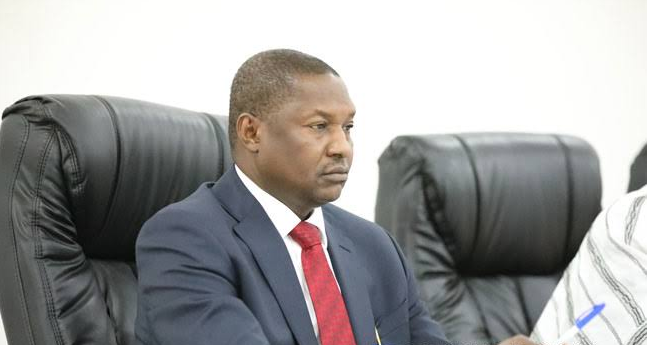
On December 7, 2017, Cable Newspaper Journalism Foundation (CNJF) sent a freedom of information (FOI) request to Abubakar Malami, then attorney-general of the federation (AGF), to demand details of the dubious payment of $17 million to Nigerian lawyers for recovery of $321 million loot linked to Sani Abacha, a former military head of state.
In the FOI request, CNJF, a not-for-profit organisation that uses the vehicle of journalism to advance transparency and accountability in government, asked Malami to provide a breakdown of the amount approved and released to Nigerian lawyers for the repatriation.
The foundation had asked Malami to explain the roles played by the Nigerian lawyers he engaged since Enrico Monfrini, a Swiss lawyer hired by the federal government since 2000 for the recovery job, had completed the work before the Abachas went to stop the restitution to Nigeria.
CNJF submitted the FOI request following a report by TheCable that exposed how Malami hired the two Nigerian lawyers after the recovery process of the loot was almost completed.
Advertisement
The engagement of the two lawyers — Oladipo Okpeseyi and Temitope Isaac Adebayo — which cost the country $16.9 million as commission and professional fees from the recovered funds.
TheCable reported that Malami engaged the two lawyers to duplicate the job of the Swiss lawyers and get their own cut from the already done deal.
Okpeseyi and Adebayo were lawyers to the Congress for Progressive Change (CPC) — the legacy party of Buhari — that merged to form the current All Progressives Congress (APC). Malami was legal adviser to CPC.
Advertisement
Before Malami assumed office, the federal government had engaged the services of Swiss lawyers, Monfrini and Christian Luscher, to recover the stolen funds from Liechtenstein and Luxembourg — and domiciled the monies with the attorney-general of Switzerland.
Nigeria had paid four percent of the recovered Luxemburg assets as professional fees and expenses to the foreign lawyers, in addition to roughly $6.8 million in fees paid to Monfrini for the Liechtenstein recoveries.
Since all the fees had been paid by Nigeria, it was expected that Malami, who was the then AGF, would sign a memorandum of understanding (MoU) with the Swiss authorities and commit to an undertaking that the funds would be properly utilised.
However, in 2016, Malami engaged Adebayo and Okpeseyi to execute an already done recovery process.
Advertisement
COURT BATTLE TRAILED FOI REQUEST
Malami refused to honour the foundation’s request.
On January 10, 2018, the foundation sued Malami over his failure to respond to a FoI request on the engagement of lawyers for the recovery of stolen funds.
The case, with suit number FHC/ABJ/CS/27/2018, was filed by Kusamotu & Kusamotu Law Chambers at a federal high court in Abuja.
Advertisement
The foundation’s lawyer sought an order of mandamus compelling the AGF to make available to CNJF the information and documents requested from its office pursuant to the FoI Act, 2011.
In September 2019, that court dismissed the foundation’s suit citing non-submission of the certified true copies of the foundation’s registration documents.
Advertisement
Inyang Ekwo, the presiding judge, ruled that CNJF had provided a photocopy of its certificate of incorporation “in contravention of the rules of evidence which stipulate that such evidence ought to be a certified true copy and not a mere photocopy. Therefore, the court found that the photocopy tendered in evidence was inadmissible”.
Ekwo argued that the portion of the affidavit in support of CNJF’s application, wherein it stated what its objectives are according to its constitution, is not proved by simply stating it in the affidavit.
Advertisement
He added that a certified true copy of the said constitution filed with the Corporate Affairs Commission (CAC) must be filed together with the affidavit and tendered as evidence.
Without considering the merits of CNJF’s application, the court ruled that the foundation has not been able to prove that it is a duly incorporated organisation that is capable of bringing the action.
Advertisement
The AGF did not raise any of the issues mentioned by the judge in his defence.