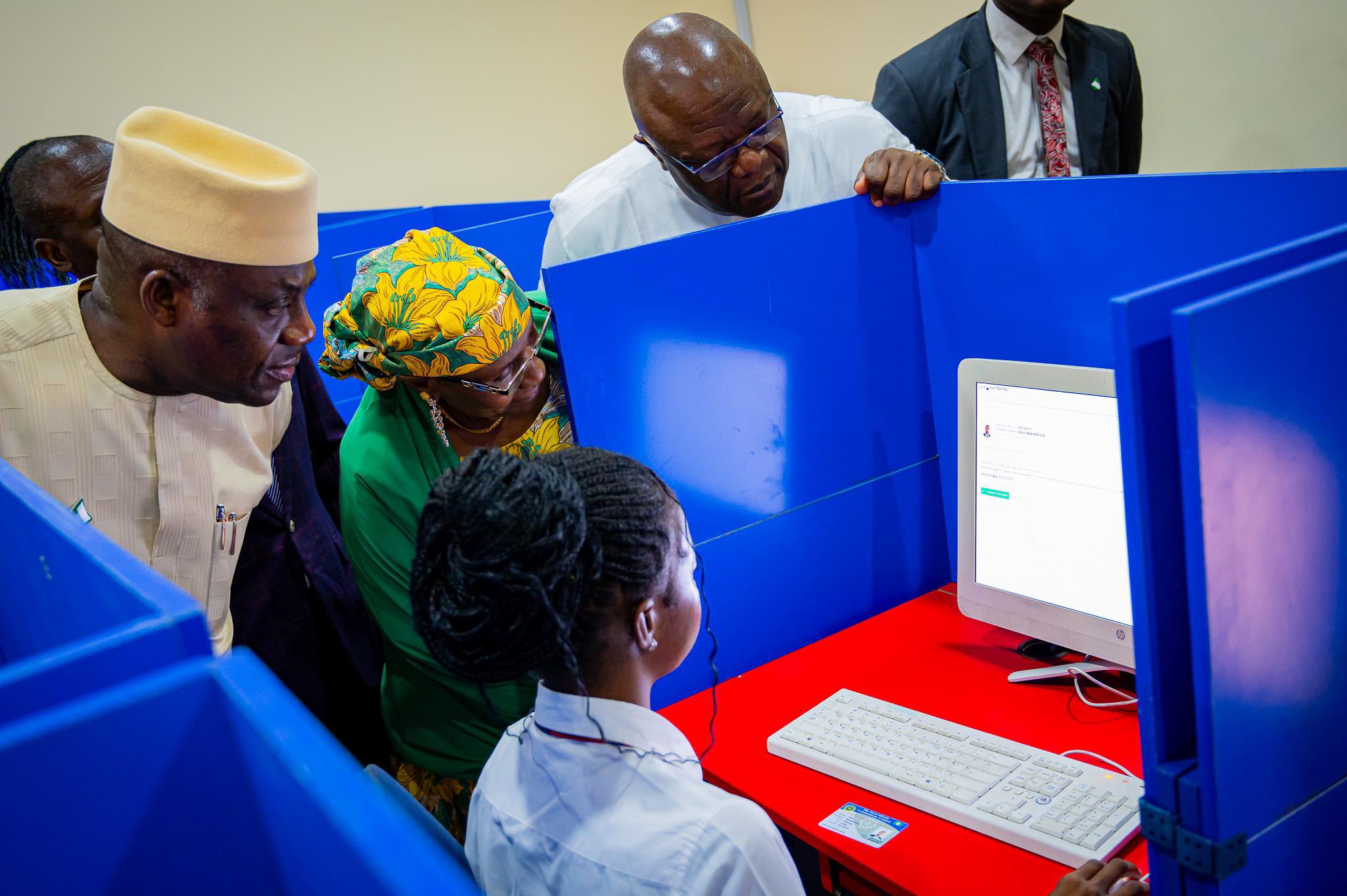
Education minister Tunji Alausa (in a cream-coloured cap) inspecting a CBT exam
A rights group says the education ministry’s clarification on subject selection for the 2026 West African Senior School Certificate Examination (WASSCE) ignored the core concerns of stakeholders.
The group, Education Rights Campaign (ERC), said the main problem is that current SSS 3 students set to sit the 2026 WASSCE are being forced to register and get tested for subjects they were never taught in SS1 and SS2.
Nigeria earlier launched a new basic and secondary education curricula, with implementation set for the 2025/2026 academic year
The education ministry had stated that implementation would commence at the beginning of each three-year education cycle.
Advertisement
This meant that incoming students in Primary 1, Primary 4, JSS1, and SS1 will get started with the new subject offerings.
Students already halfway through each cycle were to finish with the old curriculum, which would eventually be phased out.
In the new structure, approved core subjects include English Language, Mathematics, Citizenship and Heritage Studies, Digital Technologies (formerly Information and Communication Technology), and one trade subject
Advertisement
The trade subjects have also been streamlined from 26 to six, while retaining the curriculum content.
But the West African Examination Council (WAEC) abruptly introduced revised subject offerings for its 2026 SSCE, citing federal directive.
Students who did not offer any of the six trade subjects are now forced to select and get tested for subjects they were never taught in SS 1 and SS 2.
There are also objections that marketing has become a compulsory subject for business students, even at schools that do not offer it.
Advertisement
Some parents also say that students who offer courses like Civic Education and Computer are being compelled to take new subjects to make up the required minimum of eight subjects to be registered for WASSCE.
These concerns have stirred panic among students, guardians, and parents alike who are seeking clarity on the policy’s direction.
On December 6, the education minister Tunji Alausa stated that there is no restriction on the selection of any approved subject in the curriculum.
He explained that there is no obligation on students to write any of the six trade subjects if they have not been taught.
Advertisement
The ERC has, however, argued that the minister’s statement missed the central point that students with barely four months to a qualifying exam must now register for new, unstudied subjects to meet the minimum eight-subject WASSCE requirement.
The ERC noted that the minister’s statement, which affirmed a student’s freedom to choose subjects across different fields, complicates the problem for current SSS 3 students.
Advertisement
The group stressed the irrationality of expecting a student to study subjects designed for a full three-year cycle and sit for them in the WASSCE between December 2025 and April 2026.
Citing more examples, ERC said science students who studied Civic, Tourism, and Computer Studies must now register for at least two new subjects to meet the eight-subject minimum, as the previous three subjects are no longer on the WAEC portal.
Advertisement
Business students who studied Civic, Storekeeping, and Insurance face a similar compulsion to register for two new, unstudied subjects.
Humanities students who offered Civic Education and Dyeing/Bleaching must take at least one new subject.
Advertisement
The ERC cited a December 4 resolution in the house of representatives asking the education ministry to suspend the new curriculum implementation for the 2026 WASSCE and allow current SSS 3 students to be examined only in subjects they were taught.
The organisation called on the ministry to “abide by this resolution and instruct WAEC accordingly.”
It called for the “fair and sensible” approach of delaying the curriculum’s use as the basis for the WASSCE until 2028.