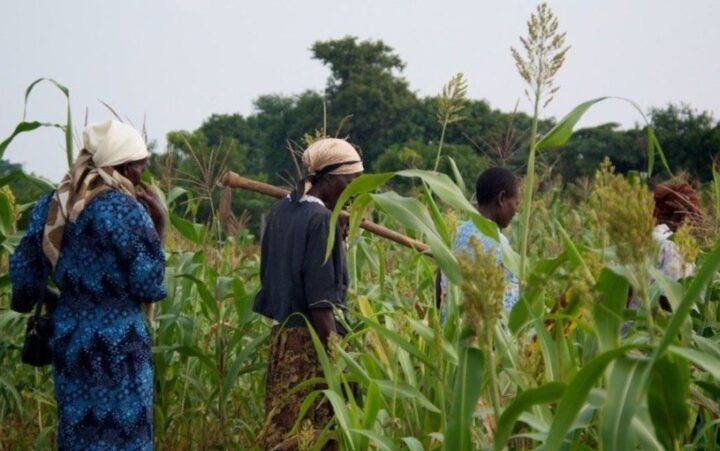
The senate on Tuesday asked the federal government to cut fertiliser prices to protect farmers’ livelihoods amid falling farm-gate prices and rising input costs.
The resolution followed a motion sponsored by Danjuma Goje, senator representing Gombe central, during the plenary.
Goje commended the federal government for reducing food prices through waivers and special permissions for large-scale importation of consumables.
He noted that while cheaper food had brought relief to Nigerians, it had created serious challenges for local farmers.
Advertisement
“While the prices of farm produce have been going down, that of the farm inputs, especially fertilisers, pesticides, insecticides, etc., have remained extremely high,” Goje said.
“The ongoing market distortion has resulted in massive post-harvest losses, as farmers are unable to sell their produce at fair or profitable rates, leading to wastage, spoilage, and income erosion.”
The former Gombe governor said the situation poses “a clear and present danger of reduced domestic food production, widespread rural economic stagnation, and worsening of the already fragile national food security situation”.
Advertisement
The senator further said the development exposes the Nigerian economy to “global price volatility and foreign exchange pressures”.
He warned that the situation threatened the livelihoods of millions of smallholder farmers who depend almost entirely on agriculture for income.
Goje said persistent declines in farm-gate prices could discourage farmers from investing in the next planting season, worsening food insecurity.
Aliyu Wamakko, senator representing Sokoto north, seconded the motion.
Advertisement
“The high cost of fertilisers and others needed to boost the agriculture sector is alarming; it needs to be addressed,” Wamakko said.
‘60% OF NIGERIANS DEPEND ON AGRICULTURE FOR SURVIVAL’
Mohammed Dandutse, senator representing Katsina south, said over 60 percent of Nigerians depended on agriculture for survival.
“The unfortunate situation of the importation of agricultural products from overseas is the major challenge that caused this problem,” Dandutse said.
Advertisement
“Those countries have subsidies for their food items in their country. I urge this important house, which is the voice of the masses, to look into this motion, because we cannot even face our masses with the current situation.
“Nigeria is blessed; we can feed Africa, we can feed the world, but we are relying on importation; what is the essence of using our dollars to import and make the farmers of other countries to be self-sufficient?”
Advertisement
Sunday Karimi, senator representing Kogi west, urged lawmakers to strike a balance between food affordability and farmers’ welfare.
“My colleagues, we have to be very careful; we are all aware of the situation in this country where farmers cannot even go to their farms,” Karimi said.
Advertisement
“We must be able to strike a balance between the two options; I believe encouraging prices to go down is the best.”
Olajide Ipinsagba, senator representing Ondo north, said price regulation should be prioritised.
Advertisement
“I am supporting this motion because it is very timely; prices and supplies are issues based on demand and supply; what we should be looking at today is how do we regulate prices,” he said.
Idiat Adebule, senator representing Lagos west, questioned the role of state governments in complementing federal agricultural initiatives.
Victor Umeh, senator representing Anambra central, also said temporary border relaxation during periods of scarcity might be necessary, but insisted that farmers must be supported with affordable inputs and stable commodity pricing.
Patrick Ndubueze, senator representing Imo north, urged the federal government to complete abandoned silos across the country and use them to purchase agricultural produce.
“We have silos cluster uncompleted up till this moment, and those establishments are in billions,” he said.
After the debate, the senate resolved to urge the federal government to introduce broad-based subsidies for fertilisers and other farm inputs.
Lawmakers also asked the government to establish benchmark minimum prices and guaranteed off-take programmes to stabilise agricultural markets.
The senate further urged a review of import waivers and special permits to ensure Nigerian farm produce can compete favourably with imported food.