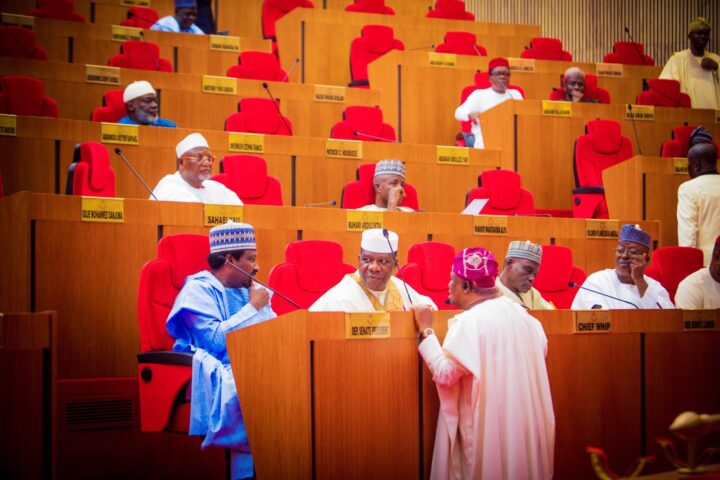
The senate has began debate on a bill seeking to amend the Banks and Other Financial Institutions Act (BOFIA) 2020 to empower the Central Bank of Nigeria (CBN) to designate and supervise non-bank financial institutions.
The bill targets major fintech operators whose activities, lawmakers say, now constitute critical national infrastructure.
Tokunbo Abiru, chairman of the senate committee on banking, insurance and other financial institutions and sponsor of the bill, said the amendment had become urgent due to the rapid evolution of Nigeria’s financial ecosystem.
Abiru said mobile money operators, payment service banks, wallet providers, digital lenders and switching companies now serve tens of millions of Nigerians and process huge volumes of daily transactions.
Advertisement
He said these entities hold vast pools of sensitive financial data but operate under a regulatory framework that has not fully adapted to their systemic importance.
“The reality today is that a non-bank institution, because of its market dominance, data concentration, customer reach or technological capacity, may pose risks equal to or even greater than those posed by a traditional bank,” he said.
“We are therefore confronted with a regulatory gap that leaves critical parts of the financial system operating outside the highest tier of statutory oversight; this bill seeks to correct that mischief.”
Advertisement
The senator warned that without modernising BOFIA, the country risked exposing itself to data insecurity, foreign control of sensitive financial infrastructure and vulnerabilities that could undermine national security.
Abiru said many fintechs operate across foreign-owned networks or offshore servers and store customer data in jurisdictions outside regulatory reach.
“Today, we cannot say with certainty where all the financial and behavioural data processed by some of these institutions is stored, who has access to it, or which foreign jurisdictions may lay claim to it,” he said.
Abiru recalled the temporary CBN restriction on fintech onboarding in April 2024 following concerns around KYC compliance, money laundering red flags and suspicious transactions.
Advertisement
The amendment proposes five key objectives, including creating a statutory framework for designating systemically important institutions and establishing a national registry of fintechs.
The bill also seeks to empower the CBN to impose enhanced supervisory requirements, strengthen data sovereignty and improve consumer protection.
Abiru dismissed calls for a separate fintech regulatory agency, saying such duplication would fragment oversight and weaken regulatory efficiency.
“Fintech regulation is deeply intertwined with monetary policy, payments oversight, prudential supervision and systemic-risk monitoring, functions that already reside naturally within the Central Bank,” he said.
Advertisement
“International best practice overwhelmingly favours integrating fintech oversight within existing regulators, not creating new bureaucracies.”
The senate also raised concerns about expanding vulnerabilities in the digital financial ecosystem, saying some large fintech platforms could become systemic risks capable of destabilising the national economy.
Advertisement
Abiru said the financial system had undergone a dramatic transformation in a decade, with digital institutions now operating at scales comparable to mid-sized banks.
He said some fintechs hold data with national security implications but store them on offshore servers and opaque ownership networks.
Advertisement
The lawmaker cited the April 2024 halt in customer onboarding by several fintech firms as evidence that the scale of their operations had outgrown existing regulatory tools.
The amendment proposes reforms, including a national registry to ensure traceability, enhanced prudential tools for digital institutions, data sovereignty safeguards and stronger consumer protection.
Advertisement
Contributing to the debate, Adams Oshiomhole, former president of the Nigerian Labour Congress (NLC), described how his bank accounts were hacked through a fintech platform.
Oshiomhole said most fintech operators have unknown ownership structures and may evade accountability for regulatory infractions.
“I know the directors of our regular banks, but I can’t say the same of these fintech banks; I don’t know the directors of MoniePoint, Opay and all others,” he said.
Oshiomhole said proper regulation through enabling legislation would ensure that online financial institutions operate in the interest of Nigerians.
Natasha Akpoti-Uduaghan, senator from Kogi central, said the debate must also consider income disparities affecting young Nigerians earning through global digital platforms.
She cited what she described as “huge discrepancies” in payments to Nigerian content creators, sometimes as low as 50 cents per 1,000 views compared with $10–$30 paid to creators in the United States.
The Kogi senator said the inequities undermined the earning capacity of Nigeria’s growing digital workforce and called for stronger engagement with global technology companies.
Barau Jibril, presiding officer and deputy senate president, referred the bill to the banking committee for additional legislative work after scaling second reading.