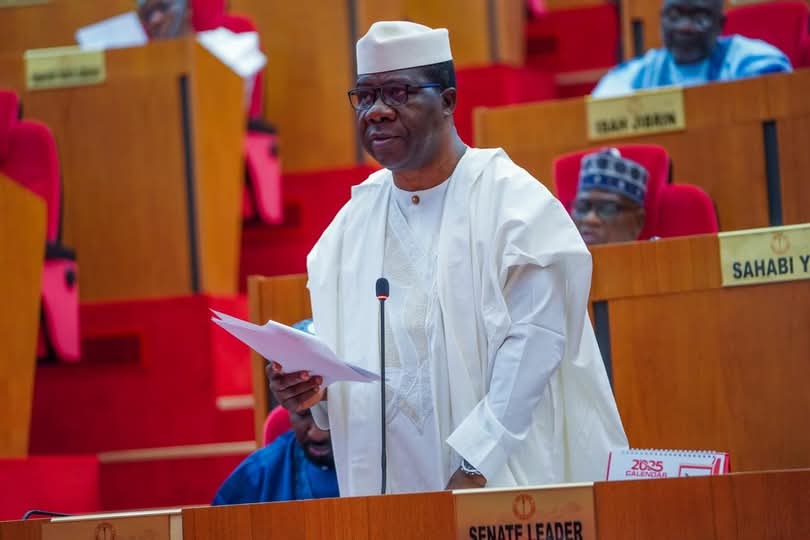
Opeyemi Bamidele, senate leader and senator representing Ekiti central,
The senate has concluded amendments to the audit ordinance of 1956 with the passage of the federal audit service bill, 2025.
The bill, if signed into law by President Bola Tinubu, will establish a new audit regime for the country and strengthen the independence of the auditor-general of the federation.
Opeyemi Bamidele, senate leader and senator representing Ekiti central, presented the concurrence bill at the plenary on Wednesday.
Bamidele said the bill would replace an outdated legal framework with a modern system aligned with international best practices and strengthen public accounts management in Nigeria.
Advertisement
The legislation was initially introduced in the house of representatives as the Federal Audit Service Bill, 2025.
It seeks to repeal the audit ordinance of 1956, a colonial-era law enacted 69 years ago.
Bamidele said the proposed law would establish the federal audit service and the federal audit board.
Advertisement
The senate leader said it would also strengthen the powers, independence and functions of the auditor-general for the federation.
“The need to repeal the Audit Ordinance Act of 1958 cannot be overemphasised,” he said.
“That ordinance is pre-independence legislation enacted for a colonial administrative structure and is grossly inadequate for Nigeria’s present constitutional democracy, complex public finance architecture, and modern accountability standards.
“It does not sufficiently guarantee institutional independence, operational autonomy, or the enforcement powers required of a supreme audit institution in a contemporary governance system.
Advertisement
“This bill therefore seeks to replace that outdated framework with a modern, robust, and fit-for-purpose legal regime that aligns Nigeria’s public audit system with international best practices, including the principles of transparency, accountability, and fiscal responsibility.
“It will enhance legislative oversight, strengthen anti-corruption efforts, and improve public confidence in the management of public funds.”
The senate also concluded consideration of the Institute of Economists of Nigeria (Establishment) bill, 2025.
Bamidele said the bill seeks to establish the Institute of Economists of Nigeria, noting that the body would regulate and maintain professional standards for economists in the country.
Advertisement
“The proposed Institute is intended to promote professionalism, ethical conduct, and capacity development within the economics profession, in line with global best practices,” he said.
“The two bills—the Federal Audit Service Bill, 2025, and the Institute of Economists of Nigeria (Establishment) Bill, 2025—are straightforward in nature and have undergone the requisite legislative scrutiny and due process in the House of Representatives.
Advertisement
“They are designed to strengthen public financial accountability and professional regulation, both of which are critical to sound governance and economic development.”
Advertisement