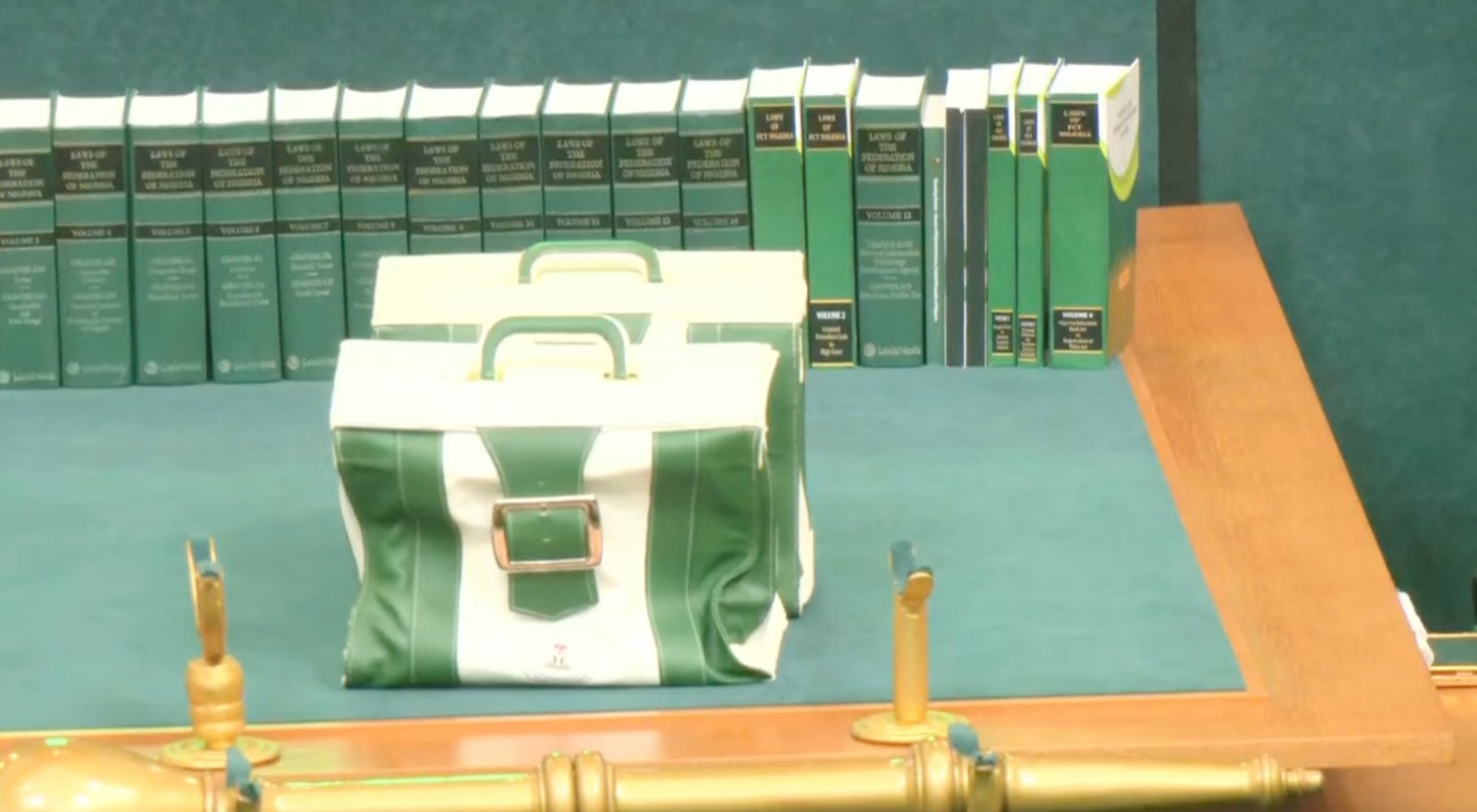
The senate on Tuesday passed the N58.47 trillion 2026 appropriation bill of President Bola Tinubu for second reading.
The passage followed a lead debate by Opeyemi Bamidele, senator representing Ekiti central and senate leader, who sponsored the bill titled ‘A Bill for an Act to Authorise the Issue from the Consolidated Revenue Fund of the Federation the total sum of ₦58,472,628,944,759 for the services of the Federation for the year ending 31st December, 2026’.
Leading the debate, Bamidele said the bill was the legal instrument for translating the policy direction outlined by Tinubu in his 2026 budget address into enforceable public expenditure.
“This b1ill is the legal instrument through which the policy direction outlined by the president in his 2026 budget address is translated into enforceable public expenditure,” he said.
Advertisement
“It is therefore central to governance, economic management, and national development in the coming fiscal year.”
Bamidele noted that the bill was deemed to have passed first reading, having been laid before a joint session of the national assembly on Friday, December 19.
He described the 2026 budget as one of consolidation, saying it builds on reforms undertaken by the administration to stabilise the economy and strengthen public finance.
Advertisement
“The economy is in a phase of adjustment following far-reaching reforms aimed at restoring stability, correcting distortions, and strengthening public finance,” he said
“The 2026 Budget is therefore not an experimental document. It is a budget of consolidation.”
According to the proposal, total expenditure of N58.47 trillion comprises N4.09 trillion for statutory transfers, N15.90 trillion for debt service, N15.25 trillion for recurrent (non-debt) expenditure and N23.21 trillion for capital expenditure through contributions to the development fund.
Bamidele said the structure of the budget reflected deliberate prioritisation, with capital spending emerging as the largest component of discretionary expenditure.
Advertisement
He said the N23.21 trillion capital allocation targets growth-driving sectors, including transport infrastructure, power and energy, agriculture, industrial development, housing and the digital economy.
“As the President emphasised, sustainable growth cannot be achieved without addressing infrastructure deficits and expanding the productive capacity of the economy,” he said.
On recurrent expenditure, Bamidele said the N15.25 trillion provision would ensure efficient government operations and service delivery, adding that strict cost controls and improved payroll management would be enforced.
He said the N15.90 trillion earmarked for debt service reflected existing obligations, but noted that the administration was pursuing improved revenue mobilisation, tax base expansion and better performance of government-owned enterprises.
Advertisement
“This senate will continue to exercise its oversight responsibility to ensure that borrowing remains prudent and that debt is deployed strictly for development purposes,” he said.
Bamidele added that the N4.09 trillion for statutory transfers was in fulfilment of constitutional obligations to key institutions critical to democratic stability.
Advertisement
FG PROJECTS N34.33TRN REVENUE
The lawmaker said the budget projected revenues of N34.33 trillion against expenditure of about N58.18 trillion, with a deficit of 4.28 percent of GDP, adding that it was within approved medium-term fiscal parameters.
Advertisement
Bamidele said the budget philosophy was anchored on consolidating macroeconomic stability, improving the business environment, promoting job-rich growth and poverty reduction, and strengthening human capital while protecting the vulnerable.
He said security, education and healthcare featured prominently among priorities alongside infrastructure and agriculture.
Advertisement
“The true test of a budget is not in its presentation, but in its delivery,” Bamidele said.
He also urged lawmakers to ensure transparency and value for money.
Contributing, Adamu Aliero, senator representing Kebbi central, said he supported the bill but urged the appropriations committee to subject it to rigorous scrutiny.
“I support the bill. However, the committee on appropriations should do thorough scrutiny,” he said.
Adams Oshiomhole, senator representing Edo north, said the emphasis on infrastructure and employment signalled a shift towards job-led growth.
He also commended Tinubu for giving the highest allocation to security, adding that it reflects “national sentiment”.
Ahmad Lawan, senator representing Yobe north and former senate president, described the budget as “very bold and courageous,” particularly in its focus on security and welfare.
Abba Moro, senate minority leader and senator representing Benue south, said the budget looked attractive but warned that implementation would be key.
Emmanuel Udende, senator representing Benue north-east, commended the president for prioritising security.
“As most of you are aware, the bulk of my people are refugees in their very own abode,” he said.
“For prioritising security, it means if the budget is enforced, my people will go back to their farms and thus, agriculture will be encouraged.”
Ali Ndume, senator representing Borno south, commended the prioritisation of security but stressed the need for strict adherence to the budget.
Following the debate, the senate passed the bill for second reading and referred it to the committee on appropriations for detailed consideration.