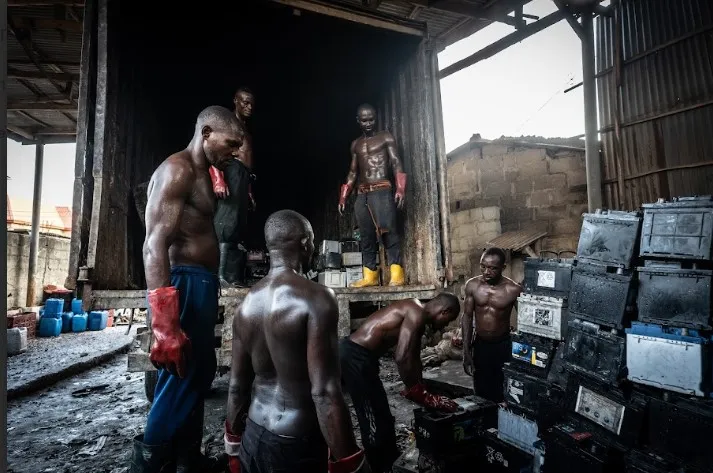
Labourers load old vehicle batteries onto a truck that will deliver them to battery recycling facilities, which melt the lead inside for new batteries. (CREDIT: Grace Ekpu for The Examination)
The senate on Thursday raised the alarm over a “widespread and scientifically verified lead-poisoning disaster” devastating Ogijo, a densely populated community spanning the Ikorodu axis of Lagos and the Ogun east senatorial district.
On November 28, the Ogun state government shut down seven used lead-acid battery recycling factories in Ogijo, Sagamu LGA, amid concerns over alleged lead poisoning.
On November 26, an investigative report showed residents who tested positive for lead poisoning live within 100 to 500 metres of True Metals Nigeria Limited and Everest Metal Nigeria Ltd, two of the most prominent used lead-acid battery (ULAB) recyclers in Ogijo.
Lawmakers said the contamination, traced to emissions from multiple used lead-acid battery recycling plants operating in the area, has escalated into “a full-scale public health emergency that is silently destroying an entire generation”.
Advertisement
Tokunbo Abiru, sponsor of the motion, said the level of toxic exposure in Ogijo was “an environmental catastrophe of global significance”, adding that laboratory findings revealed pollution “as high as 186 times the globally acceptable safety threshold”.
Abiru said testimonies from residents were heartbreaking.
“People have complained of constant headaches, abdominal pains, seizures, memory loss and a frightening drop in cognitive function,” he said.
Advertisement
“These are not random conditions; they match, almost word for word, the medical markers of long-term lead exposure.”
Abiru cited investigations by The Examination and The New York Times, saying the reports left him “deeply disturbed” because independent blood-lead testing and soil sampling “confirmed beyond doubt that Ogijo residents have been inhaling and ingesting poison for years”.
He said investigators also found that processed lead from the community had entered international supply chains.
“Contaminated Nigerian lead is feeding the supply lines of major automobile manufacturers abroad, while the local communities that produced this lead are choking, coughing and dying slowly under toxic smoke and dust,” he said.
Advertisement
He added that the human stories behind the figures were even more devastating.
“Children are dying slowly. Families have lived for years under poisonous smoke and dust,” he said.
“A mother in the report said her child wakes up screaming at night because of constant headaches.
“Another talked about sudden convulsions. How many more symptoms do we need before we act?”
Advertisement
Abiru noted that although the federal government has shut down seven factories and suspended the export of lead ingots, the intervention was “only the first step”.
“Many of the operators deny wrongdoing; enforcement is weak, and the level of exposure in the community remains extreme and unacceptable,” he said.
Advertisement
He stated that beyond environmental laws, “the constitution itself imposes a duty on government to protect citizens’ health,” adding that “the lives and futures of children in Ogijo must not be traded for toxic profits.”
Gbenga Daniel, co-sponsor of the motion and senator representing Ogun east, warned that Nigeria is gradually creating “sacrifice zones” where companies “operate with impunity because they assume nobody is watching”.
Advertisement
Saliu Mustapha, senator representing Kwara central, who seconded the motion, said the situation showed “how regulatory failure can quickly translate into human tragedy”.
“If the government does not act fast, Ogijo will only be one of many such cases,” he said.
Advertisement
Shuaibu Salisu, senator representing Ogun central, commended the Ogun government for offering medical tests and treatment, but said border communities like Ogijo “require far more attention than they currently receive”.
“People in these areas are often the first to suffer and the last to be noticed,” he said.
Babangida Hussaini, senator for Jigawa north-west, urged the federal government to widen oversight, saying “Ogijo cannot be the only community facing this”.
“If we do not extend monitoring and intervention, we are simply waiting for the next disaster,” he said.
Godswill Akpabio, senate president, said he was “deeply moved” by the motion.
“This touches on the lives of Nigerians,” he said.
“By bringing this motion, you are not only exposing the dangers of these operations but reminding us of the sacred duty we owe our citizens.
“Lead poisoning does not announce itself; it kills silently, slowly, and painfully.”
The motion was passed after a unanimous vote.
Akpabio directed the committee on legislative compliance to ensure “strict monitoring and timely execution” of the senate’s resolutions and to report back within two months.
The senate ordered federal agencies to begin emergency medical response, environmental cleanup, enforcement of recycling standards, relief support for severely affected families, and ministerial briefings.
It also directed the creation of a National Lead Poisoning Response and Remediation Office to coordinate cleanup, treatment, monitoring and global traceability of exported lead.