


BY FRANKLIN IYAMA
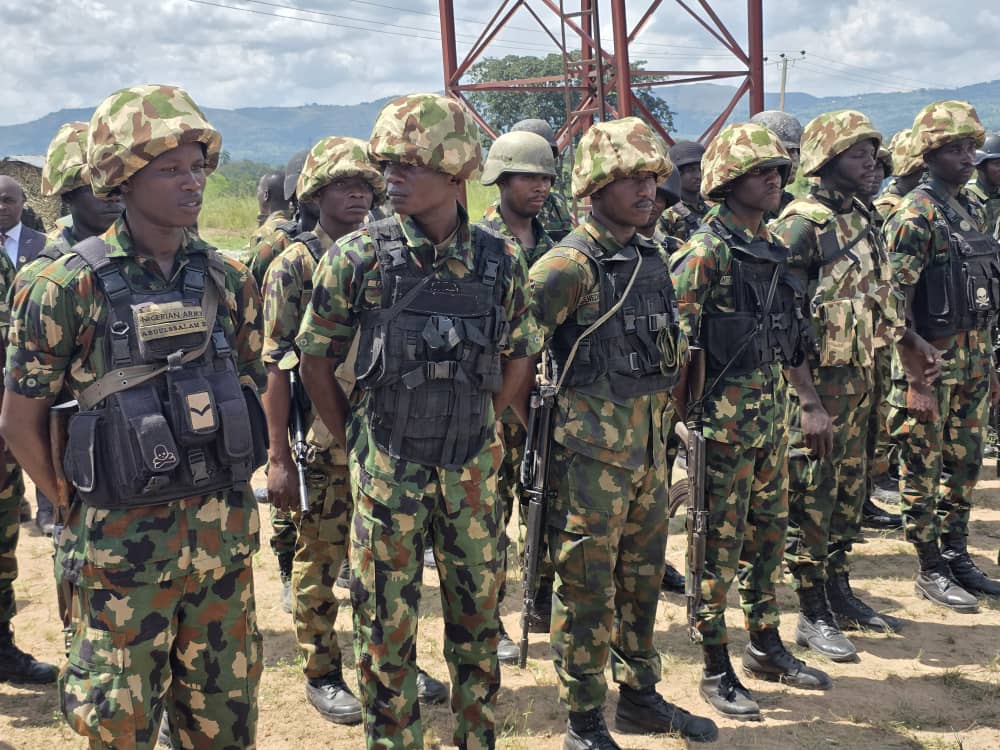
Nigeria is once again confronting a surge of violent attacks from bandits, insurgents and separatist armed groups, rekindling national anxiety and drawing renewed international scrutiny. After remarks by U.S. President Donald Trump hinting at possible American military involvement and sanctions, Nigeria’s political leaders moved quickly to demonstrate responsiveness. In December, President Bola Tinubu reshuffled the defence leadership, appointing former Army General Chris Musa as Minister of Defence, a move widely welcomed after concerns that the previous minister failed to convey urgency.
But the crisis runs far deeper than a change of personnel. The insurgency that began more than a decade ago has spread across multiple states, morphing into criminal and extremist networks that exploit weak governance, porous borders and the limitations of Nigeria’s security institutions. Instead of confronting these hard truths, parts of the political class, civil society and media have retreated into familiar cycles of ethno-regional blame, conspiracy theories, religious posturing and emotional grandstanding. Beneath the noise lies a stark fact: Nigeria’s security architecture has not been able to deal decisively with the speed, sophistication and adaptability of modern asymmetric threats. For General Musa, this is not merely a cabinet appointment. It is a moment of reckoning.
A Crisis Years in the Making
“The only thing as important to a nation as its revolution is its last major war,” Robert Jervis wrote in Perception and Misperception in International Politics.
Advertisement
The immediate past governor of Ekiti State, Kayode Fayemi, opened his 1991 doctoral thesis with that line in a rigorous study of Nigeria’s defence spending from 1970 to 1990. His conclusions remain strikingly relevant. Nigeria’s defence policy has long been reactive, fragmented and driven more by domestic politics than strategic necessity. Fayemi’s thesis argued that defence procurement decisions were shaped more by prestige, patronage and rivalry within the various armed services rather than a grounded assessment of Nigeria’s defence needs. The various military and civilian governments invested heavily in army bases and high-profile hardware but neglected the development of a domestic defence industry or an integrated military planning system. Modernisation was inconsistent and mostly crisis driven. Most damaging was the absence of a unified military doctrine, which left the armed forces ill-prepared for the asymmetric threats—terrorism, insurgency and guerrilla warfare—that now overwhelm them.
This failure stood in contrast to global trends that emphasised joint operations, air power and technological integration. In modern terms, Nigeria never built the Command, Control, Communications, Computers, Intelligence, Surveillance and Reconnaissance (C4ISR) systems required for contemporary warfare. The consequences are painfully evident. As the tragic capture and death of General Uba despite joint rescue operation underscored, the absence of seamless coordination between the armed services can be fatal in asymmetric environments.
A Military Stretched Beyond Its Structure
Advertisement
A recent analysis by retired Major General Fatai Alli exposes the institutional weaknesses that continue to undermine Nigeria’s counterinsurgency efforts. He argues that the problem is not enemy strength but internal stagnation: weak strategy, outdated doctrine, inadequate mobility, limited night-fighting capability and poor surveillance. Most corrosive, he warns, is the rise of a “dangerous myth” that only special forces can fight insurgents. Regular infantry have been relegated to static policing duties, leaving a small core of elite troops overstretched and fatigued.
The deeper issue is structural. Nigeria’s army is much smaller than official figures imply. In 2016, then–Army Chief General Tukur Buratai announced plans to expand the force from about 96,000 to 200,000 by 2022. Whether that target was met remains unclear, yet he has since advocated for a force of 800,000 personnel. Fayemi’s thesis recorded a total armed forces strength of 250,000 as far back as 1970, underlining how constrained today’s force is even as the threat landscape has expanded.
More crucial is the shortage of fully trained, equipped and combat-ready soldiers. The Army’s eight divisions—including mechanised, armoured and amphibious units—present a paper structure far stronger than their real-world capacity. Many formations are chronically understaffed, poorly equipped and not at full readiness. This hollow structure helps explain recent recruitment surges: Nigeria simply lacks enough deployable troops for simultaneous multi-theatre operations.
Built for Policing, Not War
Advertisement
The operational consequences are predictable. Insurgents strike, politicians and the media react, overstretched units are deployed and temporary gains are registered. But without rested troops for rotation or holding operations, momentum collapses and insurgents regroup. It is a cycle of tactical activity that never matures into strategy.
Independent assessments reinforce this picture. The Nigerian Armed Forces remain oriented toward internal security and defensive tasks rather than sustained, high-intensity warfare. Years of counterinsurgency have fragmented formations into isolated battalion-sized detachments, weakening cohesion and limiting capacity for combined-arms manoeuvre.
Armoured capability is similarly constrained. VT-4 tanks and UAVs indicate progress, but numbers remain small and maintenance is inconsistent. Logistics—the backbone of any serious military operation—is the weakest link. Fuel, ammunition, spares, vehicle serviceability and medical systems are chronically inadequate. Any offensive lasting more than 48 to 72 hours risks losing momentum.
Compounding this is procurement incoherence. The Army operates at least 82 weapon systems and 194 types of ammunition from fourteen manufacturers. This is not strategic diversification; it is procurement fragmentation that complicates training and sustainment. The Air Force, strengthened by Super Tucano aircraft, performs well in close air support but still lacks the airlift, strike platforms and command systems needed for deeper operations. Overall, Nigeria can achieve tactical successes but struggles to convert them into sustained operational gains.
Advertisement
The Hard Road to Reform
Nigeria’s security crisis is the result of decades of drift, fragmented planning and an outdated philosophy of warfare. Reform must be deliberate, urgent and sustained. To support that process, a concise five-point strategic blueprint can guide immediate and medium-term action.
Advertisement
Five Strategic Priorities for Defence Renewal
- One Mission, One Command: Develop a unified national campaign plan and empower a single Central Command to coordinate military actions across all active theatres. This ensures alignment of objectives, resources and operations across the services.
- Rebuild an armed forces that can deliver sustained pressure: Undertake a full audit of deployable manpower and restore selected divisions and brigades to credible strength. Regular infantry should lead persistent operations while Special Forces focus on specialised tasks. Introduce predictable rotation cycles to sustain effectiveness.
- Logistics First, Not Last: The success of every war is determined by the resilience and reliability of its supply lines. Procurement processes should be rationalised to reduce system fragmentation. This requires aligning purchases with strategic requirements rather than ad hoc requests, improving contract transparency, and gradually narrowing he diversity of weapon systems and ammunition types.
- See First, Decide Faster, Strike Smarter: Modern operations require timely intelligence and coordinated decision-making. This requires upgrading theatre-level operations centres to fuse army, air force and intelligence inputs. Upgrade C4ISR capabilities, expand UAV use and embed air liaison teams with ground units. Modern operations depend on real-time situational awareness and coordinated air–ground integration.
- Win With Partners, Not Alone: Extremist groups in the Sahel and Lake Chad Basin operate across borders. Nigeria should deepen cooperation with trusted partners for intelligence sharing, aviation support, counter-terrorism expertise and logistics reinforcement—all designed to strengthen national autonomy, not diminish it.
Conclusion
Advertisement
Nigeria has delayed core reforms for too long. If Nigeria’s political and military leadership confronts these weaknesses honestly—by rebuilding infantry, enforcing disciplined rotations, integrating divisions, improving logistics and embracing targeted external partnerships—the country can halt its slide toward deeper insecurity. If we again rely on symbolic gestures and short-term fixes, the consequences will be severe: rising instability, diminishing public trust and an expanding vacuum for extremist groups.
The courage to act must now be matched by the courage to reform. Nigeria cannot afford another lost decade.
Advertisement
Iyama is an analyst writing from Lagos.
Views expressed by contributors are strictly personal and not of TheCable.