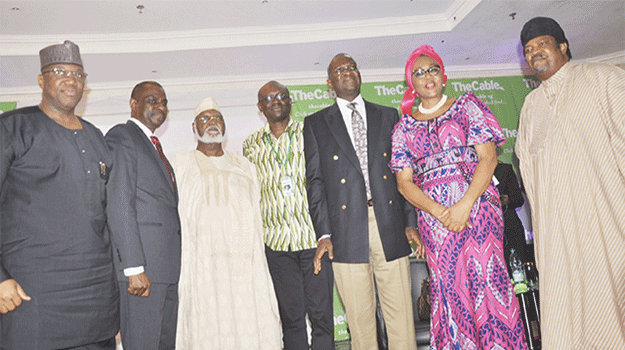

First Lady Remi Tinubu and Ademola Adeleke, Osun state governor
Last week’s drama, where the First Lady, Oluremi Tinubu, cut short Osun state governor, Ademola Adeleke, while singing worship songs at an official event, has once again reignited debate on leadership character, tone, and self-restraint in public space. While many Nigerians interpreted her interruption as abrupt, others believe she only maintained order. Whichever side one falls on, the moment exposed an issue that has been gathering dust for a while — the need for moderation in public behaviour by high-ranking officials.
I watched the video carefully, more than once, and I strongly believe the First Lady acted rightly. Before walking up to Adeleke, she whispered to the Ooni of Ife — perhaps seeking his indulgence or quietly expressing concern about the unfolding theatrics. Those of us who have interacted with Senator Oluremi Tinubu know she is assertive, sometimes blunt, and enjoys commanding the room when she speaks. She can be haughty — yes — but on this occasion, she exercised authority appropriately by calling the governor, popularly known as ‘Ade Dancer’, back to order.
Governor Adeleke is charismatic and relatable. His cheerfulness, his popular dance moves, his habit of breaking into songs at public events, and his engaging social-media presence have humanised him in a unique way. Nigerians admire leaders who feel like ‘one of us’ — warm, humorous, free-spirited. Adeleke embodies that perfectly. Videos of him jubilantly dancing at rallies and ceremonies routinely go viral, earning him applause from supporters who see him as a symbol of joy.
But charm is not a substitute for leadership. Overfamiliarity with the crowd does not equate to good governance. When a leader’s signature becomes excessive, predictable, and omnipresent, it stops being endearing and starts looking like unseriousness. Governance is not an entertainment show. A governor is not a performing artiste. He is the embodiment of state authority, a custodian of public trust, and the image through which citizens — and investors — perceive the seriousness of government.
Advertisement
The recent incident with the First Lady was not the first time Adeleke’s exuberance raised eyebrows. At a previous event where former President Olusegun Obasanjo was speaking, Adeleke arrived late and walked in while Obasanjo was on the podium. The ex-president, with characteristic humour, scolded him and jokingly imposed a fine. It drew laughter, but behind the humour was a reminder: respect for protocol matters. Public office demands discipline — in speech, movement, timing, and public conduct.
This leads to a crucial question: When does a leader’s vibrancy enrich public perception, and when does it cheapen it? A governor must know when to clap and when to keep still, when to joke and when to listen. A leader who always appears in a celebratory mood may be perceived as trivialising the seriousness of his responsibilities. In a period where Nigeria is facing economic hardship, widespread insecurity, and institutional decay, state executives must project competence and focus.
Being cheerful is not the problem. Leadership need not be gloomy to be effective. Nigerians do not desire rulers who frown to prove authority. Warmth and humanity are leadership assets. But leadership requires timing. There is a time for laughter and a time for silence. A time to entertain and a time to govern.
Advertisement
Even scripture affirms this wisdom. The Bible says, “To everything there is a season” — a time to talk and a time to keep silent, a time to mourn and a time to dance. Governance demands discernment of seasons. Unfortunately, Adeleke often blurs these lines. He wants to dance and sing at every gathering — casual or solemn, political or ceremonial. It gives the impression of a governor perpetually in celebration mode, even when the atmosphere demands restraint. Such conduct, however unintended, comes across as irresponsible and unbecoming of the office he occupies.
This is not about denying Adeleke his personality. He does not need to stop dancing entirely. But he must understand context. A governor must be versatile: cheerful in celebration, solemn at tragedy, firm in crisis, and focused in governance. The state deserves more than a performance; it deserves leadership.
The First Lady’s intervention — stern as it looked — should serve as a reminder, not an embarrassment. Programmes run on time and structure. Spontaneity should not disrupt official flow. Respect for programme order is respect for the institution. A leader who controls his impulses commands more respect than one who indulges them.
Unfortunately, Nigeria’s political climate encourages theatrics. We often elevate the spectacle of politics over policy substance. Media coverage of events frequently focuses on dancing, fashion, and humour rather than development outcomes. We laugh, we trend hashtags, but we rarely interrogate performance metrics. This is the pitfall Adeleke must avoid — becoming a meme more than a governor.
Advertisement
His supporters argue that his style endears him to the masses and breaks the stiffness common among Nigerian politicians. They are not wrong. But relatability should enhance leadership, not overshadow it. The most respected leaders are those who carry the people along while still maintaining decorum and command presence.
This moment should be a turning point. Adeleke has the opportunity to redefine his public image — not by removing his joy but by balancing it with maturity. He must communicate that beneath the rhythm lies rigour; behind the dancing shoes lies competence. He should still be the people’s governor, but also a governor who arrives early, respects time, focuses on issues, and projects authority when necessary.
Constructive criticism is not condemnation. It is guidance. Citizens deserve leaders who combine charisma with capability. Those who evolve when corrected earn greater respect. Adeleke has the capacity to leave a solid legacy if he channels his energy strategically. His dance should complement his achievements, not overshadow them.
We have seen this pattern before. What Adeleke is doing mirrors former senator Dino Melaye’s theatrics — famous for his “Ajekun Iya” performance. Many senators quietly felt he ridiculed the seriousness of the chamber. When he lost re-election in 2019, some rejoiced — not because he lacked talent, but because theatrics overshadowed lawmaking.
Advertisement
In the end, too much of everything is bad. A leader who entertains without restraint becomes a spectacle. But one who balances joy with judgment becomes a statesman. Adeleke must rediscover balance — because Nigeria needs leadership, not entertainment. The people expect seriousness. The office demands decorum. And history will judge him not by applause, but by results.
Akinsuyi, former group politics editor of Daily Independent, writes from Abuja. He can be reached at [email protected]
Advertisement
Views expressed by contributors are strictly personal and not of TheCable.