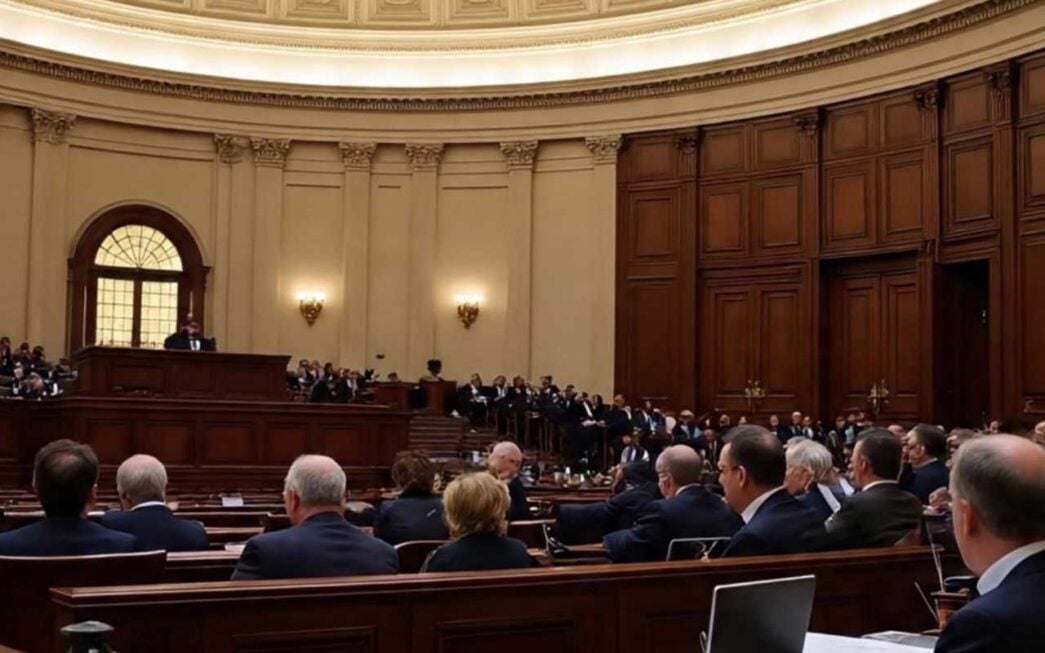
US lawmakers in congress | File photo
The United States congress has advanced a bill that seeks to revive the African Growth and Opportunity Act (AGOA), which expired on September 30 this year.
The AGOA Extension Act was introduced by Jason Smith, a member of the US house of representatives, who proposed a three-year renewal until December 31, 2028.
The extension permits retroactive duty-free treatment on imports from eligible African countries from the expiration date. This means importers can claim refunds for duties they have paid in the interval for AGOA-qualifying goods.
On Wednesday, the US house committee on ways and means passed the Extension Act by a vote of 37-3, showing strong bipartisan support before full house consideration.
Advertisement
A committee statement described the trade initiative as “the cornerstone of economic relations between the U.S. and Sub-Saharan African nations”.
Lawmakers aim to include the bill in a continuing resolution for federal funding past January 2026, amid intensified lobbying by African governments and US industry groups.
Rosa Whitaker, former assistant US trade representative for Africa and co-chair of the AGOA alliance, a coalition of US and African business, policy and trade leaders backed by Afreximbank, told The Africa Report that the renewal represents a major step forward for a programme that has supported 1.3 million African jobs, generated over half a trillion dollars in duty-free African exports to the US, and sustains nearly half a million American jobs.
Advertisement
“Since AGOA’s enactment, U.S. exports to sub-Saharan Africa have tripled — from $5.9bn to more than $18bn — strengthening supply chains and deepening strategic partnerships. AGOA has always been a true win-win for both the United States and Africa at virtually no cost to US taxpayers,” Whitaker said.
African ambassadors and business leaders are expected to arrive in Capitol Hill on Thursday for further meetings with key members of the ways and means committee, as well as the house foreign affairs and senate foreign relations committees.
AGOA’S FOOTPRINTS IN NIGERIA
Nigeria has been a beneficiary of AGOA since the programme’s inception in 2000.
Advertisement
According to a 2024 Brookings report, African beneficiary countries exported approximately $103 billion worth of non-crude products to the US between 2001 and 2022.
Of this figure, Nigeria was ranked second highest after South Africa, with a total of non-crude exports valued at $11.2 billion. South Africa contributed $55.9 billion.
Kenya was ranked third with an export value of $7.3 billion; Lesotho with $6.8 billion; and Madagascar came fifth with $3.6 billion.
Nigeria was also ranked second place for top non-crude US imports favouring natural resources in the category of light oils and preparations from petroleum oils valued at around $4 million between 2001 and 2022.
Advertisement
According to the National Bureau of Statistics (NBS), between 2015 and 2024, Nigeria imported goods worth N14.71 trillion from the US.
Exports to the US stood at N16.34 trillion in the same time period. The share attributable to AGOA is uncertain.
Advertisement
The Nigerian Export Promotion Council (NEPC) did not immediately respond to TheCable’s request seeking data on a breakdown of AGOA-export values.
AFCTA OFFERS CUSHION TO BOOST INTRA-AFRICA TRADE
Advertisement
While Africa plays a key role in Nigeria’s export economy, the data indicates that it is lagging as a source of imports for the continent’s giant.
The NBS said between 2015 and 2024, Nigeria imported goods of N7.45 trillion from African countries — about half of the N14.71 trillion spent on imports from the US within the same period.
Advertisement
After US President Donald Trump slammed a global tariff blitz on nations including Nigeria, Jumoke Oduwole, minister of industry, trade, and investment, said the move was a strong signal for Africa to start trading more within its continent through the African Continental Free Trade Area (AfCFTA) agreement.
Kubans Dandaso, an AFCTA official at the Nigeria Coordination Office, told TheCable that the pact has piloted a guided trade initiative (GTI) to help businesses benefit from market access.
“For instance, there are several ongoing initiatives around digital trade under the digital trade protocol such as the pan-African payment and settlement systems which enable ease in cross border payment and interoperability. More and more initiatives are being conceived,” Dandaso said.
“There are support packages for SMEs in terms of capacity building to take advantage of the opportunities. Some of this capacity development initiatives have the buy-in of international development partners.
“It must be added however that AfCFTA is a journey that requires collective effort to realise its full benefit.”
The AFCTA official, however, pointed to deep political wells, fragmented synergy between relevant stakeholders, lack of capacity, and weak institutional frameworks as the biggest challenge to implementing the continental trade deal.
He praised Nigeria for steady participation in regional trade but warned that there are still gaps which may widen as AfCFTA evolves.