


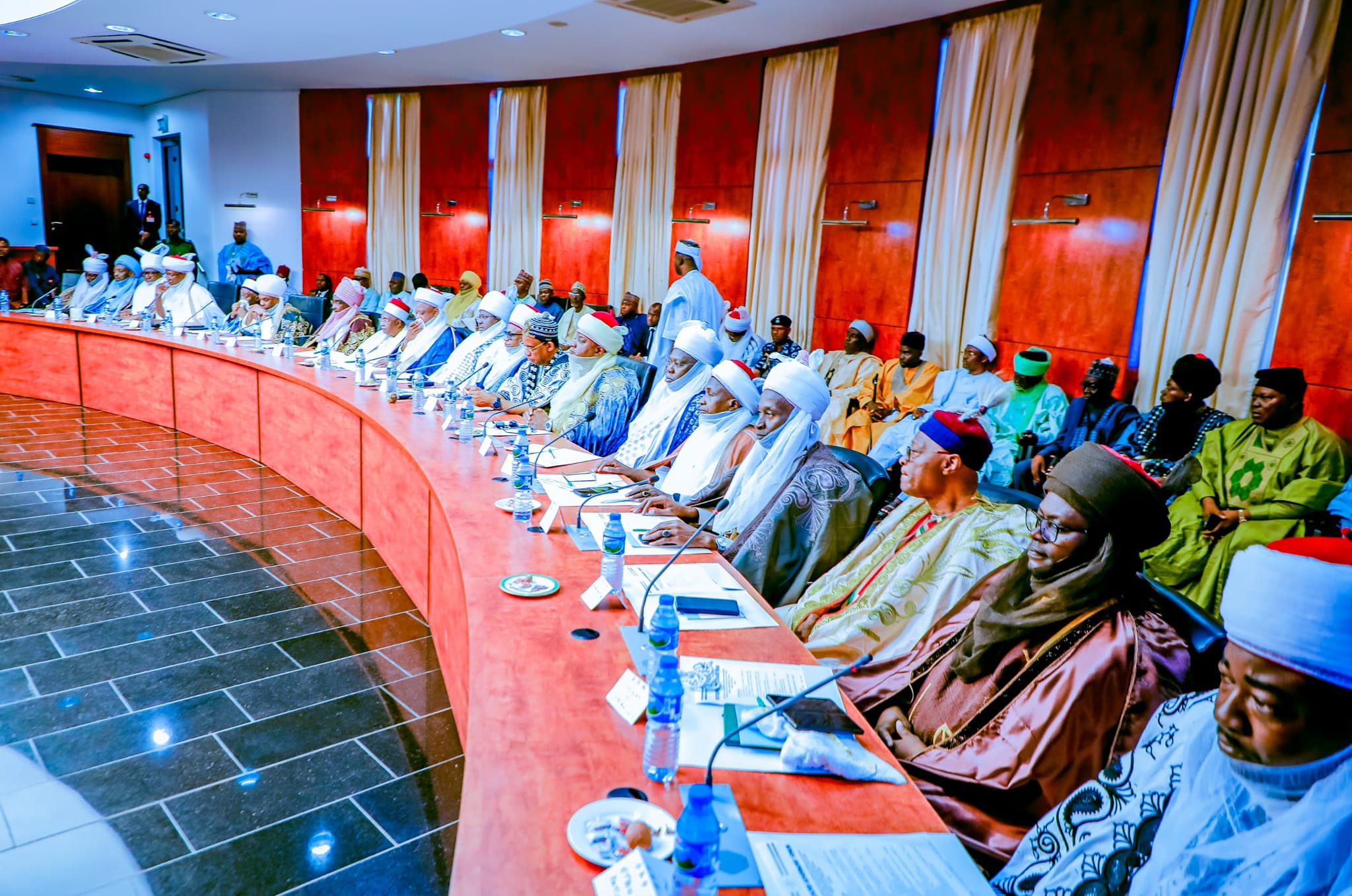
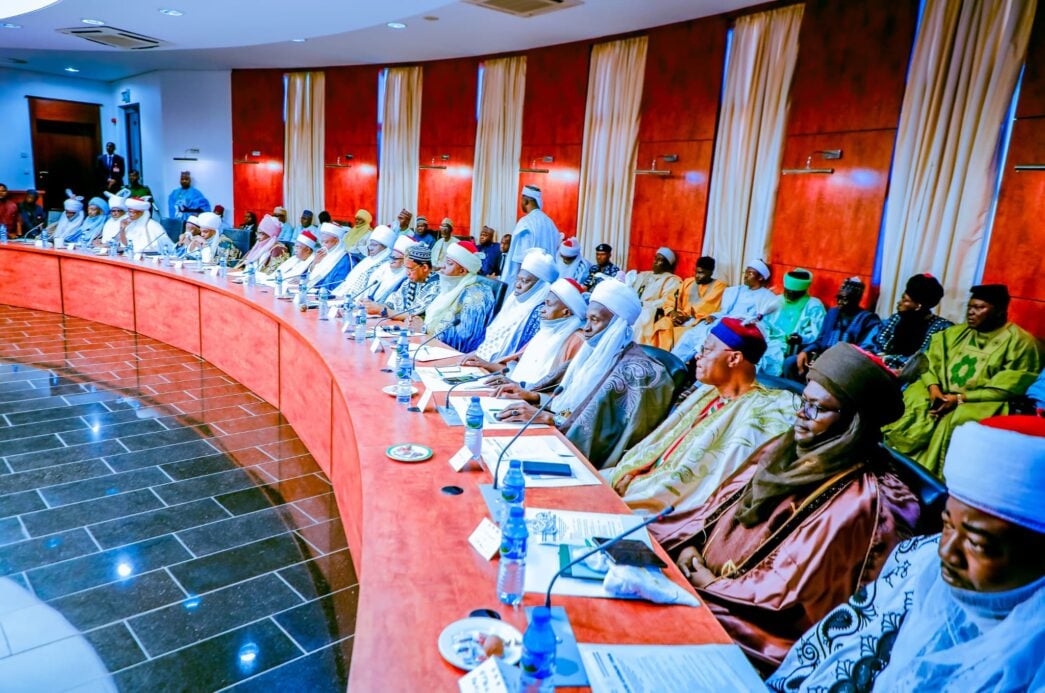
Traditional rulers during the meeting at the State House
BY JOSEPH UMARU PHILIP
For many Nigerians, particularly those living in rural areas, the government is perceived and experienced primarily through the activities of local councils. It is the village road, the primary health centre, the primary school, the market, the drainage channel, and the councillor who have been mostly appointed rather than elected as expected. This is where democracy is meant to be most tangible and where the social contract between the state and citizen should be felt most directly. Yet this is precisely where governance has failed most deeply.
Across Nigeria today, local government has become the weakest link in our democratic chain. Recognising the influence of traditional institutions, which remain deeply embedded and socially legitimate, can inspire hope, deepen citizen participation, and bridge the gap between citizens and their local governments.
In a previous essay, I made the case for reclaiming indigenous governance and integrating traditional rulers into Nigeria’s constitutional future. I argued that rising insecurity and the retreat of the state across many communities demand a new governance imagination, one that blends constitutional democracy with indigenous legitimacy rather than treating them as parallel worlds.
Advertisement
One lesson from postgraduate field research conducted across rural and semi-urban communities in the Federal Capital Territory, Abuja, is that in communities where local government presence was weak, politically captured, or practically absent, traditional institutions stepped in to fill the vacuum. They mediated land disputes, resolved conflicts, mobilised community-led development projects, coordinated informal security efforts, and maintained social order. In effect, they became the operating layer of grassroots governance.
Where informal collaboration exists between traditional institutions and statutory authorities, development projects progress more quickly, community resistance is lower, and social trust is stronger. Where hostility or isolation prevailed, projects stalled, conflicts escalated, and citizens withdrew from formal governance. Residents in most communities also expressed greater confidence in approaching traditional institutions than elected officials for leadership access and mediation, not because they rejected democracy, but because traditional systems felt more accessible, familiar, and protective.
The implication is as simple as it is uncomfortable. Nigeria’s grassroots governance already operates through an informal hybrid of democracy and tradition. The tragedy is that this hybrid remains legally unsupported, institutionally disconnected, and politically exposed.
Advertisement
Ungoverned Spaces Are Not Ungoverned
This crisis is now being amplified by the rapid spread of what may be described as ungoverned spaces. These are communities where formal state institutions have largely retreated. The Local Government office is distant or inactive. Policing is weak or absent. Justice is slow or inaccessible. Development planning is invisible. In many such places, the Nigerian state exists only in name.
Yet one of the most revealing contradictions of our political reality is that no Nigerian community is ever truly without governance. Even in the most neglected settlements, there is always a “Mai Angwa”, “a Baale”, or “an Obi” who exercises some form of traditional governance authority and enjoys a level of legitimacy from the people. Where the formal state withdraws, indigenous governance remains firmly in place.
Nigeria, therefore, does not suffer from a total absence of grassroots governance. What it suffers from is the collapse of formal local governance alongside a persistent refusal to integrate the indigenous systems that continue to regulate the everyday community life. Traditional local governance level has not collapsed; it has simply been pushed outside the law. This disconnection has resulted in a fragile balance that leads to violent alternatives and often creates criminal networks and rebel governance in certain states, where non-state actors fill the governance gap. This leadership challenge explains the reasons why the integration of traditional institutions into local governance, a matter of cultural symbolism, should no longer be. It is now a question of democratic survival, internal security, and state legitimacy.
Advertisement
Leveraging the Ongoing Constitution Review
Nigeria’s ongoing constitutional review process, driven by the National Assembly of Nigeria, must now grapple with this reality directly. Addressing Nigeria’s deepest democratic failure-the disconnection between formal local government and indigenous systems-is essential for the country’s democratic survival and internal security, urging policymakers and stakeholders to act decisively.
For the first time, the constitution must move beyond silence and formally recognise traditional institutions as essential partners in local governance—serving as civic anchors of participation, peace, accountability, and development legitimacy, not as political competitors or elective officeholders.
Reforming the Ward: Where Integration Must Begin
Advertisement
This integration must begin where governance is most immediate and most contested: at the ward level. The functions of the village or district head and those of the ward councillor should no longer operate as parallel lines of authority but be deliberately integrated into a single, unified grassroots representation structure.
The ward councillor already holds a democratic mandate to legislate and represent. The village or district head already holds social legitimacy, cultural guardianship, and intimate knowledge of the community. The reform task is to fuse these complementary strengths into one cohesive civic office that reflects both electoral legitimacy and indigenous trust.
Advertisement
Such ward-level leadership must be shaped by local realities rather than imposed by uniform political formulas. Communities should determine how candidates emerge through locally legitimate methods that still satisfy constitutional standards of inclusion, fairness, and accountability. What matters is that the occupant of the office simultaneously commands democratic authority and cultural recognition. In this model, ward governance becomes a hybrid civic institution that is constitutionally anchored, democratically accountable, and socially legitimate.
Beyond the Ward: Legislative and Advisory Roles for Traditional Institutions
Advertisement
Beyond the ward, traditional institutions with broader spheres of influence must move beyond ceremonial recognition into formal civic participation. Paramount rulers, emirate councils, kingdom authorities, and apex traditional bodies whose influence extends beyond a single ward should be granted defined advisory and legislative roles at the Local Government Council, the State Houses of Assembly, and even at the national level.
At the Local Government Council, their participation should take the form of statutory advisory involvement in deliberations on land governance, boundary disputes, communal resource management, customary justice harmonisation, cultural development, and local security architecture. Their role should shape legislative reasoning and conflict prevention without encroaching on budgetary control or executive authority.
Advertisement
At the State House of Assembly, traditional institutions with wider domains should be constitutionally recognised within a special representational or consultative framework that allows them to contribute to lawmaking on land use, rural security, community policing, chieftaincy administration, cultural preservation, and internal peacebuilding. This would finally bridge the long-standing gap between statutory law and the lived governance traditions of Nigeria’s rural and semi-urban communities.
At the national level, this representation can be further extended through designated legislative or constitutional advisory platforms, especially on issues that cut across federalism, land tenure, internal security, and citizenship.
Lessons from Sierra Leone
There is already an African precedent for this form of integration. In Sierra Leone, traditional leaders are formally represented in the governance system through rotational and elective mechanisms, ensuring that customary authority participates in the legislative process without displacing democratic representation. The lesson is not that Nigeria should completely copy another country, but that traditional authority and constitutional democracy can coexist within the same legislative framework without undermining one another. Representation can be elective rather than hereditary, rotational rather than permanent, and accountable rather than sacrosanct.
Safeguards Against Politicisation
Such a framework offers Nigeria clear advantages. It restores state legitimacy in communities where the formal system has lost relevance. It channels indigenous authority into constitutional order rather than leaving it exposed to capture by criminal or extremist forces. And it transforms traditional institutions from external observers of governance into internal stakeholders in democratic stability.
But this integration must be firmly regulated. Traditional institutions must be constitutionally barred from partisan political campaigning, budgetary control, contract awards, and executive command. Their mandate must remain civic, mediatory, cultural, stabilising, and advisory. At the same time, democratic institutions must remain bound by electoral accountability, fiscal transparency, and constitutional oversight. What changes is not who holds executive power, but how legitimacy is constructed and how participation is structured.
Rebuilding the Social Contract from the Bottom Up
Nigeria’s local government crisis is not only financial. It is not only political. It is institutional and relational. The bond between formal authority and community legitimacy has been broken. To repair it, Nigeria must stop treating democracy and traditional institutions as opposing systems. They are not. Our failure has been in running them as parallel worlds when they should function as a single, integrated local governance ecosystem. Only then can local government return to what it was meant to be: not the weakest link in Nigeria’s democracy, but its strongest foundation.
Joseph Umaru Philip is a Governance and peacebuilding practitioner with a focus on conflict prevention, democratic governance, and youth and women’s inclusion.
Views expressed by contributors are strictly personal and not of TheCable.