
BY ABDULAZIZ IDRIS ABUBAKAR
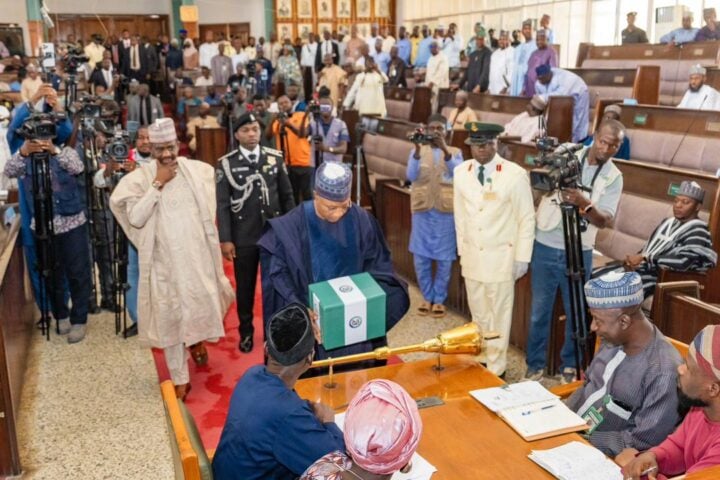
In a political era often marked by performative declarations and fragile commitments, Kaduna State has in the last two and a half years carved out a reputation for purposeful governance, methodical execution, and measurable impact. Central to this transformation is the moral clarity and administrative steadiness of Governor Uba Sani, particularly his disciplined pursuit of security, equity, prosperity, and transparency. His presentation of the 2026 Budget estimate to the Kaduna State House of Assembly, an event framed not merely as a constitutional ritual but as an act of visionary stewardship, has reaffirmed a leadership ethos grounded in prudence, ambition, and the unyielding conviction that government exists to build human dignity and expand opportunity.
The Governor’s articulation of the fiscal blueprint was as sober as it was stirring. In his words, “This document is more than an annual fiscal outline; it is a carefully constructed roadmap for consolidating the economic renewal, social inclusion, and infrastructural transformation we have pursued since assuming office.” That single line captured the essence of the moment: this is not a budget designed to impress; it is one designed to endure, to deepen, to solidify. It is a budget that seeks to move Kaduna State past the threshold of initial reforms into a new phase of durably institutionalised progress.
The Kaduna State 2026 Budget proposal, totaling ₦985,915,136,574.60, embodies a delicate balance between prudence and ambition. This equilibrium is intentional. It is not the product of political theater but the outcome of broad consultations: citizens, civil society, traditional institutions, development partners, the private sector, and the Legislature itself participated in shaping it. Indeed, in the Governor’s deliberate opening, he emphasized that the participatory process helped ensure that the budget “reflects the genuine needs and expectations of communities across the State.” It is rare to find a subnational administration that consistently matches its rhetoric of inclusion with such practical frameworks for joint decision-making. Kaduna has become one of the exceptions.
The budget’s bold allocation pattern: 71% to capital expenditure and 29% to recurrent expenditure, reveals a government intent on building for future generations rather than merely managing the present. It is a continuation of an agenda that has in two and a half years already shifted Kaduna’s developmental trajectory. Where some governments erect structures as symbolic gestures, the Sani administration has conceptualised infrastructure as a civic responsibility, a lever for economic dignity, and an instrument of long-term societal reshaping.
Advertisement
Kaduna’s transformation has been anchored on a pillar that predates every other aspiration: security. No reform, no infrastructure, no investment agenda can thrive without safety. Over the past year, the government has undertaken a multi-dimensional approach; working with federal forces, supplying logistics and intelligence support, strengthening community engagement structures, and deploying what is now generally known as the Kaduna Peace Model. Through these interventions, markets have been reopened, farmlands reclaimed, schools restored, and social life gradually returned to communities long held hostage by insecurity. Yet, in the Governor’s own sober reflection, progress is encouraging but incomplete; the forces that threaten peace evolve continuously, and governance must adapt just as dynamically.
Infrastructure has been the second great pillar; visible, expansive, and transformative. Across Phases I and II of the Roads Development Initiative, Kaduna is undertaking one of the most ambitious road construction programmes in its history: 140 road projects covering 1,335 kilometres. Sixty-four of these are already complete. But beyond the physical measurements, these corridors of asphalt and concrete are corridors of hope, reweaving the social and economic fabric of the state. Roads are connecting farms to markets, villages to cities, and Kaduna’s economy to the accelerating commerce of the wider Northern region.=
Public transportation has similarly entered a bold new era. The Kaduna Bus Rapid Transit (KBRT) system, an unprecedented partnership with the Agence Française de Développement, is the first of its scale in Northern Nigeria. Its 24-km dedicated corridor, CNG-powered buses, modern terminals, and large-scale job creation promise not only mobility efficiency but also environmental responsibility. The project was beset by delays in its earliest stage, yet the government pressed forward, and implementation is now accelerating.
Advertisement
The new Interstate Bus Terminal at Kakuri, already 75% complete, stands as a forward-looking effort to eliminate illegal parks, enhance security, and streamline travel. Over 200 bus stops are under construction, and the rationalisation of parks; from Sobawa to Tafa to Maraban Jos, reflects a government intent on converting chaotic urban habits into orderly civic systems. The proposed light rail project, resurrecting the historic Rigachikun–Sabon Tasha corridor and linking Millennium City to Rigasa in Phase II, suggests that Kaduna’s transportation evolution is only just beginning.
The rural sphere has not been neglected; indeed, it has emerged as a central stage for renewal. Over 500,000 hectares of abandoned farmland have been reclaimed, displaced farmers are returning, and rural markets are humming once again. These changes speak to a vision that recognises rural Kaduna not as peripheral territory but as the backbone of the state’s economic resilience.
No investment yields as far-reaching a return as education, and this administration has embraced that understanding with uncommon scale. In 2025 alone, 535 schools were reopened, 736 classrooms constructed, 1,220 renovated, 595 VIP toilets built, 165 boreholes installed, and over 33,000 teachers trained. More than 10,000 out-of-school children found their way back into classrooms, supported by the 40% reduction in tuition across state-owned tertiary institutions. The expansion of “Teaching at the Right Level” now benefits 373,000 learners, while new vocational centres, bilingual schools, and the Basic Education School in Tudun Biri mark a fresh reimagining of foundational learning. This is not an administration treating education as a box to tick; it is one viewing it as the bedrock of future prosperity.
Healthcare has experienced similar revitalisation. The upgrading of all 255 Primary Health Centres to Level 2 standard, arguably the most comprehensive PHC overhaul by any Nigerian state, signals a structural approach to community health. General hospitals are being reconstructed across the state, and the newly commissioned 300-bed Bola Ahmed Tinubu Specialist Hospital stands as the most modern health facility in Kaduna. Health workers have received improved welfare through full CONMESS and CONHESS implementation, while emergency services under KADSEMSAS have been upgraded. The government has even allocated ₦1 billion to expand health insurance coverage for vulnerable groups. These developments collectively indicate a philosophy that sees healthcare not as expenditure but as investment in human capital.
Advertisement
In perhaps the most astonishing transformation of all, agriculture, long destined to remain the backbone of Kaduna’s economy, has been revitalised with unprecedented scale. Fertilizer distribution reached more than 900 truckloads, provided free-of-charge to smallholder farmers, while commercial farmers now access subsidized fertilizer to stabilise production costs. Investment in agriculture has risen by nearly 5,000% in just two years. The $510 million Special Agro-Industrial Processing Zone is firmly positioning Kaduna as the agricultural engine room of Northern Nigeria, while the Agricultural Quality Assurance Centre promises to unlock regional and global markets through quality certification. In a state as large and diverse as Kaduna, such agricultural investments do not simply strengthen food security; they reposition the entire economy.
Climate action, too, has found an institutional home. The finalisation of the Kaduna State Food and Nutrition Policy, the launch of the Multisectoral Nutrition Plan (2026–2030), and the adoption of a state-wide Climate Action Policy reflect a government conscious of long-term planetary and human vulnerabilities. The Uba Sani administration clearly understands that development is meaningless if it is not sustainable.
Social welfare has been strengthened with direct support reaching more than 150,000 vulnerable households, and programmes for disability inclusion, women’s empowerment, and youth development are expanding. Underpinning these efforts is a commitment to justice and fairness; one that ensures no community is marginalised and no demographic forgotten.
Data-driven governance has become a defining characteristic of the state’s administration, with surveys in agriculture, poverty, health, education, and economic performance guiding policy and expenditure decisions. Kaduna’s commitment to transparency is reflected in its global recognition under the Open Government Partnership; standing as the only subnational entity in Nigeria fully implementing OGP commitments. Debt discipline has been equally exemplary: no new loans have been contracted since Governor Sani assumed office, and ₦114.9 billion has been paid in debt service without compromising essential services.
Advertisement
The 2026 Budget therefore emerges not merely as a set of numbers but as the crystallisation of a coherent, far-sighted vision. It allocates resources to the sectors that matter most: Education (25%), Infrastructure and Rural Transformation (25%), Health (15%), Agriculture (11%), Security (6%), Social Development (5%), and Climate Action (4%), with the remaining funds supporting governance and reforms. Yet amid these large-scale commitments, the administration has taken care to empower the smallest units of democracy: every one of the 255 wards has been allocated ₦100 million for projects chosen by the communities themselves. This is participatory budgeting at a scale unparalleled in the country.
As the Governor declared, “The 2026 Budget is an affirmation of our shared commitment to rebuild, reform, and reposition Kaduna State.” And in a final gesture of civic solidarity, he urged all stakeholders to remain united, remarking that the task ahead requires unwavering cooperation.
Advertisement
In its totality, the 2026 Budget is a testament to what purposeful governance can achieve. It is a reaffirmation that Kaduna State is not merely moving forward; it is moving forward with thoughtfulness, with discipline, and with a reverence for the future. It is the embodiment of an administration determined to ensure that progress is not episodic but permanent; not selective but inclusive; not symbolic but structural. And in this resolve, one finds the clearest evidence that Kaduna is not only being transformed: it is being redefined.
Governor Uba Sani has therefore offered not just a budget but a covenant; not just projections but promises backed by performance. As Kaduna looks towards 2026 and beyond, it does so with the confidence that leadership; steady, humane, and visionary, remains firmly on course.
Advertisement
Abubakar, a freelance journalist, resides in Kawo, Kaduna.
Advertisement