Siminalayi Fubara
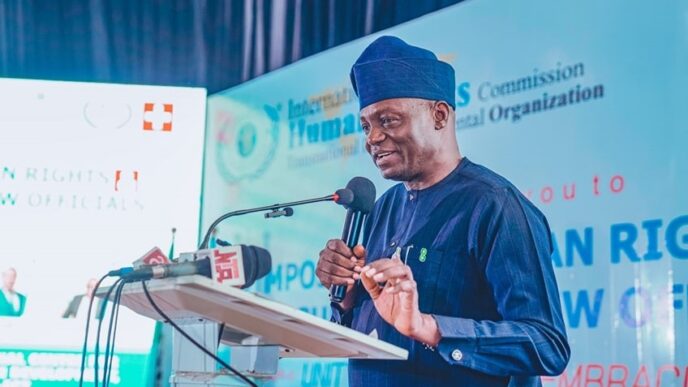
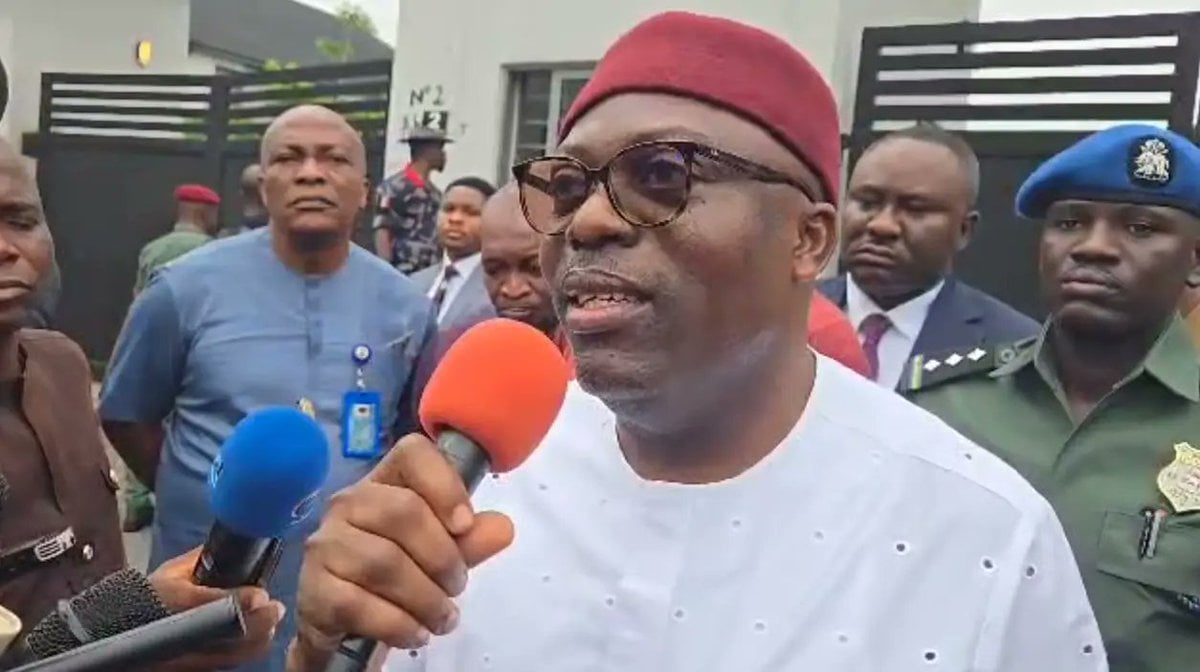
After months of political hide-and-seek, Rivers State governor, Siminalayi Fubara, formally announced his defection from the Peoples Democratic Party (PDP) to the ruling All Progressives Congress (APC) last week. The move did not come as a surprise to many Nigerians. In fact, for a large section of the political class, it felt long overdue, considering the events before, during, and after Fubara’s return to office following his six-month suspension under the state of emergency.
What, however, remains deeply puzzling—and is the reason for this intervention—is Fubara’s claim that he left the PDP because the party “failed to protect him.” When weighed against verifiable facts, this allegation raises more questions than it answers. One is therefore compelled to ask: how exactly did the PDP fail to protect him?
On March 18, President Bola Tinubu declared a state of emergency in Rivers State, suspending Fubara, his deputy, Ngozi Odu, and all elected members of the Rivers State House of Assembly. It was an extraordinary action with profound implications for federalism, constitutionalism, and democratic governance. Contrary to Fubara’s suggestion, the PDP’s response was neither silence nor complicity.
Almost immediately, the party issued a strongly worded statement condemning the emergency declaration, describing it as unconstitutional and a dangerous precedent. More significantly, PDP governors approached the courts, challenging the legality of the president’s action. In a constitutional democracy, litigation is not a sign of weakness; it is the most legitimate and responsible form of resistance available to an opposition party that does not control the federal executive or the coercive instruments of the state.
Advertisement
The chairman of the PDP Governors’ Forum, Bala Mohammed, was also particularly vocal in condemning the emergency declaration and publicly expressing solidarity with Fubara. Beyond the party’s formal structures, Adolphus Wabara, former Senate President and Chairman of the PDP Board of Trustees, openly faulted Tinubu’s decision. His intervention went beyond symbolism; it reinforced elite consensus within the party that the Rivers emergency was unjustified.
Against this backdrop, Fubara’s claim of abandonment invites an unavoidable question: what more protection was realistically available?
The PDP is not in power at the centre. It does not command the armed forces, the police, or the institutions that enforce presidential proclamations. It cannot nullify a state of emergency by issuing a press statement, nor can it restore a suspended governor through partisan fiat. The tools available to it are public opposition, legal challenge, and political advocacy—all of which it deployed.
Advertisement
Some of Fubara’s supporters argue that the PDP’s real failure lay not in its response to Tinubu, but in its earlier handling of Nyesom Wike, the former Rivers governor and now a key figure in the APC-led federal government. According to this view, the party should have expelled Wike decisively, thereby preventing the crisis that engulfed Rivers state.
This argument, however, collapses under scrutiny. Even if Wike had been expelled at the height of the intra-party conflict, such an action would not have legally constrained the president from declaring a state of emergency. Party discipline, no matter how forceful, does not override constitutional authority. At best, expelling Wike would have offered moral clarity; it would not have altered the legal mechanics that led to Fubara’s suspension.
What appears more plausible is that Fubara equates protection with decisiveness rather than legality—an understandable sentiment in a political culture where force often trumps procedure. But opposition politics, particularly for a party as internally weakened as the PDP, does not permit theatrical gestures without grave consequences. The party is already struggling with fragmentation, electoral losses, and declining public trust. To demand maximalist actions without regard to institutional capacity is to ignore political reality.
There is also a deeper irony in Fubara’s complaint. By leaving the PDP at its weakest moment, he further diminishes the very platform that challenged his suspension in court and defended his mandate in public discourse. If the party is indeed “badly damaged,” abandoning it does not strengthen resistance to executive overreach; it weakens it further.
Advertisement
This point was underscored by the new PDP National Publicity Secretary, Ini Ememobong, who disclosed that party leaders—particularly Governor Bala Mohammed—were willing to intervene more forcefully, but were repeatedly restrained by Fubara himself. According to Ememobong, the governor either became unreachable or insisted that the party should “not worry” because he would “handle it.” As he aptly put it, volenti non fit injuria—harm cannot be done to a consenting person.
Ememobong further noted that while the PDP sympathised with Fubara, it strongly rejected attempts to shift blame. Till today, the governor has not publicly explained the nature of the agreements he entered into, nor clarified the real origin of his political predicament. The suggestion that “Stockholm syndrome” may be at play—where a captive grows sympathetic to his captor—may sound harsh, but it reflects growing frustration within the party over what appears to be selective amnesia.
Indeed, in May 2025, during a service of songs in Port Harcourt in honour of the late Edwin Clark, several PDP leaders condemned the emergency declaration and referred to Fubara as the rightful governor. His response was telling: he asked them not to bother fighting for him, saying that his “spirit had left Rivers Government House.”
How ironic! A man says don’t fight for me. Yet, he kept blaming those who tried to defend him after the fight for not protecting him. That is an argument only a simpleton will espouse.
Advertisement
None of this is to argue that the PDP is blameless in the Rivers crisis. Its prolonged tolerance of internal sabotage, inconsistent messaging, and fear of confronting powerful individuals undoubtedly created conditions that made Fubara vulnerable. But those failures belong to an earlier phase of the conflict. Once the state of emergency was declared, the party acted within the limits imposed by law and opposition politics.
Politics must be grounded in achievable outcomes, not emotional expectations. If Fubara possesses a new legal strategy, a constitutional pathway to immediate reinstatement, or evidence of collusion between the PDP and the federal government, he owes Nigerians an explanation. Short of that, claims of abandonment sound less like principled critique and more like displaced frustration.
Advertisement
The PDP, for all its flaws, did what it could to defend Fubara. His claim that the party failed to protect him stand logic on its head. The majority, which is the presidency, had its way while the minority, the PDP, had its say. To demand the impossible from an opposition party is neither persuasive nor productive—and it does little to advance the democratic cause Fubara claims to defend.
Let Fubara shed more light on how the PDP failed to protect him during the crisis. Let us also remind him that the Rivers crisis is far from over. We are watching to see the protection he will get from his newfound love- the APC.
Advertisement
Akinsuyi, former group politics editor of Daily Independent, writes from Abuja. He can be reached at [email protected]
Advertisement
Views expressed by contributors are strictly personal and not of TheCable.