
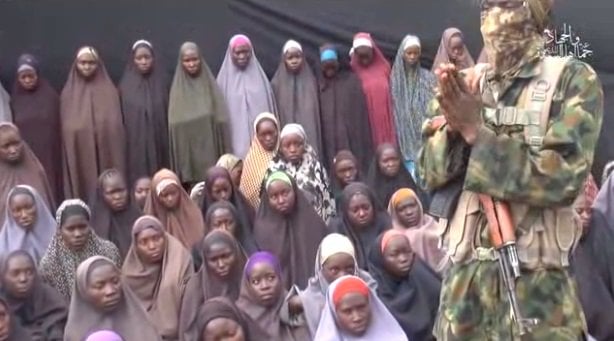
A file picture of the abducted Chibok girls
Sometimes, we find ourselves at a crossroads in our thoughts. We ask questions about a specific event that is unfolding again, and in a similar fashion. In such situations, we pause and reflect. That process is one of the fastest periods for the brain. It processes several information to conclude. Hear this: On the night of 14 April 2014, 276 young girls were kidnapped from the Government Girls Secondary School, Chibok, Borno State. And 57 girls later escaped from captivity. On November 21, 2025, gunmen abducted 303 students at St. Mary Catholic School in Papiri, Niger State. 50 students also escaped from captivity. Is this Déjà vu?
It is that time again.
The recent happenings in the country are not a false sense of familiarity. It is that time again. And everything seems premeditated. In 2009, I had a chance meeting with the late Dora Akunyili. She was the minister of information at the time the country launched the national Rebrand campaign, christened “Good People and Great Nation.” That period linked me with one of my benefactors, Sunday Dare, the former minister of youth and sports development and presently the Special Adviser to the President on Public Communication. I authored an article on the “Good People and Great Nation” campaign, and he picked me. At the time, he was the Senior Special Assistant on Media to Dora Akunyili.
He engaged me on multiple fronts, and I gained valuable insights into the inner workings of government. It is a complex regime. The intricacies are overwhelming. It was then that I learnt about the categorization of Nigerians when it comes to government business. They are the “helpers, wailers and destroyers.” The “helpers” are supportive and enthusiastic about the country. They give their best. But most times, they end up frustrated. The “wailers” are loud on problems, less on fixes. They are fickle. They get swayed easily. The “destroyers” are opportunists. They are agents of chaos. They consist of political and religious irredentists. Their sense of entitlement is nauseating. However, there is a tricky part in this categorization.
Advertisement
A “wailer” in times past might now be a “helper,” and a destroyer in times past might now be a “wailer.” It explains the fluidity of the political terrain in Nigeria. It looks like a joke most of the time. You are at liberty to draw a list of those in the various categories under our present political arrangement. I assure you that it would be a wrenching mental exercise. But keep your findings restricted. Some things are better left unsaid. I learnt this a long time ago.
It would be a dream to believe that what is happening in the country is happenstance. Think about this. Suddenly, the level of insecurity in the country rose astronomically, with a resemblance to what had happened in our recent past. Kidnappers went riot. Bandits unleashed terror. Boko Haram/ISWAP terrorists became daring with coordinated attacks in the northeast. And as usual, the tirade is directed to “whom it may concern.” And those concerned must lick their wound in equanimity.
2014 and 2025 are similar
Advertisement
The year 2014 is a reference point in our annals. The year 2025 would also be a reference point if things stay the same. In 2014, Boko Haram activities increased, and the “Chibok Girls” abduction gained global attention with the “Bring Back Our Girls” campaign. Suicide bombings were rampant. Six days after the “Chibok Girls” abduction, two bombs exploded at a crowded bus station in Nyanya. Highlighting the security challenges in the country presently is an emotional upheaval. Its frequency is reminiscent. Its methods are consistent. Its victims are, as usual. It is too much of a coincidence. I do not need a soothsayer to convince me.
Everything that happens in Nigeria has its immediate, remote, and political causes. This is what the “wailers” do not understand. They take things at face value. They are quick to criticize, not for its merit, but for what is before them. Many are in this category. They do not recognize the presence of the “destroyers” who want to decide who gets what, when and how according to their terms and conditions. Do not look too far. They are everywhere you can think of in the public and private sectors. Their power is intricately linked to their nuisance value. Most times, the political authorities are susceptible to their whims and caprices. Former President Goodluck Jonathan was a victim. And the reason is simple. He was not militaristic.
What is militarism?
Militarism is not a new concept. It is just not often used in our vocabulary. I will attempt to explain militarism as an ideology and social relations. Ideological perspectives on militarism focus on its political-cultural aspects. This was corroborated by Michael Mann, a British-American emeritus professor of sociology, in his work “The Roots and Contradictions of Modern Militarism.” He stated that “Militarism is a set of attitudes and social practices which regards war and the preparation for war as a normal and desirable social activity.” Politics is war, and war is never an isolated act.
Advertisement
The implication is that a president who holds this ideology is militaristic and can withstand the onslaught of the “destroyers.” Olusegun Obasanjo was militaristic. Umaru Yar’Adua was militaristic. Muhammadu Buhari was militaristic. But Goodluck Jonathan was not militaristic. Bola Ahmed Tinubu is militaristic. Our political history from 1999 has his inputs. I saw an old picture of him with late Sani Abacha and MKO Abiola. The picture told a thousand words. It explained the postulations of the renowned Italian philosopher and historian Niccolo Machiavelli, in his work “The Prince,” a treatise on how to acquire and maintain power. He created a distinction between “fortune and virtue” in the political space. He argued that “when a prince comes to power through luck or the blessings of powerful figures (fortune) within the regime, he typically has an easy time gaining power but a hard time keeping it thereafter, because his power is dependent on his benefactors’ goodwill.”. This happened in 2015.
He also highlighted that “Princes who rise to power through their skill and resources (virtue) rather than luck tend to have a hard time rising to the top, but once they reach the top, they are very secure in their position.” This played out in 2023. The security challenges in the country are patterned. It is too much of a coincidence. It feels less random. The “wailers” would question my position. But the “destroyers” are neck deep in their enterprise of frustrating the “helpers” and confusing the “wailers.” In all, it is a web of conspiracies that is playing out again. Let us give it some thought. I might be right.
And one more thing. Musa is back!
General C.G. Musa can pass for an institution. His goodwill cuts across. His return as the Minister of Defence is a strategic one. It is on a higher pedestal in the security architecture in the country. His screening session at the National Assembly was indicative of what to expect.
Advertisement
Ocheja, PhD, is a military historian and an alumnus of the Nigerian Defence Academy.
Advertisement
Views expressed by contributors are strictly personal and not of TheCable.