
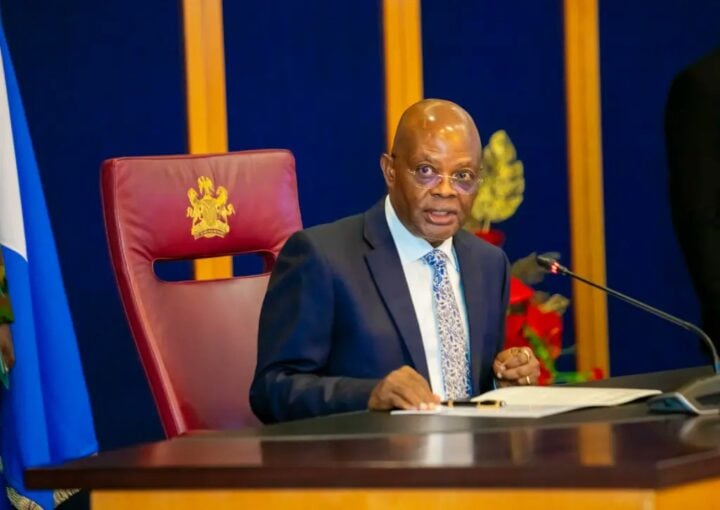
Ibok-Ete Ibas, former sole administrator of Rivers state
A correct interpretation of the Supreme Court’s pronouncement on the constitutionality of the emergency rule imposed on Rivers State leads to only one reasonable conclusion: the apex court considers the Rivers emergency unlawful. The court emphasised that presidential authority is circumscribed by constitutional procedure and underscored the imperative of protecting democratic institutions even in moments of crisis.
Although the learned justices’ declarations lacked the force of a binding and enforceable judgment due to a technical lapse that resulted in the suit being struck out, the decision, taken as a whole, offers important signals for Nigeria’s democratic survival and the institutional independence of its constitutional organs.
The ruling arose from a suit filed by 11 governors elected on the platform of the Peoples Democratic Party, challenging President Bola Tinubu’s March 18 declaration of a state of emergency in Rivers State. Relying on Section 305 of the 1999 Constitution, the President not only proclaimed an emergency but also suspended democratic structures in the state and appointed a sole administrator, retired Air Vice Marshal Ibok Ette Ibas, to govern Rivers for six months.
The suit, Attorney General of Adamawa State & 10 Ors. v. Attorney General of the Federation & Anor., was dated March 20 and filed on April 8. However, the Supreme Court did not deliver its judgment until December 15, long after the six-month emergency had lapsed and democratic institutions had been formally restored. Arguments were heard on October 21, after which judgment was reserved, a timeline that further illustrates the slow grind of justice even at the nation’s apex court.
Advertisement
In a split decision of six to one, the Supreme Court upheld the respondents’ preliminary objections and struck out the suit for want of jurisdiction, holding that the plaintiffs failed to establish a justiciable cause of action and that Rivers State itself had not consented to the litigation. Justice Mohammed Baba Idris, who delivered the lead judgment, reaffirmed that jurisdiction remains the lifeblood of adjudication under Nigeria’s constitutional framework.
Significantly, however, the court did not shy away from addressing the substantive constitutional questions raised by the plaintiffs. The justices examined whether Sections 1(2), 5(2), 176, 180, 188 and 305 of the Constitution permit a President to suspend elected state officials and replace them with an unelected sole administrator under the guise of emergency rule.
According to widely reported summaries of the judgment, the Supreme Court made it clear that while Section 305 empowers the President to declare a state of emergency, such power is neither unfettered nor automatic. Any proclamation must be approved by not less than two-thirds of all members of each chamber of the National Assembly, conducted in accordance with legislative standing orders, and implemented through measures that are temporary, proportionate and strictly directed at restoring constitutional order. On this basis, the court indicated that the Rivers emergency failed to meet constitutional requirements, rendering it unlawful in substance, even though the court lacked the procedural footing to nullify it.
Advertisement
Human rights lawyer, Inibehe Effiong, aptly captured the import of this position, noting that the Supreme Court had clarified that the Rivers emergency was both procedurally and constitutionally defective. He observed that although the suit was struck out, the court’s commentary on the merits provides authoritative guidance on the limits of presidential authority and reinforces the necessity of legislative compliance in emergency governance.
The sole dissenting judgment, delivered by Justice Obande Ogbuinya, further sharpened the democratic implications of the ruling. While accepting that the President possesses constitutional authority to declare a state of emergency, the dissent firmly rejected any interpretation that would allow the suspension or removal of governors, deputy governors or state legislatures. Justice Ogbuinya warned that emergencies, however grave, do not extinguish constitutional safeguards or justify executive encroachment on the electoral mandate of the people.
The Peoples Democratic Party reacted cautiously but firmly, warning against the potential abuse of emergency powers as a tool for undermining state autonomy and democratic choice. The party’s National Publicity Secretary, Comrade Ini Ememobong, cautioned that Nigerians and civil society must remain vigilant to prevent federal overreach under the cover of constitutional ambiguity.
Veteran journalist, Reuben Abati, in his published commentary on the judgment entitled: Supreme Court, Rivers and State of Emergency, introduces a sobering counterpoint that must be taken seriously. He argues that the timing of the Supreme Court’s intervention significantly eroded whatever practical gains might have flowed from the ruling. By the time the court spoke, the Rivers emergency had expired, the sole administrator had exited office and been rewarded with an ambassadorial appointment and, perhaps most tellingly, nearly all the original plaintiffs had defected from the PDP to the ruling All Progressives Congress. Rivers State itself had effectively crossed political lines, rendering the dispute, in Abati’s words, largely academic.
Advertisement
Abati further contends that even a judgment in favour of the plaintiffs would have delivered no tangible relief, as the political landscape had already shifted irreversibly. The case, he suggests, became an exercise in legal exposition rather than substantive justice, a reflection of how delayed adjudication can hollow out the democratic value of judicial review.
This critique is persuasive, but it does not negate the enduring democratic value of the Supreme Court’s pronouncements. While the damage occasioned by the Rivers emergency declaration cannot be undone and the immediate beneficiaries of the ruling may be difficult to identify, the court’s emphasis on constitutional limits to presidential discretion represents a substantial institutional gain. Properly understood, the judgment affirms that emergency powers are exceptional, reviewable and procedurally constrained, and that neither political expediency nor legislative complacency can lawfully clothe executive arbitrariness with constitutional legitimacy.
These gains, it must be emphasised, are not self-executing. They depend substantially, if not entirely, on a vigilant and responsible legislature willing to discharge its constitutional duty through transparent voting, recorded divisions and strict adherence to standing orders. Without such legislative fidelity, even the most carefully articulated judicial principles risk being rendered inert.
Equally important is the broader lesson highlighted by this case: Nigerian courts must increasingly resist the temptation to retreat into technicality when confronted with issues of profound public and constitutional importance. While jurisdictional discipline is essential, the persistent reliance on procedural grounds to avoid decisive adjudication on matters that strike at the heart of democracy undermines public confidence in the judiciary and weakens constitutional accountability.
Advertisement
In the final analysis, despite its limitations and unfortunate timing, the Supreme Court’s engagement with the Rivers emergency has clarified the law, established the limits of presidential powers, exposed the dangers of executive overreach and reinforced the principle that constitutional democracy does not dissolve in times of political inconvenience. That clarification, even without the force of law, remains a critical bulwark against presidential arbitrariness and a foundation upon which future democratic resistance can be built.
Ladigbolu is a Lagos-based journalist.
Advertisement
Views expressed by contributors are strictly personal and not of TheCable.