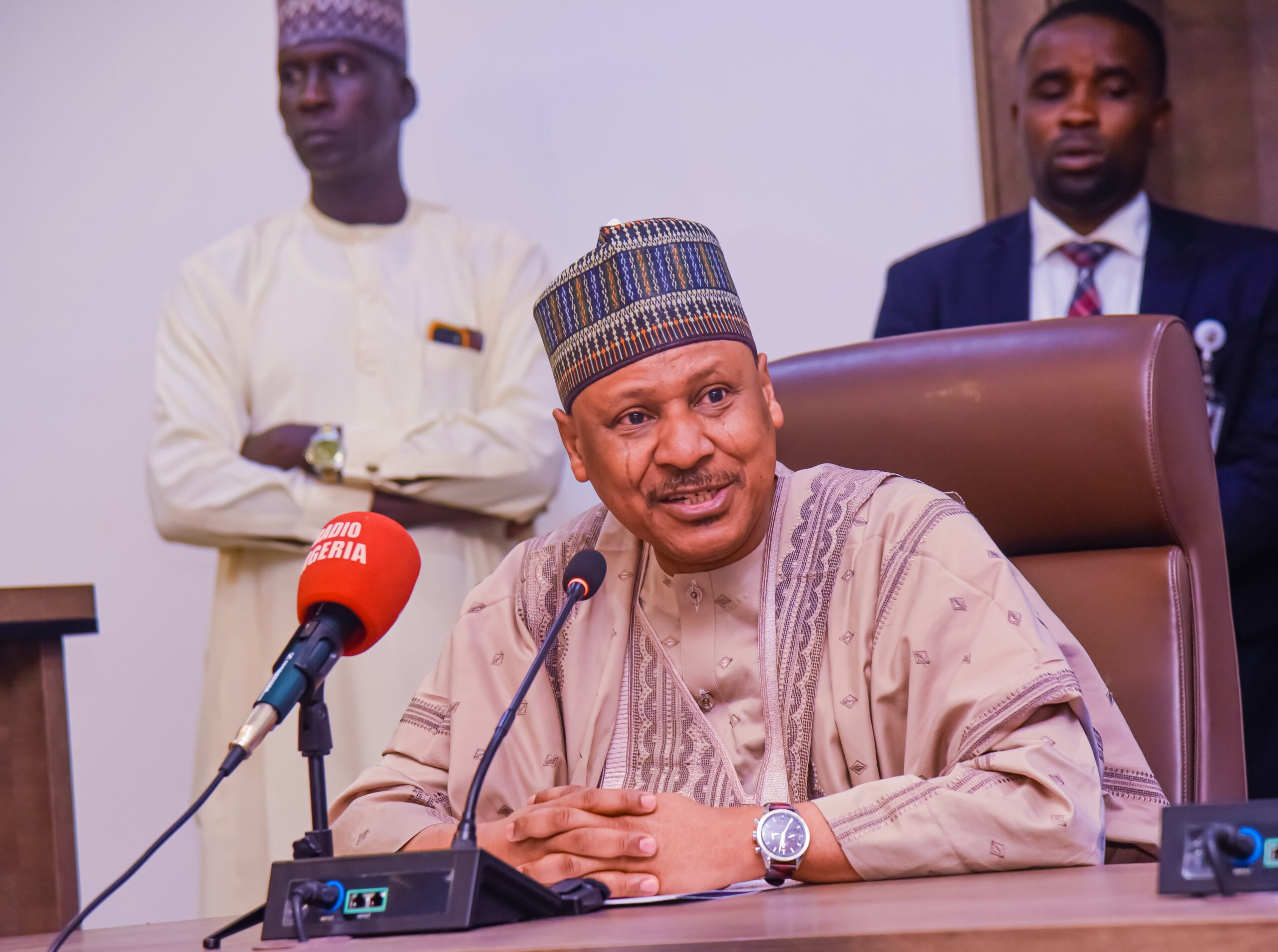
Mohammed Idris, minister of information and national orientation
I am obviously excited that the Nigerian government is going to build 4,000 telecom towers in order to boost the capacity of the nation’s telecommunications backbone. A happy Minister of Information and National Orientation, Mohammed Idris, informed, last week, that it was one of the decisions taken at the Federal Executive Council (FEC) meeting.
Good reasons, he adduced for such a landmark decision. It will help to take service to the underserved people in the underserved areas of the country. It will also help to add a fierce bite to the war against insecurity. If there is anyone who disagrees with this, it means the person does not live in this country, or may be too blind, more than a bat, or as dead as a dodo, to contemplate the avalanche of kidnappings happening across the nation.
There have to be other desperate measures to deal with a desperate situation. Strengthening the telecommunications network is a good step in the right direction, as they say. More action is needed in this respect for immediate result and urgent relief.
This may not have been lost on Idris when he said: “The Federal Executive Council has taken a decision that 4,000 of such towers be established or erected in these very underserved communities across this country.
Advertisement
“Indeed, this will also help in fighting insecurity and enhancing commerce and economic activities among the people of those communities,” he added
Explaining the memo from Dr Bosun Tijani, the Minister of Communications, Innovation and Digital Economy, Idris said, “The presentation of the Honourable Minister of Communications and Digital Economy indicates that about 23 million Nigerians are currently underserved, meaning that they are unable to do any form of communication due to the absence of some of these towers.
“The rollout is expected to significantly improve rural connectivity, stimulate commerce and enhance security surveillance in areas currently lacking network coverage,” he observed.
Advertisement
This sounds like music in the ears and it stirs hope to dizzying heights. Our prayer is for the programme to succeed but there are a few cautionary references.
Let me start with a story that is almost lost on us even in all its ramifications. In the final days of the Muhammadu Buhari administration, when the government was winding down, FEC suddenly approved a cocktail of contracts sometime in March of 2023. I will restrict myself just to one for the purpose of this writing – to build WiFi facilities in public places, airports, schools and markets. You may dig up the rest if you feel obliged.
Dr Isa Pantami, Minister of Communications and Digital Economy, brought the news to a weary populace waiting for a reed of hope from the Buhari administration, and were already preparing to wish the entire cabinet a not-too-friendly valediction.
“The Federal Executive Council today approved two memos for the Nigerian Communications Commission, a parastatal under the supervision of the Federal Ministry of Communications and Digital Economy.
Advertisement
“In these two memos, certain intervention projects are going to be implemented by the federal government of Nigeria, through the Nigerian Communications Commission, of providing internet in 20 selected airports in Nigeria and higher institutions of learning and also some markets to support micro, small and medium enterprises.”
Writing in this column on April 19,2023, under the title, In the twilight of a government, tech projects guzzle billions, we had argued that it was not the responsibility of the Nigerian Communications Commission (NCC), the regulator of the telecommunications industry, to build WiFi in the designated areas while pointing to best practices in other parts of the world. Over two years later, there is no public WiFi at the Airports, markets or even in schools. Don’t ever ask me if the money was paid. We walk around with a basket of baloney on our heads and are angered by those who point to the rubbish in the basket.
This is only to point out that good projects and good intentions can go awry; what usually saves the day is the genuine interest of promoters and the watchful eyes of the relevant stakeholders. My prayer is for the Project 4,000 towers to succeed.
However, the industry is waiting to get more details about the project; who is building what and how they will be operationalised. They are waiting to understand the model and how the government plans to surmount intimidating challenges in the sector to ensure the project succeeds.
Advertisement
This writer was told that building 4,000 base stations is a huge project by any standard, whether by the government or by the operators themselves. The sheer planning and deployment can be overwhelming; even more so is the management.
Please, accommodate the fears of those who are waiting for more details about the project. Some of them have built networks and they understand the challenges and the business terrain. They are the ones who worry about the cost of diesel for fueling generators at the base stations and they bear the headache of the theft of generators and solar facilities at these stations – a whopping 3,241 theft cases by August 2025.
Advertisement
Look at this illustration. Since 2001 when the country introduced the Global System for Mobile Communications (GSM), and with all the efforts of the government to provide a much needed good operating environment, the industry has only been able to build about 40,000 towers which on their own may carry as many as 160,000 base stations. This is just about 1,600 towers a year. It is a laborious process and deployment is even more challenging now because of the security situation across the country.
Even then, I believe in the feasibility of Project 4,000 towers. I am nearly a fanatical supporter of the Minister; his 90,000 fibre optics project worth $2bn, a pool of 3 million tech talents (3MTT), launch of AI Collective Platform and placing Nigeria among 60 AI countries of the world. And now Project 4,000 towers. With Bosun, there can be no dull cloud over the tech sector of this nation. But I do not support his National Digital and E – Commerce Bill 2025, which seeks to make NITDA a regulator over the NCC, instead of occupying its space as a development agency. If not well-managed, it create more problems beyond the razzle-dazzle which is before the National Assembly.
Advertisement
Even with all my admiration for Minister Tijani, I want to ask, who is advising him? Is he working in silos and just moving around with the swankiness that he is the best thing to have happened to the Communications industry since the days of Engr Olawale Ige? Ige was a Director in the Ministry of Communications, a Permanent Secretary, Minister and eventually a Commissioner at the NCC. He saw it all, yet remains humble. Almost too humble!
Let me explain my position. The presentation by the Minister to the Federal Executive Council could still have been made on the platform of the Universal Service Provision Fund (USPF) of which he is the Chairman of the Board (NCA 116) and whose responsibility it is to encourage the installation of network facilities and the provision for network services and applications services to institutions and in unserved, underserved areas or for underserved groups within the community.
Advertisement
So there was already an organisation to handle the project the Minister took to FEC and I am pressed to believe it’s more malleable to work through established structures instead of throwing things into the fire arbitrarily in desperation. We need to promote strong institutions instead of strong individuals. I hope the Minister is utilising the expertise within the Fund and the regulatory agency, NCC.
Honourable Minister of Information, I want to observe that too many more people than the Communications Minister periscoped, are underserved. People are underserved within the cities when the power grid goes down and nobody gives any reason. Communities are underserved when public power fails for months and they are left to rot in the failure of their government. Communities are underserved when dare-devil thieves take a mobile crane to a base station to remove the generators and other facilities. It is worse when bandits take down the entire telecommunications network.
There are too many unserved and underserved people needing help. But let me congratulate Dr Tijani with a proviso that this project does not go the way of others. We share in his optimism and pray they translate into reality and a tech future that we can all look forward to.
Views expressed by contributors are strictly personal and not of TheCable.