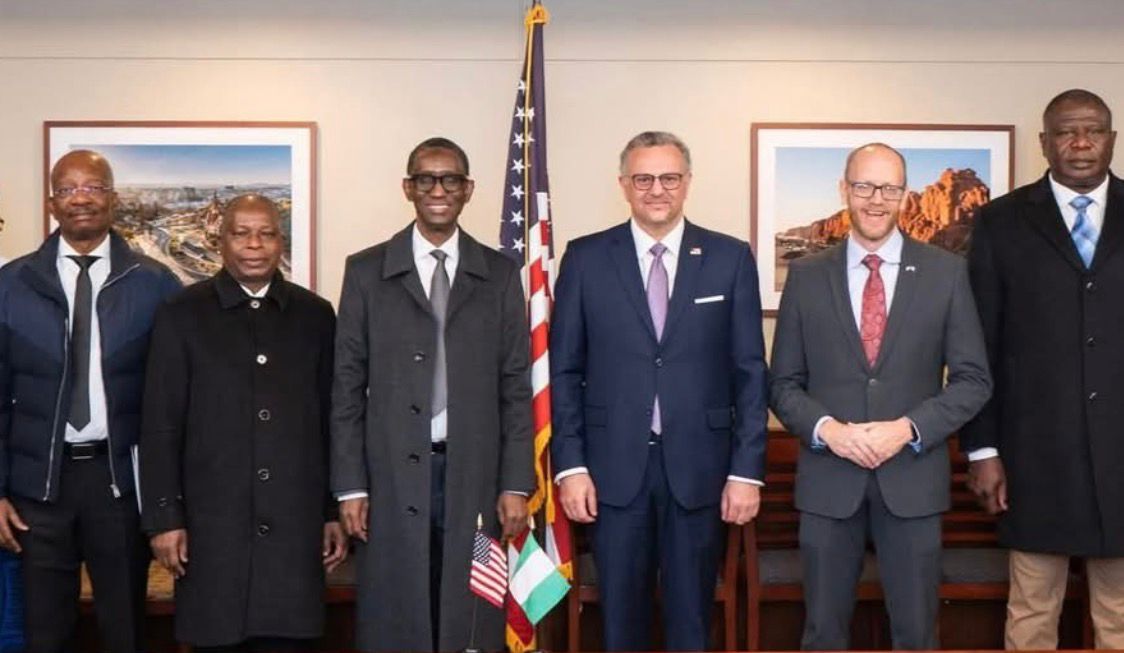
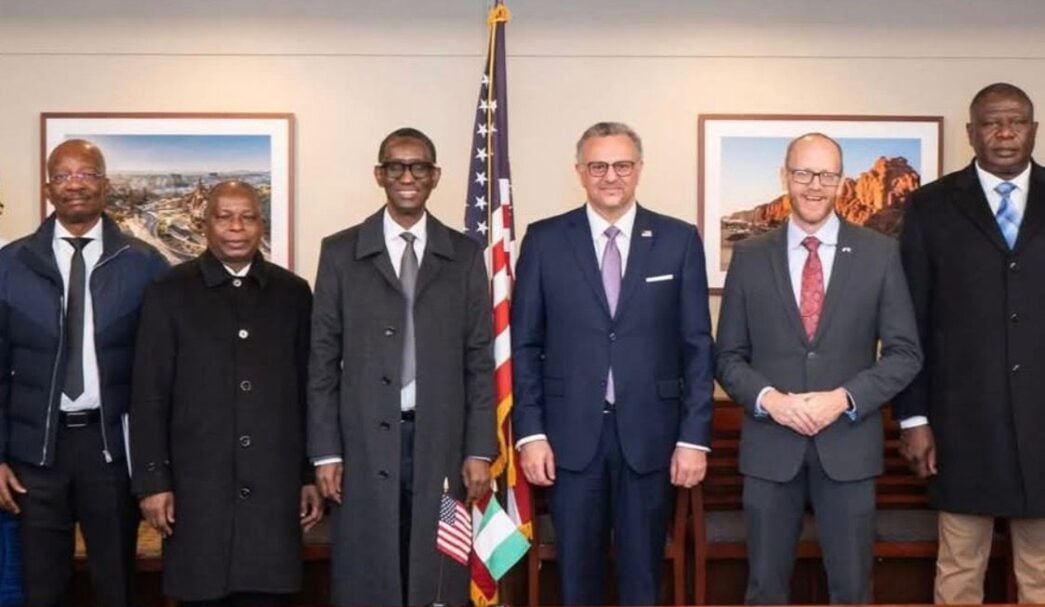
President Bola Tinubu’s constitution of Nigeria’s delegation to the US-Nigeria Joint Working Group (JWG) to deepen collaboration in tackling security challenges in the country seems like a logical reaction to the logjam created by the American government’s declaration of war. The idea that Malam Nuhu Ribadu, the National Security Adviser (NSA) will lead the Nigerian side of the JWG, supported by a multi-stakeholder team drawn from key security and policy institutions, sounds like surrender to the international sponsors of terrorism.
Members of the team include the Minister of Foreign Affairs, Ambassador Yusuf Tuggar, Minister of Defence, Abubakar Badaru and Minister of Interior, Olubunmi Tunji-Ojo. Others are Minister of Humanitarian Affairs, Bernard Doro, Chief of Defence Staff, Gen. Olufemi Oluyede, Director-General of the National Intelligence Agency, Ambassador Mohammed Mohammed, Inspector-General of Police, Kayode Egbetokun. Ms Idayat Hassan of the Office of the National Security Adviser (ONSA) and Mr Paul Alabi of the Embassy of Nigeria in the US will serve as the secretariat.
With this move, the crème de la crème of the country’s security architecture became captive to Capitol Hill. In one fell, silent swoop, the White House has annexed all the vital institutions of state sovereignty – defence, foreign affairs, internal affairs, intelligence agencies, police and humanitarian affairs. For even more deleterious effect, President Tinubu counselled the team to “work closely with their US counterparts to ensure the seamless implementation of all agreed areas of cooperation.”
From their body-language and disposition, the team does not even need the President’s extra encouragement to play ball with the US government. The creation of the JWG itself followed the recent high-level engagements in Washington, DC, led by the NSA. Earlier, in a viral video clip that trended in 2024, Malam Nuhu Ribadu was heard deprecatingly begging an incredulous cohort of Western diplomats to “come and help us restore security.”
Advertisement
The Ministers and heads of agencies now working with the Americans from America to ‘solve’ security shenanigans shaped and spread by the latter cannot save Nigeria. They would just end up getting debriefed to siphon the last drops of the secrets that keep Nigeria united despite decades-long plots to fragment it. They would shortly be transformed into unsuspecting soldiers on the side of the veiled adversaries.
Recall that in June 2024, some 10 northern governors led by Governor Dikko Umar Radda of Katsina State embarked on a trip to the United States of America to participate in a peace conference convoked by the US Institute of Peace. According to Radda, “The meeting was not at the instance of the selected governors of northern states but it was at the instance of the United States. We were invited to sit with them so that we could bring about lasting solutions to the problems that are affecting our people.” More than a year down the road, insecurity in the selected states only got worse, leading to the current stand-off where the US is threatening to launch a military attack.
Another danger of the deadly deal is that it further distracts these key operatives of the nation’s seriously challenged defence and security systems while depleting so much scarce resources.
Imagine a scenario where the CDS, NSA, IGP, NIA, Defence, Internal, Humanitarian and Foreign Ministers are recurrently shuttling between Abuja and Washington. This is thousands of man-hours and millions of Dollars drained away. Envisage a situation where these key commanders are bombarded with disinformation and disarmed by the sponsors and supporters of terrorists. These are even enough to draw back the so far minor victories recorded against the various bandits, gunmen and insurgents terrorising Nigerians courtesy USAID funding only recently stopped by President Donald Trump.
Advertisement
For more perspective, consider the outcomes of all previous international involvement in our internal affairs. In the recent past, both Presidents Goodluck Jonathan and Muhammad Buhari personally showed up at several similar security summits in Paris, France. President Tinubu even turned this country to his second home with frighteningly frequent visits. Still, the security situation is just getting worse. A new low was reached recently when the Presidency proudly announced that it negotiated the safe release of two dozen school girls kidnapped from a government school in Kebbi State. How many more fancy foreign trips do our leaders need to make to bring peace and security home?
The answer is none – zero. President Bola Tinubu should recall the Ribadu-led delegation and constitute it into a war council with the core mission of marshalling all the resources required to stanch insecurity from within Africa. These 53 other countries are all the collaborators we need. The challenges are great what with Western-inflicted poverty ravaging the continent and fuelling localised conflicts along all possible fault-lines. Yet, it is a war that Nigeria and its sister African countries must win.
Freedom is only a little less valuable than life itself. Fighting for it at all costs is now imperative or Africa will continue to be controlled for the foreseeable future. The anarchy being engineered by the West can only be catastrophic if not countered. Let us learn from those who allowed American boots on the ground in Afghanistan, Iraq, Somalia, Syria and Libya. All these states have been bombed back to the stone-age while the actual aggressors siphon crude oil, crystals and rare earth elements on their lands.
Setting internal affairs right is the first step to securing beneficial continental and international engagement. Good governance is no longer a luxury because only a caring government can command the loyalty of citizens to their state. Critical agencies of mass mobilising such as schools, the mass media and the National Orientation Agency must be brought fully on board. These institutions could be used to teach basic patriotism, self-defence, para-military training and aid in mobilising volunteers, resources and reluctant recruits into the defence and security sectors.
Advertisement
Hassan-Tom writes from Abuja.
Views expressed by contributors are strictly personal and not of TheCable.