

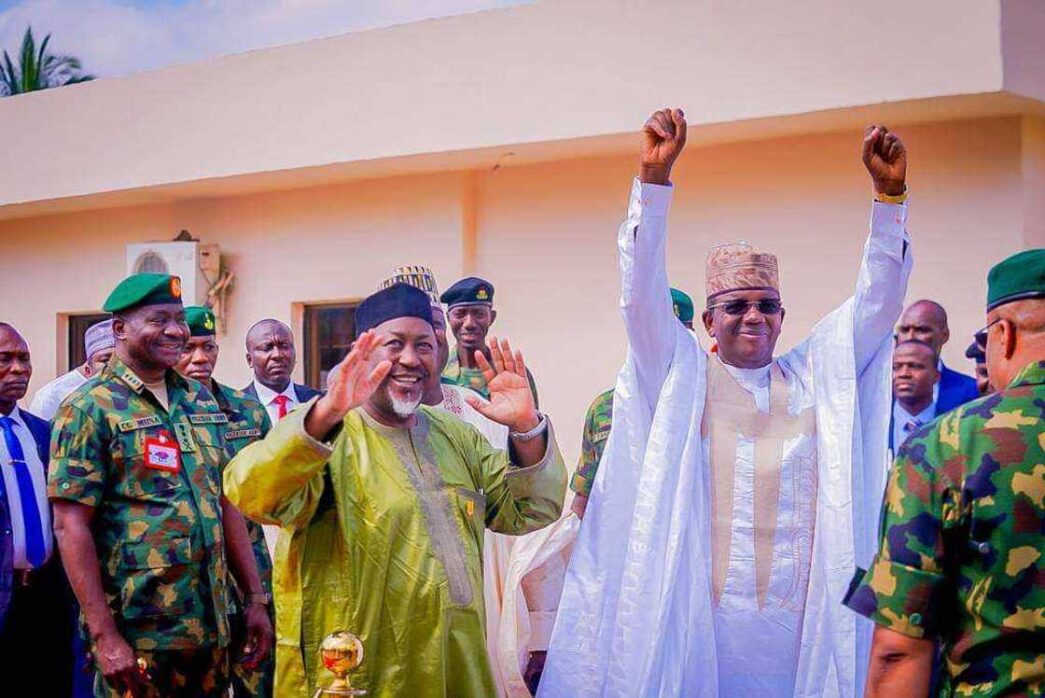
In the grand theatre of Nigerian politics, where power is traded like Ankara in Aswani or Wuse Market, and appointments often resemble a raffle draw, the Badaru episode will go down as one of the most baffling spectacles in recent memory. It was the sort of moment that forces a nation to pause, stare into the dusty horizon, and mutter, “How did we get here?”
The former Jigawa State Governor, Abubakar Badaru, marched into the Ministry of Defence as though auditioning for Rambo, yet delivered lines unworthy of a background extra in Karate Kid. His infamous claim that forests are too thick for bombs to penetrate wasn’t just a slip; it was a somersault of logic—an open advertisement of the yawning knowledge gap relative to the task he was saddled with. A gaffe so monumental it could have earned applause from confusion itself.
But the true embarrassment wasn’t Badaru’s alone. It splashed squarely on the President and Commander-in-Chief of the Armed Forces of the Federal Republic of Nigeria, Asiwaju Bola Ahmed Tinubu, who had deployed one of the country’s most strategic portfolios as a token in the endless chessboard of political IOUs. By assigning the defence ministry to someone whose military knowledge barely rivalled that of a teenager raised on Nollywood action flicks, the President inadvertently made himself the punchline. It was a governance misstep loud enough to wake the ancestors.
That, perhaps, is the real tragedy: not that Badaru fumbled, but that the President failed the test of due diligence. Leadership demands discernment; it requires the ability to foresee embarrassment before it blossoms into a national meme. How does one justify appointing a defence minister who thinks forests are bomb-defying fortresses? The absurdity still stings.
Advertisement
For many, the Badaru saga was not just disappointing; it was scandalous. An avoidable blunder that left the APC and its loyalists clutching their reputational chests like a Nollywood widow in a funeral scene.
Yet, as the dust settles, a glimmer, just a glimmer, of redemption appears.
The recent appointment of (Retired) General Christopher Musa, a man whose military credentials are beyond beer-parlour debates, has inspired cautious optimism. Days after he assumed office, the Nigerian Air Force seized a rare opportunity to demonstrate that, indeed, Nigeria possesses bombs capable of penetrating any forest in West Africa. Following a reported military putsch in neighbouring Benin Republic, the President ordered our troops to intervene and restore order. The Nigerian Air Force struck decisively, dismantling the mutineers’ ambitions. One imagines the immediate past minister reading the news and quietly revising his earlier theory. Somebody shout, Hallelujah! Pardon the little digression.
Advertisement
Musa is a man who speaks the language of the battlefield fluently. He knows bombs do penetrate forests and can split rocks for good measure. He understands how to conduct a “dialogue of violence” with hostile actors. Furthermore, he embodies competence, and in a nation starved of it, competence feels like a cup of cold water in the Harmattan heat.
And yet, even with Musa’s appointment, one knot remains stubbornly untied: someone whose résumé barely qualifies him for a messenger in the Ministry of Defence still occupies the seat of Minister of State for Defence—Bello Matawalle.
The continued presence of Matawalle in that role sits awkwardly within the nation’s security architecture. Allegations, whispers, and questions about competence, experience, and his past flirtation, real or perceived, with bandits refuse to fade. In a sector as strategic as national security, his appointment begins to look less like governance and more like self-sabotage by the Commander-in-Chief.
If Mallam Nasir El-Rufai, the immediate past Governor of Kaduna State, could be dropped at the ministerial screening stage based on security concerns, how does Matawalle find himself at the heart of the Defence Ministry, despite the weight of allegations surrounding him?
Advertisement
He is on record, in 2021, saying: “Not all of them (bandits) are criminals. If you investigate what is happening, and what made them take the law into their hands, some were cheated by the vigilante groups. Their settlements were attacked, properties destroyed, animals taken. They had no one to speak for them, so sometimes they go for revenge.”
These words are far too indicting for someone holding a defence portfolio, especially amid the current national security challenges. Worse still, he has brought no demonstrable value to the role.
The inconsistency is loud. Deafening.
Nigeria cannot continue to run its national security apparatus like a political compensation scheme. Strategic offices require strategic minds. We cannot afford to staff our most delicate sectors with individuals repaying political debts while insurgents and terrorists roam like uninvited houseguests. The allegations of Matawalle’s romance—past or present, with violent groups are too damning for him to remain in the cabinet.
Advertisement
If a region or constituency must be compensated, let it be with someone who can actually do the job—not someone who will turn Nigeria’s security architecture into a comedy skit.
May Badaru never happen to our Defence Ministry again. May competence, capacity, and character, not IOUs, shape the future of our national security architecture. Because when political debts intrude upon security decisions, when political considerations outweigh strategic national interests, the nation becomes collateral damage. And Nigeria has paid enough already.
Advertisement
Abubakar writes from Ilorin, Kwara State. He can be reached via 0805 138 8285 or [email protected].
Advertisement
Views expressed by contributors are strictly personal and not of TheCable.